ON-DEMAND WEBINAR RECORDING
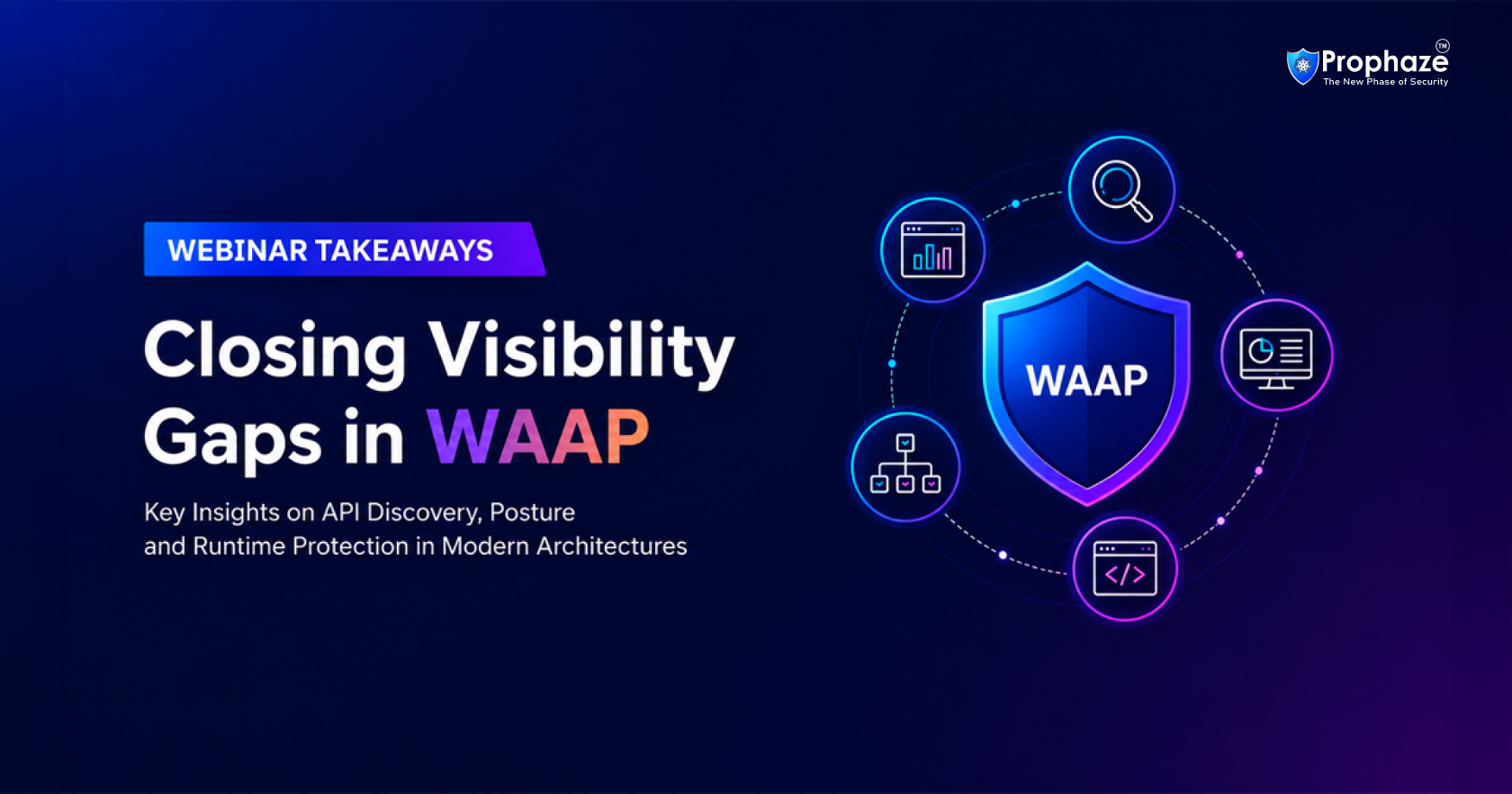
Closing Visibility Gaps in WAAP: Addressing API Discovery, Posture, and Runtime Protection in Modern Architectures
The live session has concluded. Watch the full recording on demand and access the practical deployment checklist your team can use immediately.
The Problem No One Wants to Admit
API attacks surged 400% in 2025. In the same period, only 19% of CISOs reported confidence that they have a complete API inventory. That means four out of five enterprises are running APIs in production right now that nobody has documented, nobody is monitoring, and nobody is protecting.
That is not a tooling gap. It is a visibility gap, and it is getting wider every day.
Prophaze’s recent webinar, Closing Visibility Gaps in WAAP: Addressing API Discovery, Posture, and Runtime Protection in Modern Architectures, was built around this uncomfortable reality. The session brought together security practitioners to work through why this gap exists, what it actually looks like in production, and what it takes to close it. The on-demand recording is now available at the link below.
Shadow APIs and Zombie Endpoints: The Core of the Visibility Problem
Shadow APIs and zombie endpoints were central themes across the webinar, and for good reason. These are not edge cases. They represent the natural byproduct of how modern application development actually works.
Shadow APIs are APIs that exist and are accessible in production but are not part of your official inventory. They include deprecated endpoints that were never properly retired, internal APIs accidentally exposed during cloud migrations, undocumented microservices created during rapid development cycles, and forgotten third-party integrations that outlived their purpose.
Zombie endpoints take the problem further. These are APIs that have been formally deprecated or removed from documentation but continue to respond to requests because the underlying service was never actually shut down. They are invisible to your security tooling, not covered by your rate limiting or access policies, and frequently running with outdated authentication mechanisms. From an attacker’s perspective, a zombie endpoint is ideal: it is live, it is functional, and nobody is watching it.
The core issue is deceptively simple: if an API is not in your inventory, it is not in your security policy. In CI/CD-driven environments where APIs change daily, manual inventories are obsolete almost immediately after they are created. The only viable approach is automated runtime discovery operating continuously against live production traffic.
Why API Discovery Cannot Be Manual
One of the clearest messages from the webinar was that the API inventory problem cannot be solved by spreadsheets, documentation reviews, or periodic scanning. The scale and velocity of modern API creation makes manual approaches structurally inadequate.
Prophaze’s runtime API discovery engine addresses this by identifying and cataloging APIs directly from live traffic, without requiring manual input, documentation updates, or scheduled scans. It surfaces shadow APIs, maps zombie endpoints, and provides continuous inventory that reflects what is actually running in production rather than what was documented six months ago.
For a deeper look at how runtime discovery works in practice, Prophaze’s API Discovery tool page covers the mechanics of continuous inventory, shadow API detection, and how the discovery layer feeds posture and runtime protection.
OWASP API Security Top 10: The Attack Surface the Webinar Mapped
The webinar walked through the OWASP API Security Top 10 in the context of what traditional WAFs actually detect versus what gets through. The critical insight is that most of these vulnerabilities are invisible to signature-based detection because they abuse intended functionality rather than exploiting known attack patterns.
Detecting these vulnerabilities requires behavioral intelligence: understanding what normal looks like for each API endpoint, including traffic patterns, parameter ranges, authentication sequences, and geolocation baselines, and identifying deviations that indicate abuse. The webinar demonstrated this in practice using Prophaze’s behavioral AI engine.
The Live Demo: Every Login Is More Exposed Than You Think
The session’s most eye-opening segment was the live product demo, led by Ezekiel, who asked a deceptively simple question: why do APIs even exist if they create this much risk?
The answer is speed. APIs are what make modern applications fast, they let a banking app show your balance, transactions, statements, and credit card details almost instantly by connecting dozens of backend services in milliseconds. But every one of those connections is a door. And the more doors you have, the harder it gets to know which ones are locked, which ones are wide open, and which ones you have completely forgotten about.
Think of it this way: your IAM tools, RBAC policies, and social login integrations are the front door. They control who gets into the application. But once someone is inside, the real question is whether they are walking through the right doors, and whether you even know all the doors that exist. That is where shadow APIs and zombie endpoints come in. They are doors that nobody is guarding because nobody knows they are open.
Ezekiel demonstrated this live: a single login action to a net banking application quietly triggered multiple API calls in the background, balance retrieval, transaction history, session state, each one a separate exposure point. What the demo showed next about how an attacker could chain those calls to move laterally, exfiltrate data slowly, and do it all without triggering a single alert is something you need to see to fully appreciate. The full walkthrough is in the recording.
Scenario 1: Slow Credential Stuffing Campaign
Attackers distribute login attempts across hundreds of IP addresses at very low rates over extended periods. Traditional WAFs see normal authentication traffic because requests are distributed and rate limits are never individually triggered. The live demo showed exactly how this plays out in real traffic, and how behavioral analytics catches what perimeter tools miss entirely. Watch the recording to see the detection in action.
Scenario 2: Silent Data Exfiltration via BOLA
A compromised session accesses an API returning customer data. The attacker systematically enumerates records by changing the customer ID parameter. Each request is technically valid and authorized, making this invisible to signature-based tools. The demo showed how behavioral detection identifies this pattern before significant data leaves the environment. The specifics of what was flagged and how fast it was caught are in the recording.
Scenario 3: East-West Lateral Movement in Kubernetes
After compromising an exposed microservice, an attacker calls internal APIs within the Kubernetes cluster. These service-to-service calls are trusted by design, never cross an external boundary, and are completely invisible to edge WAFs. Lateral movement and data access happen entirely inside east-west traffic, bypassing every perimeter control. The recording shows exactly how Prophaze surfaces this movement and where enforcement kicks in.
How Prophaze WAAP Closes the Gaps Covered in the Webinar
Automated Runtime API Discovery
Prophaze’s discovery engine continuously identifies and catalogs APIs from live traffic. Shadow APIs, zombie endpoints, and undocumented internal routes are surfaced automatically, without manual input. The inventory is always current because it reflects actual production traffic rather than documentation state.
Continuous API Security Posture Management
Discovery alone is not sufficient. Each cataloged API requires risk context: authentication requirements, exposure level, sensitivity of the data it handles, and compliance implications. Prophaze’s posture management layer continuously evaluates and scores APIs against these dimensions, ensuring that newly discovered APIs are immediately assessed rather than left unmonitored.
Behavioral AI and Zero False Positives
Prophaze’s machine learning engine baselines normal API behavior across traffic patterns, parameter values, geolocation, timing, and authentication sequences. Deviations are analyzed in context rather than matched against signatures, enabling detection of BOLA, broken authentication, and excessive data exposure with high confidence and minimal false positives.
Block Mode from Day One
Because the behavioral AI understands normal traffic before enforcement begins, Prophaze enables organizations to deploy in block mode from day one without risk of disrupting legitimate users. The webinar demonstrated this capability live, showing how policy enforcement and AI-driven triage operate together from initial deployment.
Kubernetes-Native East-West Protection
Prophaze extends runtime protection inside Kubernetes environments, providing visibility and enforcement for both north-south traffic (external to internal) and east-west traffic (service to service). Compromised microservices cannot be used as pivot points for lateral movement because internal API calls are inspected and policy-enforced, not merely trusted by default.
WATCH THE FULL WEBINAR RECORDING
The on-demand recording covers the full session, including:
- Why 81% of organizations have undiscovered APIs in production, and how runtime discovery closes that gap.
- How behavioral AI detects BOLA, broken authentication, and excessive data exposure that traditional WAFs miss entirely.
- What east-west traffic inspection inside Kubernetes actually looks like in practice.
- How to achieve block mode from day one without false positives.
- A practical deployment checklist your team can use immediately.
Conclusion: Complete Visibility Is Not Optional
The 400% rise in API attacks in 2025 is the predictable result of a structural gap: APIs have become the dominant interface for modern applications, yet security maturity has not kept pace. Legacy perimeter tools, signature-based detection, and manual API inventories are not sufficient in API-driven environments.
Shadow APIs and zombie endpoints represent the most visible symptom of this gap. APIs that are not in your inventory are not in your security policy. They are not monitored, rate-limited, or assessed for risk. And in environments where APIs change daily, that gap is constantly expanding.
Closing it requires a unified WAAP approach that integrates API discovery, posture management, and runtime protection into a single system rather than disconnected tools. With 81% of enterprises still operating with undiscovered APIs, the question is not whether visibility is needed but how long an organization can defer addressing it before it becomes a breach.
The full webinar recording is available now at:
For more on how Prophaze's runtime API discovery engine works, visit: