The Incident: A Multi-Vector Campaign Against Three Sectors Simultaneously
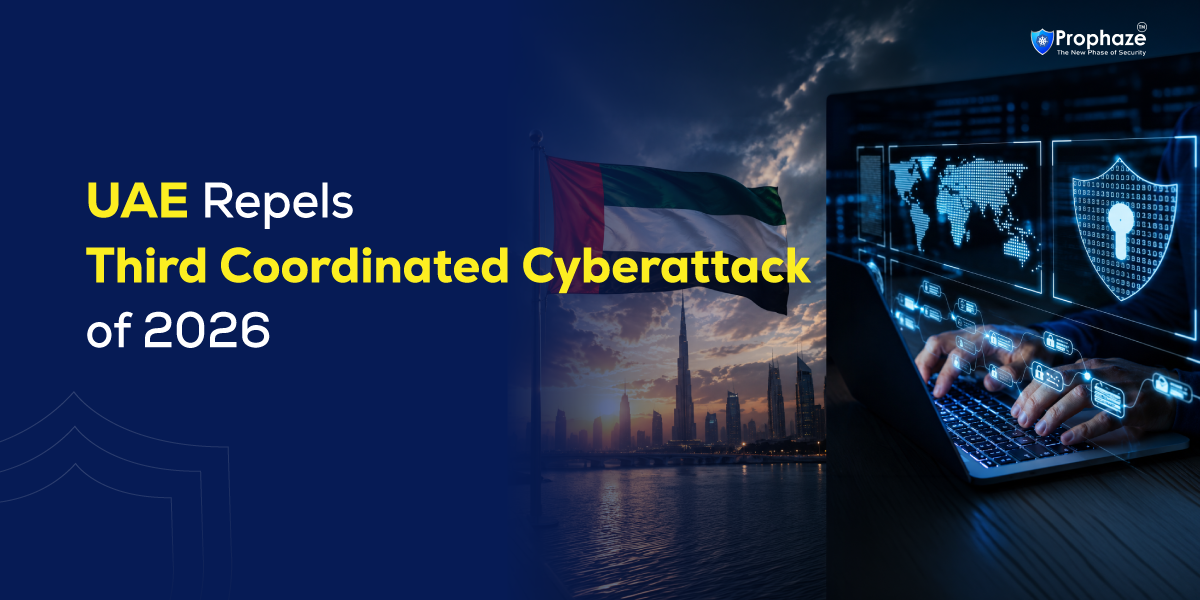
On August 10, 2026, the UAE Cybersecurity Council (CSC) confirmed through the state news agency WAM that national cybersecurity teams had detected and neutralized a coordinated, multi-vector cyberattack campaign targeting aviation, energy, and education three sectors at the core of the country’s critical national infrastructure.
This was not a single intrusion attempt. According to the Council’s statement, reported by Khaleej Times, Gulf Insider, The National, Emirates 24|7, Arab News, and Kuwait Times, the campaign combined:
- Attempts to breach digital infrastructure and operational systems.
- Efforts to compromise user accounts and access sensitive operational data.
- Targeted phishing campaigns designed to exploit employees as entry points into corporate and operational networks.
The CSC confirmed that national teams detected the activity early, traced attack paths and indicators of compromise (IOCs), and contained every intrusion attempt before any disruption to flight operations, power and energy services, or education platforms occurred. No attribution was released authorities confirmed only that the threats were neutralized before achieving their objectives.
This Was Not the First Attack This Year - It Was the Third
What makes August 10 particularly significant is context. This was the third publicly confirmed critical-infrastructure cyberattack campaign against the UAE in 2026:
- May 2026: The UAE launched its Cyber Factory initiative (a joint effort between the CSC and CPX Holding) to build next-generation AI-powered cyber defence capabilities - a direct response to escalating threat volumes.
- July 2026: The CSC disclosed that it had repelled a series of sophisticated cyberattacks targeting the financial sector, involving AI-assisted techniques, phishing, malware, and infrastructure intrusion attempts. Emirates 24|7 reported the incident at the time.
- August 10, 2026: Aviation, energy, and education - a wider set of critical sectors than any previous wave.
The pattern is unmistakable: the targeting is moving outward from financial services to broader critical national infrastructure, each wave broader than the last.
The Numbers Behind the Escalation
The scale of the pressure facing UAE cyber defences is now public and quantified. Mohammed Al Kuwaiti, Chairman of the UAE Cybersecurity Council, confirmed to Khaleej Times and Dark Reading that daily cyberattack attempts against the UAE have surged from a pre-conflict baseline of 90,000–200,000 per day to 600,000–800,000 per day in 2026. Gulf News reported in April that the figure had exceeded 800,000.
The Abu Dhabi Emergency, Crisis and Disaster Management Centre’s Cybersecurity Awareness Guide confirmed a 32% rise in phishing incidents in Q1 2026 alone, with attackers using AI tools for reconnaissance, vulnerability scanning, phishing at scale, and malware development.
This is not a crime wave. It is what independent analysts have described as a structured geopolitical pressure campaign – with around 20 countries and more than 40 organisations identified as threat sources.
Why This Attack Matters Beyond the UAE
For CISOs, IT security heads, and risk officers across the GCC, this is no longer a news story to monitor. It is a live case study in the operating reality they need to plan for. Several aspects of this campaign demand attention:
Three Critical Sectors Were Targeted Together, Deliberately
Aviation, energy, and education were not hit by separate, unrelated campaigns. The CSC described a single coordinated operation spanning all three. This points to a threat actor deliberately choosing sectors that combine high public impact with often-uneven security maturity across their vendor and operational technology (OT) ecosystems. The progression from finance (July) to aviation, energy, and education (August) suggests systematic sector-by-sector reconnaissance, not opportunistic scanning.
Phishing Was the Primary Entry Vector - Again
Even against a country investing heavily in national-scale cyber defence and absorbing 800,000 daily attack attempts, the attackers’ chosen path was people, not just perimeter. The CSC explicitly called out “phishing campaigns” and “exploiting users as entry points.” This confirms what regional CISOs already know but still struggle to operationalize: technical controls alone cannot stop a campaign that starts with a convincing email, a credential-harvesting page, or a compromised employee account.
"No Disruption" Is Not the Same as "No Exposure"
The UAE’s rapid detection-and-containment response is genuinely strong. But it also illustrates how close critical services can come to disruption when attackers combine account compromise with infrastructure-level intrusion attempts in a coordinated operation. Organisations with weaker detection and response capabilities which describe most mid-market operators in the GCC would have faced a very different outcome.
The Cost of Getting This Wrong Is $8 Million and “Rising”
IBM’s 2026 Cost of a Data Breach Report puts the average cost of a data breach in the Middle East at $8 million with financial and technology sector breaches averaging $10.67 million each and industrial sector breaches averaging $9.6 million. Twenty-six percent of malicious breaches in the region now involve AI-enabled attack techniques, and lost business alone accounts for $3.57 million per breach. Organisations using AI and security automation cut their breach costs by more than $3 million yet 23% of regional organisations have still not adopted these capabilities.
These are not hypothetical projections. They are the measured costs of incidents at organisations like the ones targeted on August 10.
The Real Risk for Aviation, Energy and Education Operators in the GCC
Each of the three targeted sectors carries a distinct risk profile that security leaders need to plan around. But they share a common front door.
Aviation
Passenger-facing web applications, mobile apps, booking APIs, loyalty programme portals, and airport/ground-operations systems are exposed to the public internet and process high volumes of PII and payment data around the clock. They are attractive to both financially motivated attackers and to actors seeking operational disruption. The attack surface is further expanded by integrations with third-party service providers ground handling, catering, cargo each of which introduces API endpoints that may not be inventoried, let alone secured.
Energy
SCADA-adjacent IT systems, vendor portals, remote-access tools, and customer-facing platforms used by energy operators are frequently the softest point of entry into otherwise hardened OT environments. This is precisely the type of “digital infrastructure breach attempt” the CSC described. As energy operators across the Gulf accelerate digitalisation, smart metering, IoT sensor networks, predictive maintenance platforms the number of web-exposed interfaces grows faster than security teams can inventory them.
Education
Universities and education platforms hold large volumes of personal data (student records, financial aid, research data) with comparatively lean security teams and open network architectures designed for collaboration. This makes them a common staging ground for credential theft campaigns that later feed attacks on better-defended targets. The August campaign confirms that attackers view educational institutions not only as targets in their own right but as weak links in the broader critical infrastructure chain.
The Common Thread
Across all three sectors, the front door is the same: web applications, APIs, and user accounts. The attackers on August 10 did not attempt a network-level brute force. They combined application-layer intrusion, account compromise, and social engineering. Any defensive strategy that stops at the network perimeter misses the actual attack surface.
What Security Leaders in the UAE and GCC Should Be Doing Now
Based on the specific attack pattern the UAE Cybersecurity Council described and the three-campaign progression across 2026 here is where regional security teams should be focusing their effort and budget:
Harden the Application and API Layer as a First-Class Defence Perimeter
Breach attempts against “digital infrastructure and operational data” the CSC’s own language increasingly happen through exposed web applications and APIs, not through network perimeters. This means deploying web application and API protection (WAAP) that goes beyond signature-based blocking to include behavioural analysis, API discovery, and positive security models that detect anomalous requests even when they don’t match a known attack pattern.
Assume Phishing Will Succeed and Build the Response Accordingly
If a coordinated campaign against the UAE’s national cyber defences chose phishing as its entry vector, your organisation will face the same approach. Pair email security with account-takeover detection, anomalous login monitoring, impossible-travel alerts, and the ability to revoke sessions and credentials rapidly when a compromise is detected.
Get Real-Time Visibility into Attack Paths and IOCs
The UAE’s own response tracing attack paths and indicators of compromise quickly enough to contain the intrusion before disruption is the playbook. Most mid-sized operators in the GCC do not have that visibility today. If your security operations centre cannot trace a multi-vector attack from initial phishing email to lateral movement to data access attempt within minutes, your detection and response capability needs investment.
Protect Against Bot-Driven Credential Attacks at Scale
Account compromise was a stated objective of the August 10 campaign. Following a successful phishing campaign, attackers routinely use credential-stuffing bots to test stolen credentials across multiple portals and APIs. Bot mitigation that can distinguish automated credential-testing from legitimate user logins without degrading user experience is essential for any organisation operating customer-facing or employee-facing web applications.
Align Controls to National and Sector-Specific Compliance Frameworks
Regulators across the GCC are converging on stricter critical-infrastructure cyber requirements. Security teams should map their controls to the applicable frameworks:
- UAE: NESA (National Electronic Security Authority), DESC (Dubai Electronic Security Centre), UAE Information Assurance Standards.
- Saudi Arabia: NCA (National Cybersecurity Authority), ECC (Essential Cybersecurity Controls), CCC (Critical Systems Cybersecurity Controls).
- Qatar: QCERT (Qatar Computer Emergency Response Team), NIA (National Information Assurance) Policy.
- Bahrain: NSSA (National Security Standards Authority) requirements.
- Oman: ITA (Information Technology Authority) Cybersecurity Framework.
- Kuwait: CITRA (Communication and Information Technology Regulatory Authority) guidelines.
Compliance is not security but it is an increasingly non-negotiable baseline.
Assume You Are a Target Regardless of Size
Vendors, contractors, and smaller operators in the aviation, energy, and education supply chain are often the easier path into a hardened target. The August 10 campaign’s multi-sector scope suggests the attackers were probing exactly these kinds of interconnected ecosystems. If you are a supplier to a critical infrastructure operator in the GCC, you are on the same target list.
How Prophaze Helps Aviation, Energy and Education Operators Close This Gap
This is precisely the attack surface Prophaze’s AI-driven WAAP (Web Application and API Protection) platform is built to defend for exactly the kind of high-stakes, high-availability environments the UAE just protected.
- Positive security model + AI-based anomaly detection to catch novel intrusion attempts against operational web apps and portals, not just known signatures.
- API security and discovery to find and lock down the shadow APIs that often connect OT-adjacent systems to the internet.
- Bot mitigation and credential-stuffing protection to blunt account-takeover attempts that follow successful phishing.
- DDoS protection at scale, keeping aviation booking systems, energy customer portals and education platforms online during an active campaign.
- Virtual patching, so newly disclosed vulnerabilities in critical systems are shielded immediately, without waiting on maintenance windows for OT-adjacent infrastructure.
- Compliance-ready reporting aligned to UAE (NESA/DESC/IA Standard), Saudi (NCA/ECC), and broader GCC regulatory requirements.
Critical infrastructure operators across the UAE, Saudi Arabia, Qatar and the wider GCC don’t need to wait for their own version of this incident to find out where their gaps are.
Why Prophaze - Not a Legacy CDN-Security Vendor
Prophaze is recognised as a Leader in the SecureIQLab Cloud WAAP v5.0 CyberRisk Validation 2026, Representative Vendor in the Gartner Market Guide for Cloud WAAP (2025) and a Strong Performer in Gartner Peer Insights Voice of the Customer for Cloud WAAP, DDoS Mitigation, and API Protection. KuppingerCole has positioned Prophaze as an Overall Leader and Product Leader in its Leadership Compass for Web Application Firewall (2022, 2024). Prophaze is also a nominated Core Committee Member of India’s National Cyber Security Research Council (NCSRC).
Critical infrastructure operators across the UAE, Saudi Arabia, Qatar, and the wider GCC do not need to wait for their own version of this incident to find out where their gaps are.
[Request a free API attack surface assessment →] See what Prophaze discovers across your web applications and APIs in your environment, on your infrastructure before an attacker does.