The UAE's API Economy Is Outgrowing Its Perimeter
Open banking, real-time payment rails, government digital services, and free-zone cloud-native platforms now run on APIs and APIs, not web pages, carry most of the application traffic moving between those systems. For buyers, the practical question is specific: can a platform actually discover, govern, and protect every API you run not just the handful sitting behind your online banking portal?
This guide compares the top API security providers in the UAE for 2026, helping banking, government, healthcare, telecom, and cloud-native organizations evaluate the right API security solution for their environment.
What Getting This Wrong Actually Costs
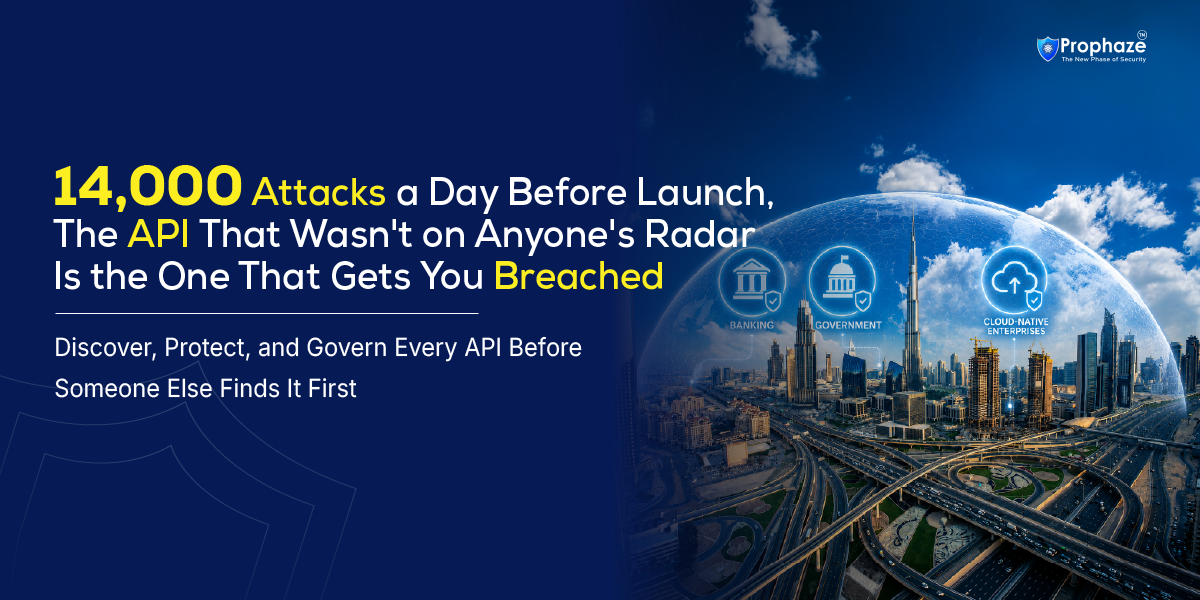
In March 2024, Anonymous Sudan knocked First Abu Dhabi Bank, RAKBANK, and Mashreq offline for hours with a wave of Layer 7 DDoS traffic aimed squarely at their online banking services , not their networks, their applications. It’s the kind of incident that’s become routine background noise in a country whose financial sector now absorbs roughly 14,000 cyberattacks a day, with accumulated sector losses exceeding $2.5 billion since 2020.
No firewall was bypassed by design, the applications, and the APIs behind them, were the target. And the backdrop has only intensified since: The UAE Cyber Security Council reported more than 200,000 cyberattacks per day against strategic sectors in 2025. During periods of heightened regional tensions in early 2026, Council Chairman Dr. Mohammed Al Kuwaiti said daily attack volumes rose to between 500,000 and 700,000 attempts, highlighting the rapidly escalating cyber threat landscape.
For UAE organizations, this is also increasingly a compliance question, tying back to the Personal Data Protection Law (PDPL), the Dubai Information Security Regulation (ISR), and CBUAE’s cybersecurity framework. The question isn’t whether to secure APIs, it’s which platform gives you continuous visibility, governance, and protection across every API you run, not just the ones exposed to the internet.
UAE Cyber Threat Landscape in Numbers (2025–2026)
| Metric | Figure | Context |
|---|---|---|
| Daily cyberattacks on the financial sector | ~14,000 | UAE Cyber Security Council data (via Facephi) |
| Accumulated financial-sector losses since 2020 | $2.5 billion+ | UAE Cyber Security Council data |
| Daily cyberattacks blocked nationally (2025 baseline) | 200,000+ | From threat groups across 14 countries |
| Daily cyberattacks reported amid 2026 regional tensions | 500,000–700,000 | UAE Cyber Security Council chairman, March–May 2026 statements |
| Share of incidents hitting financial services | 21% | State of the UAE Cybersecurity Report 2025 |
| Critical UAE vulnerabilities left unpatched for 5+ years | ~50% | Chambers and Partners, Cybersecurity 2026 – UAE |
| Newly disclosed exploited within 48 hours (global) | 61% | SonicWall 2025 Cyber Threat Report |
| Surge in AI-driven security incidents (6 months to May 2026) | +340% | OAD Technologies, 2026 |
| PDPL fines for serious security/notification failures | Up to AED 20 million | eShield IT, 2026 |
| Source: UAE Cyber Security Council, State of the UAE Cybersecurity Report 2025; Chambers and Partners, Cybersecurity 2026 – UAE; OAD Technologies; eShield IT Services | ||
What Security Teams Now Have to Protect
Why Old, Forgotten Access Points Matter More Than Novel Attacks
Here’s the detail that should worry every CISO in the Emirates more than the daily attack count: roughly half of the UAE’s critical vulnerabilities have sat unpatched for more than five years. Attackers move fast on new flaws 61% of newly disclosed vulnerabilities are exploited within 48 hours globally but in the UAE, the bigger, quieter problem is old, known exposure that never got closed. That’s the door attackers reach for first.
For API security specifically, that translates directly. A forgotten partner integration from a completed free-zone project. An internal banking API nobody decommissioned after a system migration. A government portal endpoint built for a since-shuttered service. None of these show up on a firewall dashboard. They show up when someone finds them first.
Why an API Security Solution Has to Cover What You've Forgotten, Not Just What You're Watching
The UAE’s stale-vulnerability problem, roughly half of exploited flaws are five-plus years old, isn’t really a patching issue. It’s a visibility issue. A forgotten free-zone integration, a core banking API left running after a migration, a government portal endpoint for a service that no longer exists: none of it shows up on a dashboard built to watch the APIs someone remembers deploying.
That’s the bar an API security solution provider needs to clear here:
- Find what's actually running, not what's documented. Shadow, zombie, deprecated, and AI-facing APIs included, undocumented is the norm, not the exception.
- Stop business logic abuse and credential misuse in real time. Most regional incidents trace back to old, known flaws, not zero-days, so signature-matching alone won't catch them.
- Watch East-West traffic inside cloud environments. That's where lateral movement, and the real damage, happens after a breach.
- Manage the full API lifecycle, including deprecation. Otherwise today's fix is next year's forgotten endpoint.
Evaluation Criteria for a UAE API Security Solution Provider
- Runtime API Discovery: Surfaces the forgotten free-zone integrations and post-migration APIs that traditional tools never see, the gap most API security providers in the region are hired to close.
- Version Control & Deprecation Management: Targets the ~50% of exploited vulnerabilities that are 5+ years old , the core exposure problem an API security solution needs to solve here, not novel zero-days.
- Behavioral API Security: Distinguishes real threats from noise during sustained, high-volume attack periods, so teams aren't drowning in alerts from a platform that can't tell normal traffic from an anomaly.
- Layer 7 / Application-Layer DDoS Protection: Directly answers the attack pattern that disrupted three major UAE banks in a single 2024 wave , a baseline requirement for any API security provider serving the financial sector.
- Fine-Grained API Access Governance: Scopes access control down to the sub-resource level rather than broad, all-or-nothing permissions ,increasingly relevant as CBUAE's reporting expectations around system and data access continue to tighten across financial services.
What a Strong API Security Solution Buys UAE Organizations, Beyond the Technology
For a financial sector absorbing roughly 14,000 attacks a day and $2.5B+ in accumulated losses since 2020, the value of the right API security provider isn’t abstract, it’s fewer successful Layer 7 floods reaching production, and faster recovery when one does land.
For compliance teams, it’s a continuously updated answer to PDPL, Dubai ISR, and CBUAE questions, rather than a point-in-time audit that’s already stale by the time it’s filed.
And for security leadership watching national attack volumes climb from roughly 200,000 to as high as 700,000 a day amid regional tensions, the right API security solution is the difference between reacting to each spike and having a governance model built to absorb it.
Top 5 API Security Solution Providers in the UAE Worth Evaluating
1. Prophaze
AI-native API security built for exactly this environment. Unlike traditional API security platforms that rely on static rules and manual policy tuning, Prophaze continuously learns application behavior, discovers shadow, zombie, orphaned, and undocumented APIs at runtime, and detects business logic abuse, zero-day exploits, and AI-driven threats through behavioral analysis and deep payload inspection.
Built Kubernetes-native, Prophaze secures external APIs, internal APIs, East-West traffic, and AI-driven APIs, providing continuous visibility, governance, and runtime protection from a single platform.
With Prophaze, organizations can:
- Discover shadow, zombie, orphaned, and undocumented APIs
- Gain visibility across external, internal, and East-West API traffic
- Detect business logic abuse with behavioral API security
- Govern REST/GraphQL access down to the sub-resource level, fine-grained control over exactly what any client, service, or integration can reach.
- Secure AI APIs alongside traditional APIs
- Deploy in minutes with an agentless, no-code architecture
- Choose self-managed or fully managed deployment, with WAF, bot management, and L7 DDoS unified in one console.
Recognised multiple times by Gartner analysts, Prophaze is built to defend and mitigate against how modern API attacks actually work in the current, fast-moving regional threat landscape.
2. Cloudflare API Shield / Gateway
Cloudflare uses machine learning and heuristics on Cloudflare’s global network to catalog every endpoint, including undocumented ones, and enforces a positive security model that only allows traffic matching a validated schema, while continuously scanning outbound response payloads for sensitive-data leakage.
Evaluation Consideration: Organizations with complex API environments should evaluate runtime API discovery, governance capabilities, and visibility into internal APIs and East-West traffic alongside protection for internet-facing APIs.
3. Akamai API Security
Now expanded to cover GenAI, LLM, and MCP-connected endpoints, Akamai organizes around four domains, Discovery, Posture Management, Runtime Protection, and Testing, and offers a differentiated Shadow Hunt managed service that routes machine-learning signals to human threat hunters for investigation.
Evaluation Consideration: Organizations should assess deployment complexity, policy tuning requirements, and the depth of runtime API visibility needed for cloud-native environments.
4. Imperva API Security
Now part of Thales following its 2023 acquisition, Imperva runs a three-step Discover–Assess–Mitigate model with particular strength in detecting BOLA (broken object-level authorization), a vulnerability class central to banking API abuse.
Evaluation Consideration: Organizations with rapidly growing API estates should validate discovery accuracy, governance capabilities, and operational simplicity within dynamic cloud-native environments.
5. F5 Distributed Cloud API Security
Combines AI/ML traffic analysis with code-repository scanning and external crawling to find forgotten endpoints, and includes built-in masking for PII, PCI, and GDPR-classified data as it moves through APIs.
Evaluation Consideration: Organizations should validate API discovery depth, runtime governance, and support coverage against their regulatory reporting requirements.
What Others Miss. What Prophaze Secures.
Many security platforms still rely on static rules and manual tuning, making them slow to adapt and prone to false positives. Prophaze uses AI-driven behavioral analysis to continuously learn application behavior and detect threats in real time.
While most tools struggle to keep pace with dynamic API environments, Prophaze discovers shadow, zombie, and orphaned APIs at runtime, providing continuous visibility across the entire API estate. Unlike solutions focused only on external APIs, Prophaze applies unified security policies across north-south, east-west, and internal API traffic, eliminating critical blind spots attackers often exploit.
Prophaze also delivers granular REST and GraphQL access governance, agentless deployment in minutes, and flexible SaaS or self-managed deployment options—all without code changes or complex integrations.
Recognized as a Gartner Representative Vendor for two consecutive years, Prophaze helps organizations move beyond traditional WAF protection by securing the APIs, internal traffic, and hidden attack surfaces that conventional solutions often miss.
- Your APIs Are Already Being Tested. The Question Is Whether You'll Know First.
Somewhere in your API estate, there’s likely an endpoint nobody’s checked on since the project that built it ended. It won’t announce itself, it’ll just wait to be found, by your team or someone else’s. Anonymous Sudan didn’t breach a single system to take three UAE banks offline; they just found the door no one was watching. Talk to Prophaze, and make sure you’re the one who finds it first.
Frequently Asked Questions (FAQ)
1. Why do UAE enterprises need runtime API discovery specifically?
Because roughly half of the region’s most-exploited vulnerabilities are years old and unpatched, the risk is what’s already deployed and forgotten, not what’s new.
2. Does API security help with PDPL or CBUAE compliance?
Continuous discovery and posture data support audit readiness, but compliance depends on your full control environment, confirm specific requirements with current UAE Data Office and CBUAE guidance.
3. Why is internal, East-West API visibility as important as protecting public-facing APIs?
Attackers frequently move laterally after an initial compromise. Securing internal APIs and service-to-service traffic reduces blind spots that public-facing-only tools were never built to see.