Imagine this. A development team launches a new customer-facing feature on Friday afternoon. To speed up integration, a developer creates a temporary API endpoint and deploys it alongside production services. The feature works. Customers are happy.
Six months later, nobody remembers that endpoint exists. No one monitors it. No one patches it. No one includes it in vulnerability scans. Yet it remains publicly accessible. For attackers, this isn’t a bug, it’s an opportunity. This is the reality of shadow APIs, one of the fastest, growing yet least visible security risks facing modern organizations. As a result, shadow API discovery has become a critical priority for security teams seeking complete visibility into their application environments.
As organizations race toward cloud, native architectures, microservices, AI integrations, and continuous deployment, APIs are multiplying faster than security teams can track them. The result is a growing layer of undocumented, unmanaged, and often forgotten interfaces operating outside governance controls.
The most dangerous part? Many organizations don’t even know these APIs exist.
What Are Shadow APIs?
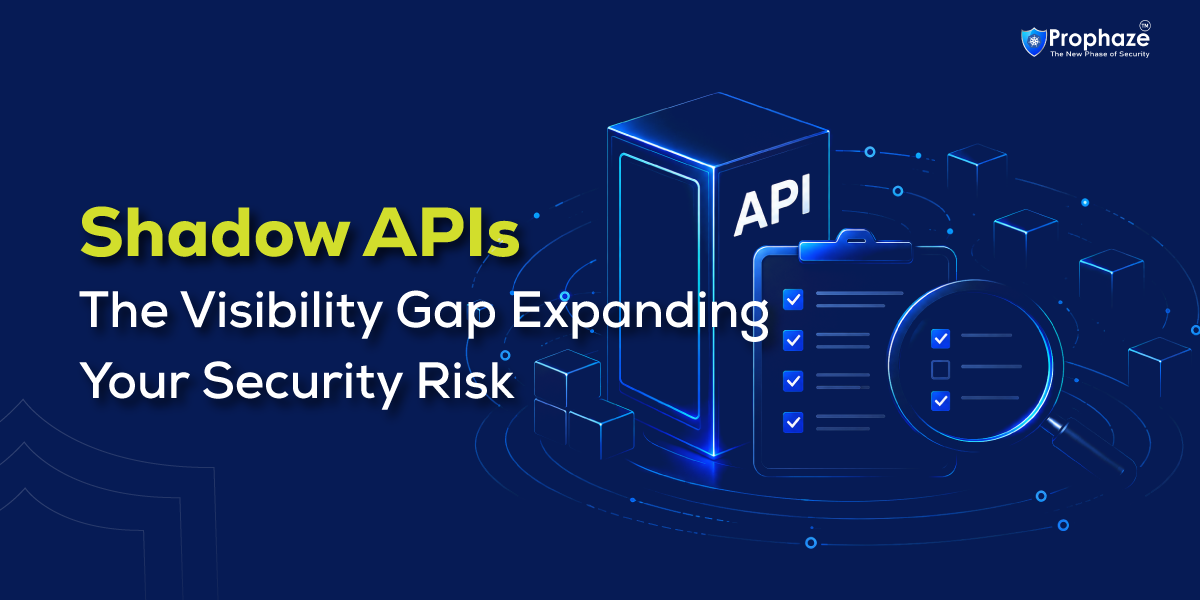
Shadow APIs are API endpoints that exist outside an organization’s official inventory, documentation, or security governance processes. They are not only a technical security issue, they are fundamentally a governance and visibility problem. Recent industry research highlights that many organizations operate with incomplete API inventories and inconsistent oversight, creating blind spots across production environments.
Unlike malicious or unauthorized APIs, shadow APIs are usually created for legitimate business purposes. They often emerge during:
- Rapid development cycles
- Testing and debugging activities
- Third-party integrations
- Legacy application migrations
- Microservice deployments
- AI and machine learning projects
Over time, these endpoints become disconnected from ownership and security oversight while remaining active and accessible. Without effective shadow API detection, these forgotten endpoints can remain exposed for months or even years before they are identified.
Quick Definition: A shadow API is any API that is deployed, accessible, but unknown to security teams, governance processes, or centralized inventory systems.
Why Shadow APIs Have Expanded The Threat Surface In 2026
Modern organizations depend on APIs for nearly every digital interaction. From cloud, native applications and mobile platforms to AI systems, SaaS integrations, and internal services, APIs have become the connective tissue of modern business.
This rapid growth has been fueled by:
- Microservices
- Multi-cloud environments
- Platform engineering
- DevOps automation
- AI-powered applications
- Agentic workflows
As APIs multiply across environments, documentation and governance often struggle to keep pace. The result is a growing attack surface filled with undocumented, unmanaged, and often forgotten endpoints. Security leaders no longer struggle with securing known APIs they struggle with discovering unknown ones. This growing visibility challenge is why organizations are investing in continuous shadow API discovery programs rather than relying on periodic inventories and manual audits.
The Hidden Cost of API Blind Spots
Most discussions about shadow APIs focus on technical vulnerabilities. The bigger issue is business visibility.
When organizations cannot accurately answer:
- How many APIs do we have?
- Which APIs expose sensitive data?
- Who owns each API?
- Which APIs connect to AI systems?
- Which APIs are internet facing?
They lose control of risk management itself. A shadow API isn’t merely a security problem. It’s an operational blind spot. And blind spots create uncertainty during audits, incident response, mergers, acquisitions, and compliance reviews.
Why Shadow APIs Rarely Stay Hidden
Many organizations assume that undocumented APIs are difficult to discover, but hidden endpoints often leave traces across applications, cloud environments, and third party integrations. Frontend code, mobile apps, exposed documentation, and forgotten services can unintentionally reveal APIs that were never included in official inventories.
At the same time, rapid development cycles and decentralized teams create new endpoints faster than governance processes can track them. As a result, shadow APIs frequently become visible to external parties long before security teams realize they exist.
How AI Is Expanding Shadow API Risk Across Modern Environments
As organizations increasingly integrate APIs with Large Language Models (LLMs), AI assistants, autonomous agents, vector databases, retrieval systems, and other AI-driven workflows, a new category of shadow API risk is emerging. An undocumented or unmanaged endpoint connected to AI infrastructure can inadvertently expose proprietary training data, customer conversations, internal knowledge bases, model outputs, business intelligence, and even sensitive prompts.
This expands the impact of shadow APIs beyond traditional application security concerns and into the realm of AI governance. As AI adoption accelerates, organizations that focus only on conventional API security practices may overlook these new exposure pathways and the risks they introduce.
Shadow APIs vs. Zombie APIs vs. Rogue APIs
Many organizations confuse these terms.
While all three increase attack surface, shadow APIs are often the hardest to identify because they appear legitimate and frequently support active business processes.
5 Critical Indicators Your Organization Has a Shadow API Breach
In many cases, organizations only realize they have a visibility problem after implementing shadow API detection tools that uncover endpoints missing from existing inventories. If any of the following are true, shadow APIs likely exist in your environment:
- No Central API Inventory: Teams maintain separate records or spreadsheets.
- Rapid CI/CD Deployments: New services are deployed faster than governance reviews occur.
- Multiple Development Teams: Different groups create APIs independently.
- Frequent Cloud Expansion: New workloads appear across multiple cloud platforms.
- AI Projects Launching Across Departments: Innovation initiatives often create APIs outside traditional security oversight.
The larger the organization, the higher the probability that undocumented APIs already exist.
Strategic Framework for Managing Shadow API Risk at Scale
Organizations need to move beyond periodic API discovery exercises and adopt a continuous visibility approach. A practical framework includes:
- Discover: Continuously identify APIs across cloud environments, applications, gateways, network traffic, and code repositories using automated shadow API discovery capabilities.
- Classify: Determine ownership, data sensitivity, internet exposure, and business criticality for every API.
- Validate: Assess authentication, authorization, encryption, and vulnerability posture to ensure security controls are functioning as intended.
- Govern: Apply consistent security policies, compliance requirements, and access controls across the entire API ecosystem.
- Retire: Remove unused, duplicate, deprecated, and obsolete APIs to reduce unnecessary attack surface.
The goal isn’t simply to find shadow APIs, it’s to ensure new APIs never become invisible to security teams in the first place.
Why Shadow APIs Are a Business Risk, Not Just a Security Risk
Executives increasingly recognize that cyber risk is business risk. A single undocumented API can expose customer data, trigger regulatory penalties, disrupt operations, and damage brand trust. For boards and leadership teams, shadow APIs represent a critical governance challenge:
You cannot secure assets you cannot see.
Organizations that achieve complete API visibility gain advantages beyond security:
- Faster compliance audits
- Better operational resilience
- Reduced breach risk
- Stronger customer trust
- Improved AI governance
In a digital, first economy, visibility has become a competitive advantage.
The Cost of Not Knowing Your API Attack Surface
As organizations expand cloud environments, AI initiatives, and digital services, undocumented APIs can quickly become hidden risks operating outside governance and security oversight.
The solution isn’t simply finding shadow APIs once. It’s establishing continuous API discovery and visibility so new endpoints never become invisible in the first place.
In modern application security, the greatest risks are often the ones organizations don’t know exist. That’s why understanding your API landscape has become just as important as securing it.
- Ready to Eliminate Hidden APIs, Start Now
Can your security team confidently locate every API operating across your estate? If you hesitate, your organization already risks data leakage, unauthorized access, and compliance failures. Begin shadow API discovery and detection today before unseen APIs become your next breach.
Frequently Asked Questions (FAQ)
1. What is a shadow API?
A shadow API is an undocumented, unmanaged, or unknown API endpoint that operates outside an organization’s official inventory and security governance processes.
2. Why are shadow APIs dangerous?
Shadow APIs can expose sensitive data, bypass security controls, create compliance gaps, and introduce hidden attack paths that security teams may not monitor or test.
3. How do organizations discover shadow APIs?
Organizations use continuous API discovery techniques including traffic analysis, cloud asset monitoring, API gateway integrations, source code analysis, and attack surface management tools.
4. How are shadow APIs different from zombie APIs?
Shadow APIs are unknown or undocumented APIs that remain active, while zombie APIs are deprecated APIs that should have been retired but continue operating in production environments.