Stop Magecart Attacks in Banking Applications: The Most Overlooked Threat in 2026

Magecart Attacks in Banking Applications

Table of Contents

Share Article

Stop Magecart Attack In Banking Applications Before They Expose Customer Data

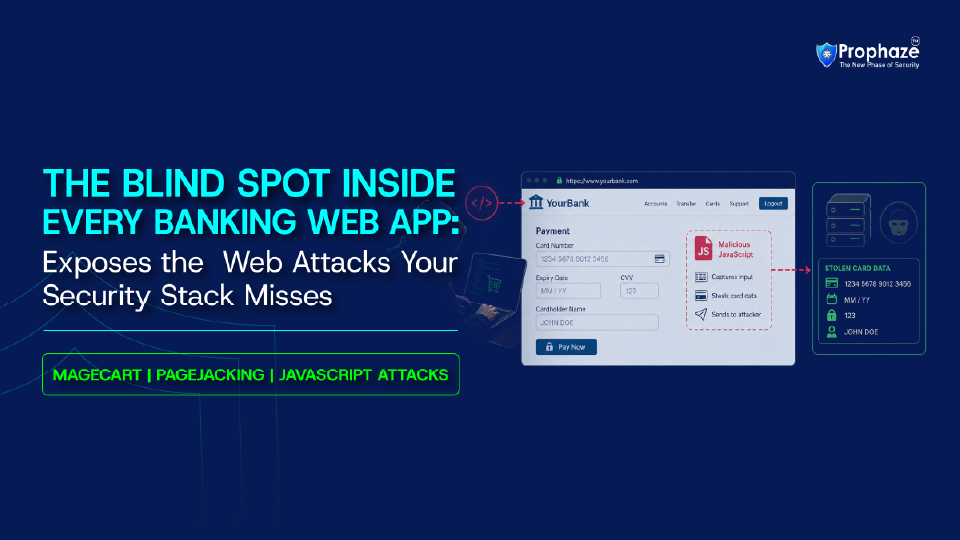
Magecart attacks on banking internet packages have elevated to one of the most dangerous customer-side banking security threats in 2026. Unlike traditional attacks, those JavaScript injection banking security threats work inside the browser beyond the visibility of WAFs, CSP, and server-side defenses.
On January 15, 2026, researchers identified a live table Magecart style keylogger on a major bank portal, silently capturing credentials and payment records from hundreds and thousands of users, while 96 out of 97 security devices did not detect it.
It’s evolving faster than traditional defenses, making client-side attacks one of the most biggest blind spots in modern banking security today.

What Is Magecart & Why Considering It Just An "E-Commerce Problem" Is The Most Dangerous Misconception in BFSI

Magecart began in 2015 as a web-skimming attack in BFSI-like environments, targeting Magento-based retail stores. Today, it refers to any attack that injects malicious code into a web page to steal data that is entered into forms, such as credit card details, credentials, account numbers, insurance data, and mortgage records in a user’s browser in real time, before it ever reaches your server.
The biggest and most dangerous misconception in BFSI is that “this is a retail problem, we are a bank.” assumption. Analysis from ANY.RUN in April 2026 reveals that banks face significant financial impacts due to stolen card data, leading to fraud losses and chargebacks. Compromised credentials facilitate account takeovers, and exposed software vulnerabilities contribute to identity theft and large-scale fraud.

What makes this critical for BFSI in 2026 is how widely it applies across banking interfaces:

All of these pages process sensitive financial data through a browser, and each one runs third-party JavaScript. They all carry Magecart exposure and client-side attack risks that traditional web application firewall solutions for BFSI cannot detect.

The 2026 Magecart Attack Techniques Targeting Banking Systems

In 2026, Magecart attacks have evolved beyond traditional formjacking banking attacks into advanced client-side exploits, with WebRTC-based exfiltration, SVG overlay injections, and GTM container hijacking, which made banking packages vulnerable even under full PCI DSS 4.0 Magecart compliance.

Attack 1: The WebRTC Skimmer, Bypassing CSP Entirely

In March 2026, researchers documented a new class of Magecart attack using WebRTC DataChannels for data exfiltration. Content Security Policy (CSP) has been widely deployed in financial institutions to restrict script execution and outbound requests.
The WebRTC skimmer bypasses CSP attacks and defeats those controls altogether. Instead of HTTP requests, the injected script uses native WebRTC APIs to establish peer-to-peer connections and exfiltrate stolen data over encrypted UDP channels
Key Characteristics:
Because this traffic doesn’t use HTTP, it bypasses WAF client-side attack detection and traditional monitoring tools. As a result, a PCI DSS 4.0-aligned portal with a robust CSP configuration can remain exposed to this attack path.

Attack 2: The Invisible SVG Overlay, The Fake "Secure Checkout" Deception

A large-scale campaign in April 2026 verified a new SVG overlay attack on payment pages. The attack introduces a 1×1 pixel SVG element into the DOM. While visually undetectable, it triggers JavaScript execution when rendered through the browser.
The overlay deception creates a completely convincing “secure checkout” experience that simulates legitimate banking or payment flows. It replicates card validation indicators, billing address fields, and checkout UI elements, all styled to match the real application.
During this flow, the payment data is silently captured before being forwarded to the legitimate backend.
Key Characteristics:
The transaction is generally completed normally from the user’s perspective. The payment is successful, and the interface behaves as expected, and there should be no instantaneous indication of compromises. Detection of such incidents typically occurs only after fraudulent transactions have happened.
Since the attack operates entirely on the client-side UI layer, it leaves no clear server-side trace. Even monitored payment environments and PCI DSS-aligned workflows may fail to detect this class of deception.

Attack 3: Google Tag Manager as a Skimmer Delivery Vehicle

The most insidious technique is GTM hijacking in banking portals. Google Tag Manager (GTM) is widely used across banking and insurance portals for analysis and tracking. It executes a JavaScript container for every page load and is generally trusted through default security policies. Attackers exploit this trust by compromising GTM containers and injecting skimmer logic into legitimate tracking flows. Since it loads from googletagmanager.com, it’s far too often allowedlisted in CSP and trusted by WAF controls.

Key Characteristics:

Once compromised, GTM executes malicious code in the same context as legitimate scripts, allowing capture of sensitive user inputs such as card data and credentials during interaction.
This is a supply chain JavaScript attack in financial services. From the system view, everything appears normal: pages load, scripts execute, and transactions complete without visible disruption. However, data is silently captured at the client-side layer, leaving minimal server-side visibility even in monitored environments.
Once compromised, GTM executes malicious code in the same context as legitimate scripts, allowing the capture of sensitive user inputs such as card data and credentials during the interaction.

Why Traditional Security Cannot Detect Magecart

Understanding this banking web app security blind spot is critical. The entire Magecart threat class exploits one fundamental assumption built into enterprise security infrastructure over twenty years: the threat lives between the internet and your server.

WAF Blindness:

Web application firewalls sit between the internet and your origin server. Magecart does not operate in that channel. Once injected, the malicious script runs inside the visitor’s browser, reads keystrokes from DOM elements, and exfiltrates data, all client-side, in a browser session your WAF log entry shows as 200 OK. The WebRTC variant goes further: exfiltration uses encrypted UDP with no HTTP at all.

CSP Failures:

CSP defeats classic Magecart. The 2026 attack variants defeat CSP:

PCI DSS 4.0 Gaps:

Requirements 6.4.3 and 11.6.1 (mandatory since March 2025) require script inventory and tamper detection. But GTM container compromise changes the behaviour of a listed script, not its inventory entry. WebRTC exfiltration does not modify HTTP headers or payment page content, it executes through a separate browser API after page load.

Server-side Scanning:

Magecart attacks operate entirely after your server has correctly served a clean page. A clean penetration test result and an actively compromised checkout page are not mutually exclusive.

The Real Scale of Client-Side Banking Security Threats in 2026

Understanding the true scale of client-side banking security threats reveals how Magecart and web skimming attacks have evolved into continuous, large-scale financial data breaches targeting BFSI applications worldwide.
This highlights the scale of client-side banking attacks and web skimming BFSI threats globally. Financial institutions that have not deployed dedicated client-side monitoring and script integrity verification are statistically almost certain to have been affected, and most simply do not know it.

How Prophaze Secures Banking Applications Against Client-Side Attacks

Magecart’s client-side execution does not eliminate the role of a WAF. It redefines it. Protection must focus on where attacks originate, how they propagate, and how data is exfiltrated across the application lifecycle. Prophaze’s AI-native WAAP platform secures banking applications across the application layer, API layer, bot layer, and behavioral layer. It enables financial institutions to prevent injection, reduce attack surface, and detect early indicators of compromise, even in advanced client-side attack scenarios.

Injection Vector Protection

Nearly every Magecart campaign originates from a server-side or API-layer vulnerability. Prophaze proactively blocks both common and advanced exploitation attempts, including SQL injection, cross-site scripting (XSS), remote code execution, file upload abuse, and API exploitation. By stopping these threats at the entry point, Prophaze ensures malicious scripts are never injected into the application. This effectively prevents the attack before it reaches the browser.

Virtual Patching for Zero-day Exposure

In BFSI environments, patching delays are common due to strict change management processes. When zero-day or N-day vulnerabilities such as PolyShell are actively exploited, Prophaze provides immediate protection through virtual patching at the WAF layer without requiring code changes. This minimizes exposure windows and ensures continuous protection until permanent fixes are deployed.

AI-driven Behavioral Threat Detection

Modern attacks increasingly evade static, signature-based defenses by mimicking legitimate behavior. Prophaze uses AI-driven behavioral analysis to establish baselines across user sessions, API traffic, and application workflows. It identifies anomalies such as unusual request patterns, session deviations, or suspicious interactions, even from trusted sources. This helps detect hidden threats like compromised scripts or abnormal application behavior.

Bot and Automated Attack Prevention

Automated tools are widely used by attackers to scan for vulnerabilities, perform credential stuffing, and execute large-scale attacks. Prophaze delivers advanced bot detection and mitigation that blocks malicious automation while allowing legitimate traffic. This reduces reconnaissance activity and significantly lowers the probability of successful exploitation at scale.

Outbound Exfiltration Detection

Detecting data exfiltration is critical, especially when attacks bypass initial defenses. Prophaze monitors outbound application traffic and flags anomalies such as communication with unknown domains, irregular data transfers, or deviations from established behavioral patterns. This provides visibility into potential data leakage attempts and adds a critical layer of defense against stealthy attacks.

PCI DSS 4.0 Compliance Support

Prophaze enables financial institutions to align with PCI DSS 4.0 by providing detailed visibility and audit logs across application and API activity. It supports key requirements such as script monitoring (6.4.3) and tamper detection (11.6.1). This ensures organizations can demonstrate continuous security controls while maintaining compliance.

What BFSI CISOs Must Do This Quarter

To mitigate client-side banking security threats like Magecart and JavaScript injection, BFSI security teams must adopt continuous script monitoring, outbound traffic validation, and PCI DSS 4.0-aligned application protection strategies.

Quick Reference: 2026 Magecart Threat Summary for BFSI

Can Your Banking Security Stack Detect Client-Side Magecart Attacks in Real Time?

Most BFSI security tools still focus on server-side threats, while Magecart operates silently inside the browser through trusted scripts, GTM containers, and third-party JavaScript. If your platform cannot detect malicious script behavior, monitor outbound browser activity, or identify supply chain compromise in real time, your banking applications remain exposed.

Stop client-side banking attacks before they become a breach. See how Prophaze protects BFSI web applications in real time.

You May Also Like

Magecart Attacks in Banking Applications

Stop Magecart Attacks in Banking Applications: The Most Overlooked Threat in 2026

Stop Magecart Attack In Banking Applications Before They Expose Customer Data Magecart attacks on banking

Application and API Security for BFSI

Application And API Security For BFSI: The Shift From Perimeter Defense To Transaction-Layer Security

Application and API Security for BFSI: Why Traditional Defenses Are Failing Application and API security

SSRF Attacks on EHR Integration APIs The Blind Spot in Healthcare Security

The Blind Spot: SSRF Attacks on EHR Integration APIs

The Attack Nobody Is Logging: Server-Side Request Forgery in Healthcare Behind your perimeter firewalls, deep

Scroll to Top