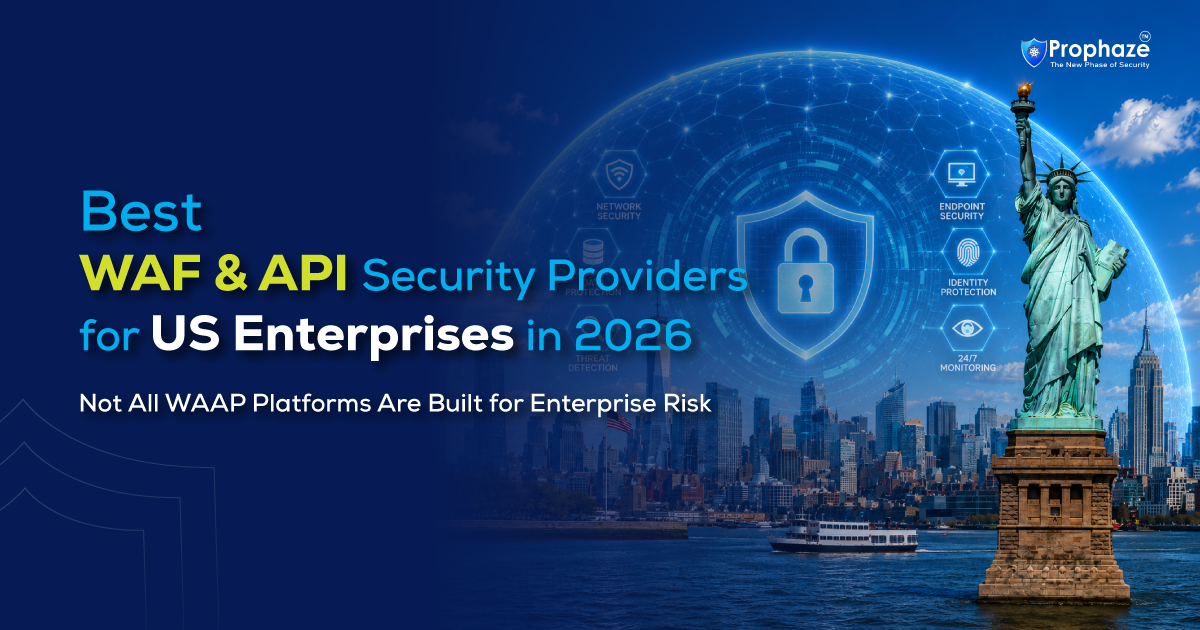
Why US Enterprises Are Investing in WAF and API Security in 2026
US enterprises are securing more applications, APIs, and AI-powered services than ever before. From banking platforms and healthcare portals to SaaS applications and manufacturing systems, modern organizations increasingly rely on web applications and APIs to power critical business operations.
As a result, choosing the right security solution has become a strategic priority. In this guide, we examine the top 7 Enterprise Grade WAF and API Security Solution Providers in the US for 2026.
We will review the top Web Application Firewall and API solution providers in US, from enterprise WAF solutions to the leading API security solution providers for US enterprises and compare their capabilities, industry fit, compliance coverage, and deployment models so security leaders can choose the right solution with confidence.
The rising challenge is that threat actors have noticed the numerous vulnerabilities that can be exploited across Web and APIs and how many are not sufficiently protected in the evolving cybersecurity threat landscape.
Rising Threats Against US Applications and APIs: 2025–2026 Data
According to the Verizon 2025 Data Breach Investigations Report (DBIR), exploitation of vulnerabilities in internet-facing applications accounted for 20% of breaches, while vulnerability exploitation as an attack vector grew 34% year over year. At the same time, the IBM X-Force Threat Intelligence Index 2026 reported a 44% increase in exploitation of public-facing applications, highlighting how attackers continue to target web applications and APIs as preferred entry points.and CrowdStrike found that AI-enabled adversaries increased operations 89% year-over-year with an average breakout time of just 29 minutes

For security leaders, this means traditional perimeter security is no longer enough. Organizations need visibility into application traffic, API activity, bot behavior, and runtime threats that operate beyond conventional network defenses.
The message is clear: attackers are increasingly targeting applications, APIs, identities, and AI-connected services rather than traditional network infrastructure.
Why Enterprise WAF Solutions and API Security for Enterprises Go Hand in Hand
The modern attack surface extends far beyond websites. Organizations now expose APIs through customer applications, mobile apps, cloud workloads, partner integrations, AI assistants, and microservices environments. Every new API endpoint creates another potential path into sensitive systems and data.
Traditional WAF solutions providers in the USA usually protect web applications against Layer 7 attacks: SQL injection (SQLi), cross-site scripting (XSS), remote code execution (RCE), command injection, and directory traversal. But modern adversaries are increasingly bypassing the perimeter entirely, targeting application logic and APIs directly.
Unlike traditional attacks, many API attacks use valid credentials and legitimate HTTP requests, making them invisible to signature-based defenses alone. This is why WAF solutions in the USA increasingly need to go beyond signatures and why API security solutions in US enterprises must include behavioral analytics and runtime visibility to catch what rule-based tools miss.
And hence why modern enterprises are moving beyond standalone WAFs toward WAAP (Web Application and API Protection) platforms for enterprise unified solutions that combine WAF, API protection, runtime visibility, bot mitigation, and behavioral analytics in a single architecture.
The Security Trends Driving WAF and API Security Adoption in the US
Public-Facing Application Exploitation Is Rising
IBM X-Force reported a 44% increase in public-facing application exploitation in 2025, while Verizon’s DBIR found vulnerability exploitation grew 34% as a breach vector. The CrowdStrike 2026 Global Threat Report adds further urgency: AI-enabled adversaries increased operations 89% year-over-year, and the average eCrime breakout time fell to just 29 minutes, meaning adversaries move from initial access to lateral movement faster than most security teams can detect. As a result, demand for WAF solution providers in the USA with real-time Layer 7 inspection and virtual patching has surged across every major industry.
API Sprawl Has Become a Security Problem
Cloud-native applications and microservices have made API sprawl security risks a board-level concern for US enterprises. Shadow APIs, zombie APIs, deprecated endpoints, and unmanaged third-party integrations accumulate silently and threat actors are actively hunting for them. Modern API protection solutions address this through shadow API detection, continuous runtime API discovery, schema validation, and inventory management that keeps pace with how fast development teams ship.
AI Has Created a New Application Attack Surface
IBM X-Force observed more than 300,000 ChatGPT credentials circulating on underground marketplaces. The CrowdStrike 2026 report found ChatGPT mentioned in criminal forums 550% more than any other AI model, and over 90 organizations had legitimate AI tools exploited to generate malicious commands. As US enterprises deploy AI assistants, agents, and LLM-powered services connected to APIs and business systems, AI-powered threat detection and strong API governance have become non-negotiable, not optional add-ons.
Industry-Specific Risk Drivers Shaping US Enterprise Security
While every organization faces application-layer threats, the risk profile varies significantly by sector. Financial institutions defend against account takeover and payment fraud; healthcare organizations protect sensitive patient data; SaaS providers battle API sprawl and authorization vulnerabilities; manufacturers face OT and supply chain compromise. The table below maps the most pressing Web application and API security challenges across major US industries.
Although the attack techniques differ across industries, the underlying challenge remains the same: applications and APIs have become the primary gateway to sensitive data and critical business functions. Organizations need visibility into both traditional web traffic and API activity to detect threats, enforce security policies, and meet increasingly demanding compliance requirements.
This is why security leaders are consolidating onto platforms that unify WAF protection, API discovery, runtime monitoring, bot mitigation, and automated threat response rather than managing a patchwork of point solutions.
Top 7 WAF and API Security Solutions for US Enterprises
The following list of top WAF and API Security Solution Providers in the US highlights platforms designed to protect enterprises from evolving application and API-layer threats.
1. Prophaze
Prophaze combines advanced WAF protection, API security, bot mitigation, runtime discovery, and Kubernetes-native security in a unified platform designed for modern application environments. Its capabilities include runtime API discovery, shadow and zombie API detection, AI-powered threat detection, OWASP API Top 10 protection, eBPF-powered visibility, virtual patching, Kubernetes-native deployment, and advanced bot and abuse protection. Together, these capabilities help organizations gain deeper visibility into application and API traffic while defending against evolving threats across cloud-native applications, Kubernetes workloads, AI-enabled services, and modern API ecosystems.
2. Imperva
Imperva offers application security through WAF, API protection, bot protection, client-side protection, and DDoS mitigation, helping organizations secure web applications and APIs across cloud, hybrid, and on-premises environments.
3. Akamai
Akamai provides cloud-based application security with WAF, API protection, bot management, and DDoS defense, leveraging its global edge network to protect high-traffic applications.
4. Fastly
Fastly delivers an edge-native WAF and API protection solution focused on protecting modern applications from OWASP threats, account takeover attempts, automated attacks, and API abuse while maintaining low latency.
5. Wallarm
Wallarm combines WAF and API security capabilities with API discovery, specification enforcement, runtime attack detection, and protection for cloud-native and microservices-based applications.
6. Salt Security
Salt Security focuses on API security through API discovery, posture governance, threat detection, behavioral analytics, and protection against risks such as broken object-level authorization (BOLA) and API abuse.
7. Cloudflare
Cloudflare offers application and API security through its WAF, API Shield, bot management, DDoS protection, and threat intelligence capabilities, helping organizations secure internet-facing applications and APIs at global scale.
Why Runtime API Visibility Matters
Traditional security controls rely on static API inventories, gateway policies, and documented specifications but production environments change constantly. New APIs are deployed daily, old endpoints stay exposed, authentication policies drift, and third-party integrations evolve without security review. Runtime API discovery gives organizations a continuously updated, accurate view of every API in production including the shadow APIs and zombie endpoints that static tools never see.
Without continuous runtime visibility, organizations cannot secure what they cannot see. They cannot enforce policies on APIs they do not know exist. And they cannot detect attacks on endpoints that are not in their inventory. Hence for API Security Solution Providers In USA, runtime API discovery is not an optional add-on.
Why US Security Teams Choose Prophaze for WAF and API Security
US enterprises operate in a threat environment defined by speed, evasion, and AI-driven attacks. CrowdStrike reports adversaries now achieve breakout times under 29 minutes, while IBM X-Force found public-facing application exploitation surged 44%. This has significantly increased demand for Enterprise grade security especially across industries evaluating modern Web Application Firewall and API Security Solutions.
As a result, organizations that are actively assessing WAF and API Security Solution Providers in the US, that can protect modern cloud-native applications against OWASP Top 10 threats, bot attacks, credential stuffing, and application-layer exploitation. At the same time, demand is rising for API Security Solution Providers US capable of securing rapidly expanding API ecosystems.
Prophaze delivers high-performance Enterprise grade WAF Solutions alongside advanced API protection solutions in US, that are designed for modern distributed architectures. Unlike traditional WAF solutions, Prophaze provides continuous runtime API discovery, enabling organizations to detect shadow and undocumented APIs that often go unmonitored in production environments.
Its eBPF-powered visibility layer delivers deep runtime insight across Kubernetes and cloud-native environments, helping security teams analyze API behavior, authentication flows, and anomalies in real time, capabilities increasingly required for Enterprises.
Prophaze is also recognized across leading industry analyst ecosystems, including:
- Gartner Peer Insights - Strong Performer (Voice of the Customer, 2025)
- Gartner Market Guide - WAAP (2025)
- Gartner Market Guide - API Security (2024)
- KuppingerCole - Overall Leader (2024)
- G2 - High Performer (Fall 2024)
These validations reinforce its position among emerging WAF and API Security Solution Providers in the US, particularly for organizations modernizing their security stack around such Security Solutions.
The Reality Facing US Enterprises in 2026
The US application security landscape is evolving rapidly as public-facing application attacks increase, APIs expand across cloud-native environments, and AI-powered services create new attack surfaces. At the same time, organizations face growing compliance requirements and increasingly complex digital ecosystems.
Traditional perimeter-focused security is no longer enough; modern enterprises need a combination of WAF protection, API protection, runtime visibility, behavioral analytics, bot mitigation, and AI-driven threat detection to effectively reduce risk and secure applications, APIs, Kubernetes workloads, and AI-enabled services. Hence the increasing need to consider the top WAF and API Security Solution Providers in the US for protecting against such advanced threat landscape across web application and APIs.
Struggling with Weak Web Defenses or Untracked API Sprawl?
If your current WAF can’t keep pace with workloads, or if your security team is completely blind to new API deployments, it’s time to evaluate a provider built for 2026 threats. Prophaze solves both challenges independently. Secure your public-facing web applications with our advanced Enterprise WAF, or gain complete visibility into your endpoints with our dedicated API solutions.
- Don't leave your enterprise exposed. Talk to our experts or schedule a demo today.
Frequently Asked Questions (FAQ)
1. What is the difference between a WAF and API Security?
A WAF protects web applications against Layer 7 attacks such as SQL injection, cross-site scripting (XSS), command injection, and remote code execution. API security focuses on protecting APIs against risks such as broken object-level authorization (BOLA), excessive data exposure, authentication weaknesses, and business logic abuse.
2. Why is API discovery important?
Many organizations do not have a complete inventory of their APIs. API discovery helps identify shadow APIs, zombie APIs, deprecated endpoints, and unmanaged services that can increase the attack surface.
3. What is virtual patching and why does it matter?
Virtual patching allows organizations to block exploitation attempts at the WAF layer while development teams work on permanent fixes. This reduces exposure to newly disclosed vulnerabilities and zero-day threats.
4. How does Prophaze help secure cloud-native applications?
Prophaze combines WAF protection, API protection, runtime API discovery, bot mitigation, behavioral analytics, virtual patching, and Kubernetes-native deployment to help organizations secure modern cloud-native and API-driven environments.