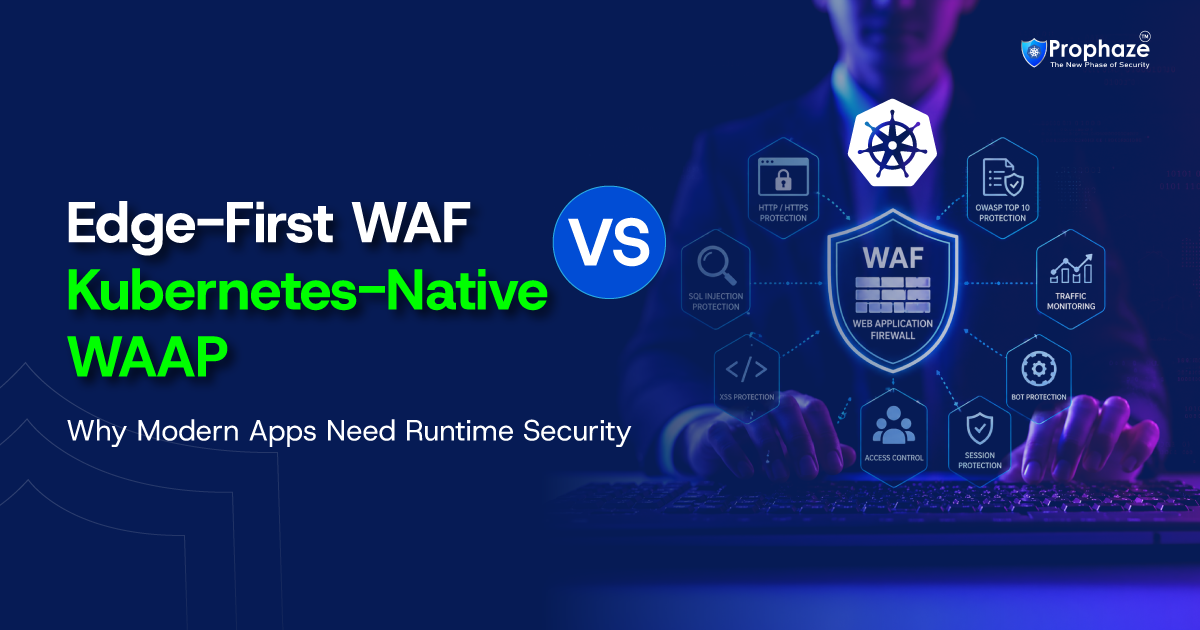
Choosing a Web Application and API Protection (WAAP) platform is no longer simply a feature comparison. For modern DevSecOps, platform engineering, and security teams, the decision has become architectural. As enterprises move toward Kubernetes, APIs, microservices, and distributed cloud-native applications, traditional edge-only security models are increasingly unable to provide the runtime visibility modern environments require.
Edge-first Web Application Firewalls (WAFs) became popular because they simplified perimeter protection, absorbed large-scale DDoS attacks, and accelerated traffic through globally distributed CDN networks. However, modern applications no longer operate only at the edge. APIs evolve continuously, internal service communication expands rapidly, and runtime application behavior changes dynamically inside Kubernetes clusters.
This shift is driving enterprises toward Kubernetes-native WAAP architectures that provide visibility closer to the application itself rather than only at the network perimeter.
Edge-First WAF vs Kubernetes-Native WAAP: Understanding the Architectural Difference
At a high level, both edge-first WAF platforms and Kubernetes-native WAAP solutions offer web application protection, API security, bot mitigation, and DDoS defense. The key difference lies in where inspection, visibility, and enforcement occur.
An Edge-First WAF (such as Cloudflare) operates as an external reverse proxy that filters traffic before it reaches your application environment. This model performs well for CDN acceleration, perimeter filtering, and blocking volumetric attacks close to the network edge.
In contrast, Prophaze is designed as a Kubernetes-native WAAP that integrates directly inside Kubernetes clusters, ingress environments, API gateways, or service mesh layers. Instead of protecting only ingress traffic, a cloud-native WAAP platform continuously inspects runtime behavior, API interactions, and internal service communication.
This architectural difference impacts:
- Runtime visibility into application behavior
- API discovery accuracy and real-time mapping
- Detection of shadow and undocumented APIs
- Internal traffic (East-West) inspection capabilities
- Operational overhead and false-positive management
- Data sovereignty and deployment flexibility
For organizations adopting cloud-native infrastructure, architectural alignment is now more important than traditional feature checklists.
Edge WAF vs Application-Native Security: Where Each Model Performs Best
The edge WAF vs application-native security debate comes down to where traffic inspection happens. Edge-centric security excels in scenarios where traffic volume, global reach, and performance optimization are the primary concerns. Its network absorbs large-scale, volumetric DDoS attacks and ensures consistent performance across geographies.
However, edge-based inspection has inherent limitations. It evaluates requests before they enter your private infrastructure, which means it cannot fully understand internal service communication, API logic, or container runtime behavior. This is a critical blind spot for enterprises running a microservices security platform.
A Kubernetes-native WAAP addresses this gap by embedding security within the application environment. This enables deeper visibility into:
- Continuous runtime API discovery
- Behavioral threat detection
- Shadow API identification
- Service-to-service visibility
- Context-aware protection
Over time, this results in more precise protection with less dependency on manual rule adjustments. As APIs continue expanding across modern infrastructures, runtime-aware protection is becoming a foundational security requirement for any robust Kubernetes WAF solution.
Complete Feature Comparison: Edge-First WAF vs. Kubernetes-Native WAAP
The differences between these security models become clearer when evaluated across architecture, API security, bot mitigation, and operational overhead.
East-West Traffic: The Blind Spot Legacy Edge WAFs Cannot See
For organizations utilizing a Kubernetes WAF platform, security cannot stop at the perimeter. While an edge WAF protects the front door, it remains entirely blind to internal “East-West” traffic—the communication flowing laterally between your microservices, database pods, and internal API gateways.
If an attacker manages to bypass the edge or exploit a vulnerability through a trusted partner API, they can move laterally through your network without detection.
A cloud-native API protection model like Prophaze operates directly inside the cluster, inspecting every internal service-to-service call. By implementing security at the ingress and sidecar levels, it ensures that your internal microservices are isolated and verified, closing the critical East-West blind spot.
Operational Overhead: Manual Rule Tuning vs. Adaptive Runtime Protection
Another key factor in choosing a WAAP for cloud-native applications is long-term operational effort. Legacy WAFs rely on static signatures that require constant, manual rules updates to avoid blocking legitimate user traffic. Every time a development team updates an application or releases a new API endpoint, the security team must manually tune the WAF to prevent false positives.
A runtime WAAP platform solves this by leveraging an adaptive, machine-learning-driven threat detection engine. By monitoring the application’s actual behavior, container states, and system calls in real-time, the platform automatically adapts its security policies to application updates. This minimizes false alerts and allows engineering teams to ship code faster without security bottlenecks.
Data Sovereignty and Infrastructure-Level Control in Modern WAAP
For highly regulated industries such as fintech, banking, and healthcare, data sovereignty is a primary concern. Traditional edge WAFs require you to hand over your SSL certificates so they can decrypt, inspect, and re-encrypt your traffic on their external, globally distributed servers.
A Kubernetes-native WAAP architecture gives you complete infrastructure-level control. Since the WAAP runs natively within your own virtual private cloud (VPC) or local Kubernetes cluster, decryption and inspection are performed entirely within your sovereign security boundary. Your sensitive payload data, PII, and financial keys never leave your infrastructure, offering a robust WAAP for multi-cloud environments without violating strict compliance mandates.
Which WAAP Architecture Fits Your Modern Enterprise?
The decision between an edge-first WAF and a Kubernetes-native WAAP is not about choosing the tool with the most features; it is about choosing the architecture that matches your infrastructure.
Choose an Edge-First WAF if:
Your application stack is mostly monolithic, depends heavily on a global CDN for static asset delivery, and requires volumetric DDoS mitigation at the network boundary.
Choose a Kubernetes-Native WAAP if:
Your system relies on Kubernetes, dynamic microservices, and rapid API updates. If you require deep, runtime-level threat protection, automated API discovery, and strict data sovereignty, an application-native WAAP is the optimal choice.
- Align Your Security with Your Architecture
Most teams do not replace a WAF because it fails; they replace it because it no longer fits their modern architecture. If your applications are built on Kubernetes and APIs, it is time to move your security beyond the edge.
Compare Prophaze against Cloudflare in your own environment and identify the gaps.
Frequently Asked Questions (FAQ)
1. What is the difference between Edge-First WAF and Kubernetes-Native WAAP?
Edge-first WAF platforms inspect traffic externally at the network perimeter, while Kubernetes-native WAAP platforms operate closer to the application runtime inside Kubernetes and cloud-native environments.
2. Why is runtime API visibility important?
Runtime visibility helps organizations identify shadow APIs, monitor service-to-service communication, detect behavioral anomalies, and secure dynamic API environments more effectively.
3. Can edge-only WAFs inspect east-west traffic?
No. Edge-only WAF architectures have limited to no visibility into east-west traffic because internal service-to-service communication within a cluster does not pass back out through the external edge perimeter.
4. Why are enterprises adopting Kubernetes-native WAAP architectures?
Modern applications rely heavily on APIs, microservices, and distributed runtime environments that require application-aware security visibility beyond traditional edge inspection.