The Hidden Risk Behind Trusted Third-Party APIs
Third-party applications have become essential to modern business, but they have also changed how organizations need to think about vendor risk. From identity providers and payment gateways to AI platforms and collaboration tools, organizations rely on hundreds of external services to power everyday operations. While these integrations improve productivity and accelerate innovation, they also introduce trusted API connections that continuously expand an organization’s API attack surface.
For many security teams, managing this growing attack surface still begins with vendor risk assessments. However, understanding whether a vendor is secure is only part of the picture. Securing today’s API attack surface requires continuous visibility into the APIs, integrations, and trust relationships that vendors introduce into your environment.
Recent third-party breaches have shown that attackers no longer need to target every organization individually. Compromising a trusted software provider can expose hundreds or even thousands of downstream customers because modern applications are deeply interconnected. It’s no longer enough to know which vendors your organization uses, you also need to understand the API trust relationships they create.
This is where Continuous API Discovery becomes essential, helping security teams continuously discover APIs, monitor evolving trust relationships, and secure an API attack surface that changes every day.
Why Recent Third-Party Breaches Matter to Every Enterprise
Several high-profile security incidents over the past few years have reinforced the same lesson: organizations increasingly inherit risk through the software and services they trust.
Although these incidents affected different industries and technologies, they revealed the same security challenge: attackers exploited the trusted relationships between applications and third-party services. Modern applications rely on APIs to connect with identity providers, payment platforms, AI services, and cloud infrastructure. When a trusted service is compromised, those same connections can become attack paths. The challenge is no longer just vendor risk, it’s understanding how trusted APIs expand your attack surface. So why can a single breach impact thousands of organizations? The answer lies in how modern applications communicate.
Every Third-Party Integration Expands Your API Attack Surface
Applications rarely operate in isolation. A single customer-facing application may interact with identity providers, payment gateways, AI services, cloud platforms, and dozens of other internal and external systems through APIs. These interactions rely on trusted authentication and communication mechanisms to establish secure connections and automate business processes.
As organizations adopt more cloud-native services, new integrations and evolving permissions continuously expand the API attack surface. For security teams, the challenge is understanding how applications communicate and how API trust relationships evolve. Without continuous visibility, shadow APIs, overprivileged integrations, and hidden attack paths can easily go unnoticed.
Why Vendor Risk Assessments and Static API Inventories Fall Short
Most organizations already have vendor risk management programs in place. Security questionnaires, compliance certifications, penetration testing reports, and annual reviews all play an important role in evaluating third-party vendors. However, these assessments provide a point-in-time view of a vendor’s security posture; they don’t reveal how applications communicate once they’re deployed.
Traditional vendor risk programs answer questions like: Is this vendor compliant? or Does this provider follow security best practices? They rarely answer questions such as:
- Which third-party APIs are currently being consumed?
- What new API endpoints have appeared since deployment?
- Which APIs use OAuth tokens or service accounts?
- How have permissions or authentication methods changed over time?
Static API inventories face the same challenge. Documentation quickly becomes outdated as developers release new features, cloud services evolve, and third-party integrations change independently. Shadow APIs emerge, legacy endpoints remain active, and authentication mechanisms continue to evolve without being reflected in manual inventories.
Modern application environments are dynamic. Understanding them requires continuous runtime visibility rather than periodic assessments or static documentation.
Discover the Hidden APIs Expanding Your Attack Surface
Continuous API Discovery provides security teams with real-time visibility into the APIs operating across their environments. Instead of relying on manually maintained inventories, it continuously identifies new APIs, monitors changes, and uncovers previously unknown or unmanaged endpoints.
This visibility extends beyond internally developed APIs. It also helps organizations understand which third-party APIs are being consumed, how applications authenticate with external services, and how trust relationships evolve as new integrations are introduced.
By continuously monitoring API activity, security teams can:
- Discover shadow and undocumented APIs
- Maintain an up-to-date API inventory
- Monitor third-party API consumption
- Identify authentication and authorization risks
- Prioritize high-risk APIs based on runtime activity
- Detect changes before they become your blind spots
Continuous API Discovery transforms API visibility from a periodic exercise into an ongoing security capability, enabling organizations to understand their expanding API attack surface as it changes.
How Prophaze Provides Visibility Across Internal and External APIs
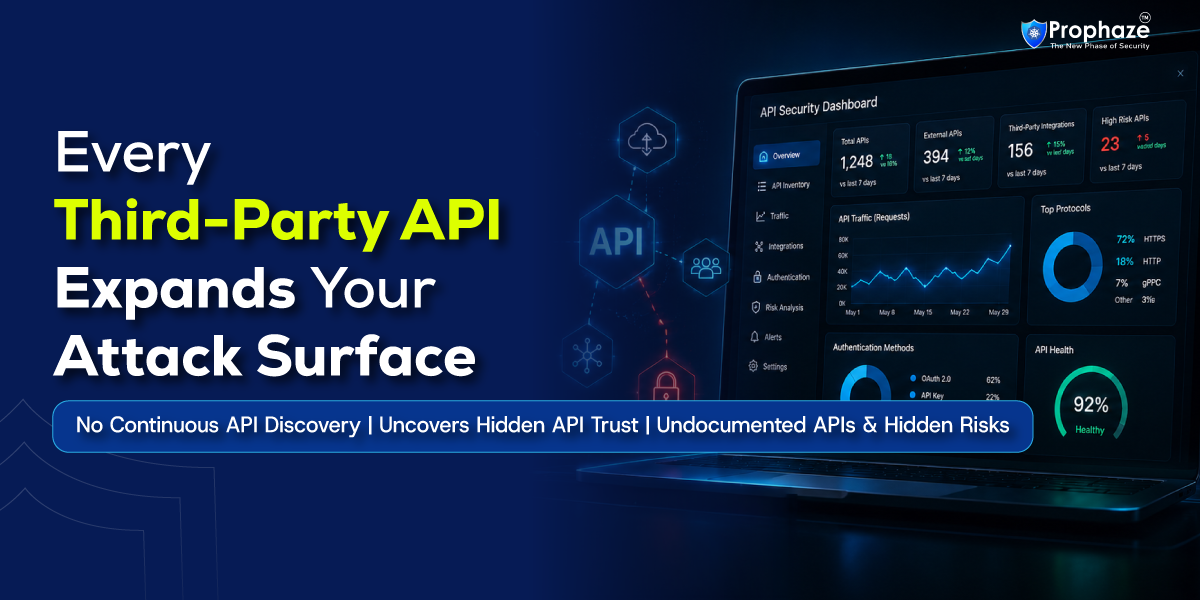
Continuous visibility becomes far more valuable when security teams can see not only which APIs exist, but also how third-party services are being consumed across the enterprise. Prophaze’s External API Security Dashboard provides centralized visibility into unique external API endpoints, helping organizations identify consumed services and analyze endpoint-level activity in real time.
High-level summary cards and time-series visualizations provide immediate insight into API usage, traffic trends, error rates, data transfer volumes, and authentication activity. This enables security teams to quickly identify anomalies, monitor API behavior, and understand how external services interact with their applications over time.
The dashboard also strengthens API governance with detailed visibility into token usage, authentication sources, endpoint authentication coverage, and request distribution across protocols and HTTP methods. By combining continuous API discovery with runtime insights, Prophaze helps organizations uncover hidden third-party APIs, monitor trust relationships, and reduce the risks associated with modern interconnected application environments.
Beyond Visibility, Toward Continuous Trust
Third-party software isn’t inherently risky. The challenge lies in the trusted API relationships that every integration introduces. As organizations adopt more cloud-native applications, AI services, and external platforms, these connections continue to expand the enterprise API attack surface in ways that traditional vendor assessments and static API inventories cannot fully capture.
Securing modern applications requires more than evaluating vendors,it requires continuously understanding how applications communicate, which third-party APIs they consume, and how trust relationships evolve over time. Continuous API Discovery provides the visibility needed to identify these connections, uncover hidden risks, and strengthen API security before attackers can exploit them.
- Understand Your Third-Party API Attack Surface
Every third-party integration introduces trusted API connections that evolve over time. Gain continuous visibility into your API attack surface and protect your applications before trusted relationships become attack paths.
Frequently Asked Questions (FAQ)
1. What is Continuous API Discovery?
Continuous API Discovery automatically identifies, inventories, and monitors APIs across your environment in real time, helping organizations maintain visibility as applications and integrations evolve.
2. What is Continuous API Discovery?
Third-party applications communicate through APIs using trusted authentication mechanisms such as OAuth, API keys, service accounts, and machine identities. These trusted connections expand the API attack surface and can introduce security risks if they are not continuously monitored.
3. What are shadow APIs?
Shadow APIs are undocumented, forgotten, or unmanaged APIs that exist outside official inventories. Because they often lack proper governance and monitoring, they can become attractive targets for attackers.
4. How does Prophaze help secure third-party APIs?
Prophaze provides continuous visibility into third-party API consumption through its enhanced External API Security Dashboard. Organizations can discover external API endpoints, monitor authentication activity, analyze API traffic, improve governance, and better understand the trust relationships that exist across their application ecosystem.