Introduction
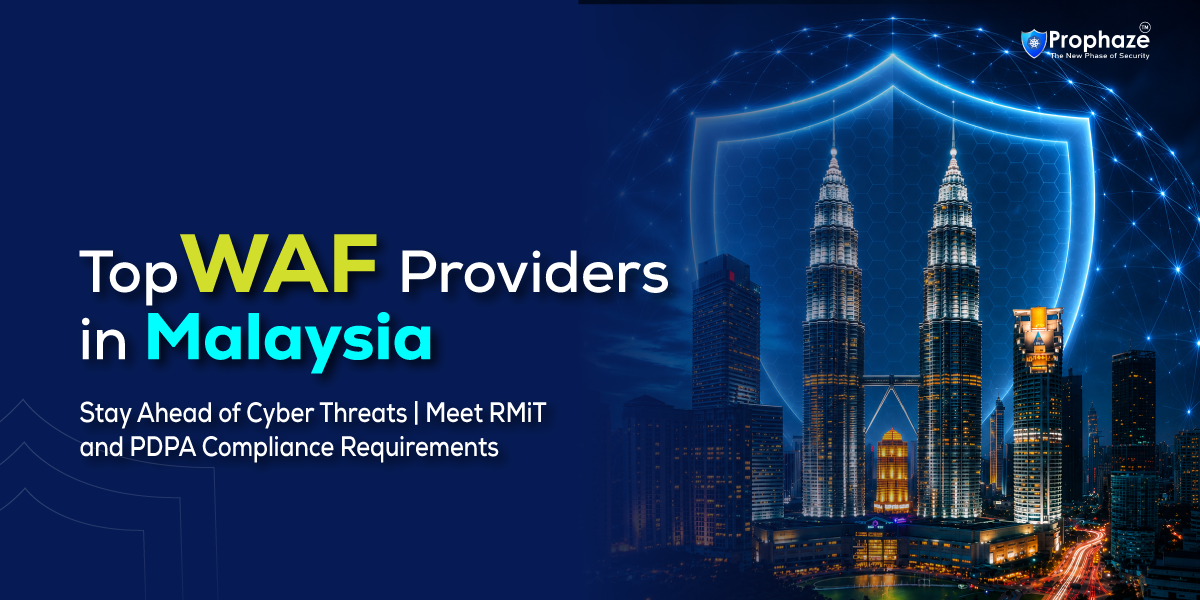
If you are evaluating the top WAF solution providers in Malaysia right now, the threat environment and regulatory pressure make 2026 the most consequential year to get this decision right. Web application attacks, SQL injection, credential stuffing, API abuse, and Layer 7 DDoS, are the most common initial access vectors across Malaysia’s financial, healthcare, government, and logistics sectors. At the same time, BNM’s November 2025 RMiT update and the PDPA 2024 amendments have introduced personal director liability, mandatory breach notification within 72 hours, and fines up to RM1 million. A WAF is no longer an optional security layer, it is a compliance control with legal consequences attached.
This guide covers what to look for, who the leading providers are, and why Malaysian regulated organizations are increasingly choosing Prophaze.
The Threat Environment Malaysian Organizations Are Facing Right Now
Malaysia’s digital economy runs on web applications and APIs. Banking portals, government services, healthcare platforms, logistics systems, and e-commerce applications have become the primary targets for attackers.
According to Kaspersky and Security Quotient’s 2025 Malaysia Cyber Threat Outlook, ransomware attacks against Malaysian users increased by 153% year-over-year in 2024. CyberSecurity Malaysia and PDRM reported losses exceeding RM1.22 billion, while Cyber999 recorded a 78% increase in ransomware incidents in a single quarter.
Recent incidents illustrate the scale of the challenge:
The common thread across these incidents is simple: attackers are targeting applications, APIs, and user credentials. Stopping attacks before they reach those systems is exactly what a modern WAF is designed to do.
What Is a Legacy WAF and What Should a Modern WAF Do?
A Web Application Firewall (WAF) platform inspects and filters HTTP/HTTPS traffic between users and your web applications, blocking attacks like SQL injection, cross-site scripting (XSS), and credential stuffing before they reach your systems.
Traditional WAFs relied on static signature rules; they blocked known attack patterns. Modern WAFs go further: they use behavioral analytics and machine learning to detect novel attacks, automatically discover and protect API endpoints, and provide bot mitigation alongside web traffic filtering. When evaluating WAF solution providers in Malaysia, the distinction matters, a signature-only WAF will miss the zero-day exploits and business logic attacks that are most prevalent in today’s threat landscape.
The Regulatory Pressure: What BNM RMiT and PDPA Actually Require
BNM RMiT, November 2025 Update:
Bank Negara Malaysia’s revised RMiT policy significantly strengthens cybersecurity accountability across the financial sector. Requirements designated as Standards (“S”) carry direct legal force and may result in enforcement action against both institutions and responsible officers.
For WAF deployments, three requirements matter most:
- Continuous monitoring of internet-facing systems
- Application vulnerability management
- Availability controls for critical digital services
RMiT S 10.32 limits unplanned downtime for critical systems to 120 minutes per incident. This means WAF accuracy matters. Excessive false positives can create the very outages institutions are required to prevent.
Financial institutions must also submit a gap analysis and remediation plan within 90 days of the November 2025 update.
PDPA 2024 Amendments, Effective 2025:
SQL injection, XSS, and credential stuffing, the attacks a WAF is designed to block, are among the most common triggers for personal data breaches that activate PDPA’s 72-hour notification clock. A WAF deployment is simultaneously a cybersecurity control and a PDPA compliance control.
Which Malaysian Industries Need a WAF Most?
Organizations that rely on customer-facing applications, APIs, or sensitive data are at the highest risk from web application attacks and compliance violations.
- Banking & Financial Services: Online banking, payment platforms, and APIs face constant attack and strict BNM RMiT requirements.
- Healthcare: Sensitive patient data makes healthcare organizations a prime target for ransomware and data breaches.
- Government & Public Sector: Citizen-facing services face risks from DDoS attacks, defacement, and unauthorized access.
- Education: Universities hold large volumes of student, research, and financial data.
- Logistics & Critical Infrastructure: Operational disruptions can have significant financial and business impact.
- E-Commerce & Digital Services: Online storefronts, checkout applications, and customer account portals are common targets for bot attacks, card testing, and account takeover.
For these sectors, a WAF is no longer just a security tool, it’s a critical layer of operational resilience and compliance.
How to Choose a WAF Provider: What Malaysian Organizations Should Evaluate
Before comparing WAF Solution Providers In Malaysia, these are the criteria that matter most in Malaysia’s regulatory and threat context:
- False positive rate, A WAF that blocks legitimate traffic contributes to RMiT downtime violations. Look for behavioral detection that distinguishes real attacks from normal traffic accurately.
- API protection, Modern applications expose API endpoints that signature-based WAFs cannot adequately protect. Shadow API discovery, automatically finding undocumented endpoints, is increasingly essential.
- Bot mitigation, Credential stuffing against banking portals requires bot detection that works without adding CAPTCHA friction to legitimate users.
- Compliance logging, RMiT auditors and PDPA breach documentation both require continuous, timestamped, forensic-quality logs. Not all WAFs generate audit-ready evidence trails.
- Deployment flexibility, Malaysian organizations run on AWS, Azure, GCP, on-premises, and hybrid configurations. Your WAF must work across all of them with consistent policy enforcement.
- Onboarding speed, In an active threat environment with 90-day RMiT gap analysis deadlines, a WAF that takes months to deploy is a liability.
Top 5 WAF Solution Providers in Malaysia (2026)
1. Prophaze, Built for Malaysia's Regulated Market
Prophaze is a WAAP and WAF platform that aligns closely with the compliance requirements, threat landscape, and hybrid infrastructure realities faced by Malaysian organizations in 2026. It combines behavioral machine learning-based detection, automatic API discovery, bot mitigation, and Layer 7 DDoS protection in a single cloud-native platform designed for regulated environments where both speed and control are critical. Its behavioral engine establishes baseline application traffic and identifies anomalies in real time, enabling detection of zero-day attacks and business logic abuse that traditional signature-based WAFs often miss.
In the Malaysian context, Prophaze supports continuous compliance with frameworks such as BNM RMiT and PDPA by maintaining audit-ready forensic logs, integrating with SIEM systems, and minimizing operational risk through consistently low false positive rates below 0.1%, allowing protections to remain in active blocking mode without disrupting applications. It also provides automatic shadow API discovery, CAPTCHA-less bot mitigation, and rapid deployment across AWS, Azure, GCP, Kubernetes, and on-premises environments, enabling onboarding in minutes and full enforcement within days while maintaining high availability for critical digital services.
2. FortiWeb (Fortinet)
FortiWeb is widely deployed across Malaysia’s enterprise and public sectors, offering machine learning-based protection against OWASP Top 10 threats, API attacks, bots, and application-layer exploits across cloud and on-premises environments.
Consideration: Best suited for organizations already using the Fortinet ecosystem.
3. AWS WAF
AWS WAF provides native protection for applications running on AWS, with managed rules, rate limiting, and seamless integration with services such as CloudFront, API Gateway, and Application Load Balancers.
Consideration: Ideal for AWS-first environments but less flexible for hybrid or multi-cloud deployments.
4. Alibaba Cloud WAF
Alibaba Cloud WAF delivers web application, API, bot, and DDoS protection through its regional cloud infrastructure, making it a strong option for organizations operating within the Alibaba Cloud ecosystem.
Consideration: Best value for businesses already invested in Alibaba Cloud services.
5. NSFOCUS WAF
NSFOCUS combines web application protection, API security, and DDoS mitigation, with a strong presence across critical infrastructure, telecommunications, and public sector environments in Asia-Pacific.
Consideration: Typically geared toward larger enterprise and government deployments with dedicated security teams.
Why Prophaze Is the Best WAF Solution for Malaysian Organizations
Malaysian organizations are dealing with a unique combination of regulatory pressure, expanding API exposure, and increasingly sophisticated application-layer attacks. Many security teams are also managing a mix of cloud, on-premises, and legacy systems, making it difficult to maintain consistent protection across environments.
Prophaze helps address several of the challenges commonly faced by Malaysian enterprises:
- Meeting RMiT and PDPA expectations through continuous application protection, centralized visibility, and audit-ready security logging.
- Protecting growing API attack surfaces by automatically discovering and securing exposed APIs, including undocumented endpoints.
- Reducing operational complexity by consolidating WAF, API security, bot mitigation, and Layer 7 DDoS protection into a single platform.
- Securing hybrid infrastructure environments across cloud, Kubernetes, and on-premises deployments with consistent security policies.
- Preventing application downtime caused by attacks through real-time threat detection and automated protection against common web application threats.
For organizations looking to strengthen application security while simplifying operations, Prophaze provides a unified platform that aligns with the realities of modern Malaysian IT environments.
Choosing a WAF That Delivers Security, Compliance, and Operational Resilience
Malaysia’s threat landscape continues to evolve as organizations expand their use of web applications and APIs. At the same time, regulatory frameworks such as BNM RMiT and the amended PDPA have increased the operational and legal consequences of security failures.
Choosing the right WAF is no longer just a cybersecurity decision. It is a compliance, resilience, and business continuity decision.
The providers in this guide represent the leading options available in Malaysia today. For organizations operating in regulated sectors, factors such as detection accuracy, API protection, audit readiness, and deployment speed should carry as much weight as traditional WAF capabilities.
Your Applications Are Being Targeted. Your Regulators Are Watching. Are You Protected?
BNM’s multimillion-ringgit fines, PDPA’s 72-hour breach notification rule, and growing director liability mean Malaysian organizations cannot afford security blind spots. Prophaze helps security teams protect against OWASP Top 10 and API-based attacks, uncover unmanaged APIs, mitigate automated abuse and credential stuffing, and maintain forensic-quality visibility across applications and APIs for faster detection, response, and compliance reporting.
- Discover, monitor, and protect every application and API, including the ones you don't know exist.
Frequently Asked Questions (FAQ)
1. What is a WAF and why do Malaysian organizations need one in 2026?
A WAF protects web applications by filtering malicious traffic before it reaches your systems. With stricter BNM RMiT and PDPA requirements, it has become a critical security and compliance control.
2. What is the difference between a traditional WAF and a modern WAF?
Traditional WAFs rely on signatures to block known threats. Modern WAFs add behavioral detection, API discovery, bot mitigation, and protection against emerging attacks that rules alone cannot detect.
3. How does a WAF support PDPA 2024 compliance?
A WAF helps prevent breaches that could trigger PDPA reporting requirements and provides the visibility and audit logs needed for investigations and compliance reporting.
4. What should I look for in a WAF for BNM RMiT compliance?
Look for low false positives, continuous monitoring, audit-ready logging, automatic API discovery, behavioral threat detection, and high availability to support regulatory requirements.