The Threat Landscape Dubai Businesses Cannot Ignore
WAF solution providers in the UAE have spent years selling perimeter-based protection to enterprises that have long since outgrown it. Legacy vendors were built for a different threat landscape, one where attacks were loud, detectable, and came from outside the network. That is no longer the reality Dubai cloud security and cybersecurity compliance are operating in.
According to StormWall’s Q2 2025 MENA DDoS Threat Report, API-targeted attacks across the region rose 162% year-over-year, with 79% of all cyberattacks on MENA financial services targeting banking APIs and payment systems directly. By Q1 2026, the UAE had returned to global DDoS top-ten rankings driven by escalating geopolitical tensions and the 1.8 Tbps Layer-7 attack that struck a UAE financial institution that quarter remains the largest ever recorded in the region.
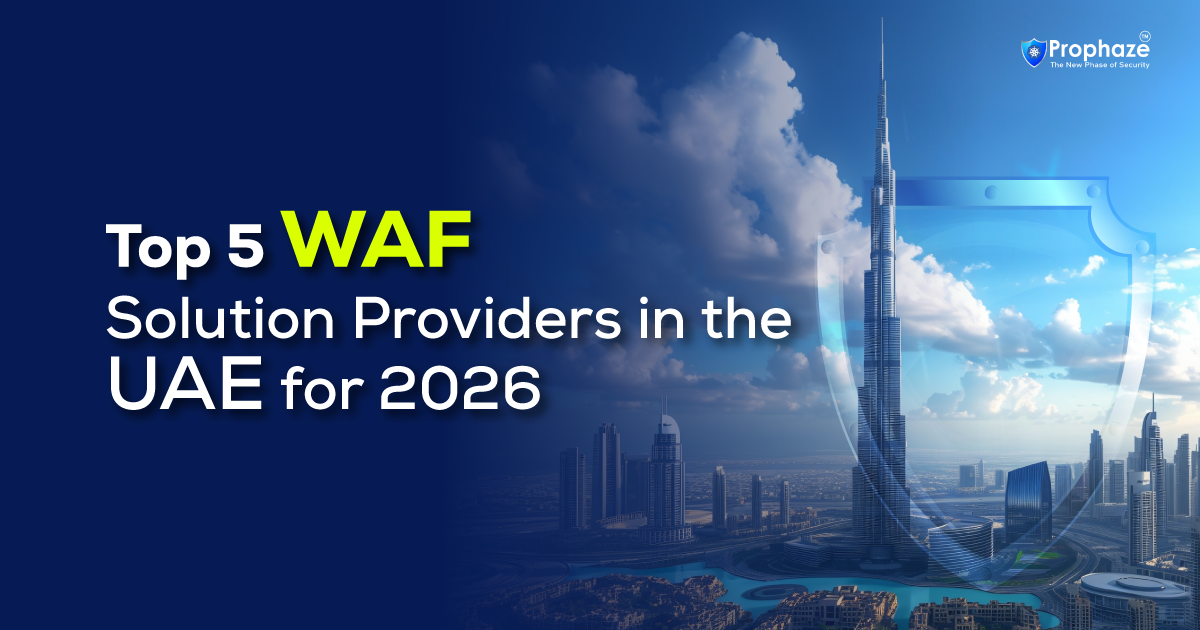
The threat landscape has moved. Choosing the right WAF solution in the UAE today means looking beyond legacy vendors, understanding what modern attacks actually look like and which platforms are genuinely built to stop them. That is exactly what this guide covers: the top 5 WAF solution providers in the UAE for 2026, evaluated against the threat landscape Dubai businesses are actually facing.
Advanced WAF Solutions: Why Legacy Vendors Are Losing Ground in the UAE
Dubai and Abu Dhabi’s enterprise environments have outgrown the security architectures that traditional WAF vendors were built for. Legacy on-premises appliances cannot scale with cloud-native workloads. Perimeter-only tools have no visibility into containerized microservices. Signature-based detection misses the API-layer attacks that now make up the majority of threats hitting UAE financial institutions, government platforms, and e-commerce infrastructure. As UAE organizations modernize, the gap between what legacy WAF vendors deliver and what modern environments actually require is widening and threat actors are operating precisely in that gap.
On-Premises WAF : When Data Cannot Leave Your Infrastructure
PDPL, SAMA CSF Level 3, DOH, and HAAD compliance means sensitive traffic cannot leave UAE infrastructure. Legacy cloud WAF vendors cannot meet this natively. On-premises WAF keeps all inspection, logs, and policies within borders full sovereignty, no compromise.
Consider the shift when: compliance obligations require strict data localization.
Cloud WAF : When Scale Outpaces Your Appliances
Hardware appliances and manual rulesets cannot keep pace with dynamic cloud environments. Cloud WAF scales automatically, updates continuously, and integrates natively with CI/CD pipelines.
Consider the shift when: legacy appliances are slowing deployments or leaving gaps during traffic spikes.
Hybrid WAF : When Your Environment Lives in Both Worlds
Most UAE enterprises run regulated workloads on-premises and customer-facing applications in the cloud simultaneously. Legacy tools leave policy gaps at the boundary between them. Hybrid WAF enforces consistent protection across both from one control plane.
Consider the shift when: separate WAF tools are producing fragmented visibility across environments.
Kubernetes-Native WAF : When the Perimeter Is No Longer the Boundary
Traditional WAFs never see inside Kubernetes clusters. East-west traffic between microservices is the fastest-growing attack surface in UAE environments. A Kubernetes-native WAF deploys inside the cluster and inspects it in real time.
Consider the shift when: containerized workloads are scaling faster than perimeter security can cover.
The reality for most UAE enterprises is that infrastructure does not fit neatly into one category: some workloads are on-premises, others are in the cloud, and many are somewhere in between. Prophaze builds a purpose-built WAF for each: KWAF for Kubernetes-native deployments, on-premises WAF for sovereign infrastructure, cloud WAF for AWS, Azure, and GCP, hybrid WAF for mixed environments, and multi-cloud WAF for organizations spanning multiple providers. The right WAF is not the one that covers the most ground on paper, it is the one built for where your applications actually live.
Top 5 WAF Solutions in the UAE for 2026
1. Prophaze AI WAF, Best for Cloud-Native and Kubernetes-Native Environments in the UAE
AI WAF is purpose-built for the cloud-native, Kubernetes-driven, and hybrid application architectures that define modern UAE enterprise infrastructure. Recognized as a Strong Performer in the Gartner Peer Insights Voice of the Customer report for Cloud WAAP 2025, it is designed specifically for the runtime application security, sovereignty, and Layer 7 protection requirements that traditional WAF platforms rarely address natively.
What makes it the right choice for UAE organizations:
- AI-driven runtime protection: Prophaze continuously analyzes live traffic patterns to detect and block threats that bypass traditional rule-based WAFs.
- Behavioral threat detection: AI-driven behavioral baselines identify credential stuffing, bot abuse, and Layer 7 anomalies in real time.
- Kubernetes-native WAF architecture: Protects cloud, Kubernetes, hybrid, and on-prem applications without code changes or complex integrations.
- Flexible sovereign deployment: Supports on-premises and sovereign cloud deployments to maintain traffic visibility and policy control within UAE infrastructure boundaries.
- Unified AI-powered WAF platform: Combines WAF, bot mitigation, Layer 7 DDoS defense, and behavioral analytics into a single intelligent security platform.
Best for: Banks, fintech platforms, government entities, healthcare providers, and cloud-native enterprises across the UAE and GCC requiring unified API protection, sovereign deployment, and multi-framework compliance in a single platform.
2. Cloudflare WAF, Best for Edge-Optimized Security
Cloudflare WAF runs on one of the world’s largest edge networks, delivering OWASP Top 10 protection, bot mitigation, rate limiting, and continuously updated managed rules for high-performance web application security.
3. Fortinet FortiWeb, Best for Fortinet Ecosystem Environments
FortiWeb integrates closely with the Fortinet Security Fabric, offering AI-driven threat detection, bot mitigation, compliance reporting, and centralized security management for enterprises already using Fortinet infrastructure.
4. Imperva WAAP, Best for Regulated Industries
Imperva is widely adopted across financial services and healthcare environments for its low false positives, managed rule updates, and compliance-focused protection designed for highly regulated enterprises.
5. Akamai App and API Protector, Best for High-Traffic Enterprises
Akamai combines WAF, Layer 7 DDoS protection, bot mitigation, and API security on a globally distributed edge platform built for large enterprises managing high traffic volumes and complex application environments.
Is Prophaze the Right WAF Solution for Your Industry in the UAE?
Prophaze is purpose-built for the sectors that face the highest application security risk across Dubai, Abu Dhabi, and the wider Emirates:
Banking and Financial Services
Prevents API fraud, account takeover, and transaction abuse across Dubai’s DIFC and Abu Dhabi’s ADGM financial ecosystems while maintaining full SAMA CSF Level 3 and UAE Central Bank compliance.
Government and Critical Infrastructure
Protects sovereign digital services and smart city platforms across the UAE from APTs, zero-day exploitation, and data exfiltration, aligned to NCA ECC and UAE IA Framework controls.
Oil, Gas and Energy
Secures digital oilfield infrastructure and OT-connected environments across UAE energy operations against nation-state threats and IT/OT lateral movement.
Telecoms
Mitigates subscriber API abuse, SS7 exploitation, and large-scale DDoS targeting UAE telecom infrastructure under TRA UAE regulatory frameworks.
The Standard for WAF Solutions in the UAE Has Changed. Has Your Security?
Dubai’s threat landscape in 2025 and 2026 has made one thing clear: web application security in the UAE can no longer be a perimeter checkbox. It must be continuous, behavioral, and API-aware, operating at the same speed as the threat actors targeting the region’s financial institutions, government platforms, and critical infrastructure.
Prophaze WAAP gives UAE organizations a unified platform to make that shift real: one dashboard, one AI engine, one deployment that secures web, API, bot, and DDoS threats, built for UAE sovereign compliance and operational simplicity.
Frequently Asked Questions (FAQ)
1. Is WAAP the same as a WAF?
No. A WAF is one component of a WAAP platform. WAAP adds API security with runtime discovery, behavioral bot management, and integrated Layer 7 DDoS protection, capabilities a traditional WAF does not include. For UAE organizations operating cloud-native or API-first architectures, a WAF alone leaves critical gaps in coverage.
2. Does Prophaze WAAP support data residency requirements under UAE PDPL?
Yes. Prophaze supports fully on-premises and sovereign cloud deployments, ensuring that traffic logs, threat data, and security policies remain within UAE infrastructure. This directly supports PDPL compliance obligations and the data residency requirements enforced by DIFC and ADGM regulated entities in Dubai and Abu Dhabi.
3. How quickly can Prophaze be deployed as a WAF solution in the UAE?
Prophaze’s Kubernetes-native architecture allows deployment in approximately fifteen minutes for containerized environments. It integrates natively with CI/CD pipelines, SIEM platforms including Splunk and Elastic, and SOAR systems, so your UAE SOC team has full visibility from day one.
4. Which WAF solution is best for SAMA CSF Level 3 compliance in the UAE?
Prophaze is purpose-built for SAMA CSF Level 3 alignment, supporting sovereign deployment, behavioral API monitoring, and the full compliance framework coverage required by UAE financial institutions operating under Central Bank and SAMA requirements.
5. Is a WAF enough for API security in the UAE?
No. A traditional web application firewall does not discover shadow APIs, validate against OpenAPI schemas, or detect behavioral anomalies in authenticated API traffic. For UAE enterprises with complex API ecosystems across banking, government, and e-commerce platforms, a WAAP platform with runtime API discovery and behavioral AI is required to close the full attack surface.