Why API Security Has Become the Biggest Blind Spot Across All Businesses
APIs are the most crucial links that join various elements of modern business. Whether it’s mobile banking, payment gateways, cloud-native microservices, or third-party integrations, every digital interaction is based on APIs, and as organizations expand their API ecosystems, these endpoints become the most exposed and least understood attack surface within organizations. It makes it impossible to ignore the need for a modern API security solution.
APIs enable direct communication between systems, allowing them to expose business logic and manage sensitive data. However, many security strategies still treat APIs as standard web traffic, creating gaps in protection. Attackers are increasingly exploiting APIs using valid credentials and normal requests, making these attacks hard to detect. As a result, many breaches occur in real time through legitimate API calls without triggering any alerts. Therefore, selecting an API security solution is crucial not just for compliance but also for detecting and preventing misuse before it leads to data loss or system compromises.
Modern threats like credential abuse, business logic manipulation, and multi-step API abuse can easily bypass traditional defenses, as they often look like legitimate traffic. This is why businesses of all sizes are increasingly seeking API security solution that can identify every API, eliminate critical API blind spots, detect attacks through real-time threat detection, and provide immediate protection.
What Is an API Security Solution?
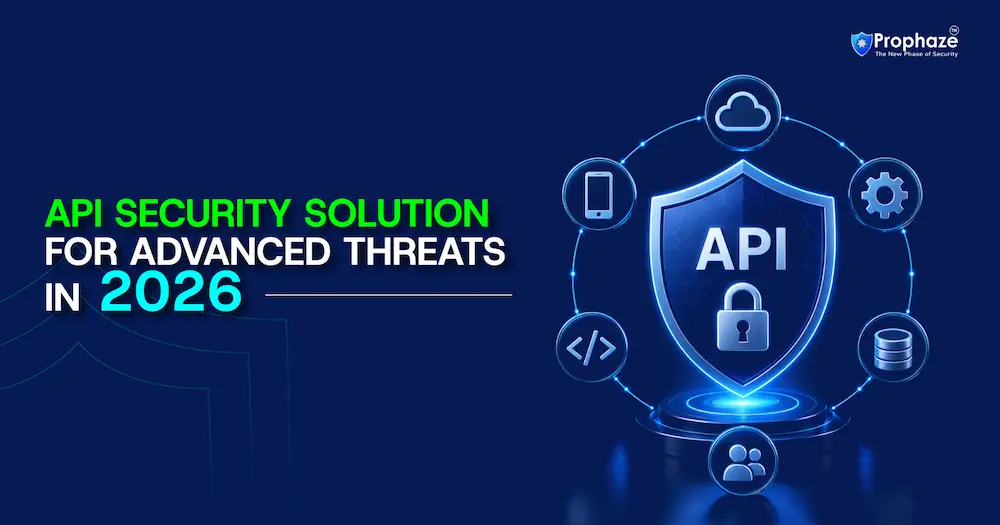
An API security solution is a platform that protects APIs from unauthorized access, abuse, and data breaches through continuous discovery, real-time monitoring, behavioral analysis, and runtime enforcement. Unlike traditional web application firewalls or generic API security tools, API security solutions are built to understand how APIs behave, what data they expose, and how users interact with them across the entire API lifecycle.
This distinction is important because APIs do more than just deliver content; they also carry out business logic. A single API call can initiate a financial transaction, retrieve protected health records, or trigger backend workflows that interact with numerous downstream systems. For instance, a banking API that manages account inquiries may appear secure at the network perimeter. However, if an attacker possesses valid credentials, they can silently access and enumerate thousands of accounts without triggering any alerts. The system recognizes these as legitimate requests, yet data can still be compromised.
The difference between an API gateway and a true API security solution is significant. API gateways manage traffic and enforce basic authentication policies. A full API security platform goes further: it discovers shadow and zombie APIs, performs continuous posture assessment, detects behavioral anomalies and business-logic abuse in real time, and provides runtime blocking, not just alerting.
In 2026, businesses of all sizes need API security that covers the full lifecycle: design, testing, discovery, runtime protection, and threat response.
API Security vs WAF: Why Traditional Defenses Fall Short
A common misconception is that a Web Application Firewall (WAF) is enough to protect APIs. While WAFs are important, they address a different issue. WAFs are designed to detect known attack patterns, such as SQL injection and cross-site scripting, by analyzing request payloads at the network perimeter.
But modern API attacks don’t just rely on malicious payloads. They rely on abusing legitimate functionality.API security operates at a fundamentally different level. Instead of looking for known signatures, it analyzes behavior, context, and intent across API calls.
This distinction is critical because many of the most damaging API attacks involve valid, authenticated requests, such as:
- Accessing other users’ data by manipulating object IDs (BOLA).
- Using stolen credentials to automate login attempts (credential stuffing).
- Extracting sensitive data through legitimate partner APIs (business logic abuse).
- Chaining multiple API calls to escalate privileges across systems (multi-step API abuse).
As a result, a WAF alone may miss these attacks, as they do not exhibit obvious malicious patterns.
Why API Security Matters:
API security matters because APIs expose core business logic, not just application interfaces. Every API call can trigger sensitive operations:
- Financial transactions
- Data retrieval
- Account modifications
- Backend workflows across multiple systems
Without dedicated API security, organizations lack visibility into how these operations are being abused.
Top API Threats Every Business Must Address in 2026
API security threats in 2026 are increasingly rooted in legitimate API interactions rather than obvious malicious payloads. The OWASP API Top 10 (2026) offers a solid framework for understanding API risks. However, merely listing these threats is insufficient. It is crucial to comprehend how they are exploited in real-world environments, often through entirely legitimate API interactions.
API1: Broken Object Level Authorization (BOLA)
Broken Object Level Authorization (BOLA) is the most prevalent API vulnerability in production. Adversaries manipulate object IDs in API requests to access data belonging to other users, and because the requests are authenticated, traditional security tools miss them entirely.
API2: Broken Authentication
Broken Authentication covers weak or improperly implemented authentication mechanisms that facilitate session hijacking, token abuse, or credential-based account takeover at scale.
API3: Excessive Data Exposure
Excessive Data Exposure occurs when APIs return far more data than the application actually uses, exposing sensitive fields that the client simply filters out in the UI, but that an attacker can easily extract.
API4: Lack of Rate Limiting
Lack of Rate Limiting leaves APIs open to abuse, ranging from credential stuffing and scraping to full Layer-7 DDoS attacks that exhaust backend resources without ever triggering network-layer defenses.
API5: Broken Function Level Authorization
Broken Function Level Authorization allows attackers to access administrative endpoints or elevated functions by manipulating request paths, often in APIs that were never intended to be public.
API6: Mass Assignment
Mass Assignment enables attackers to modify object properties that the API was never intended to expose by exploiting auto-binding of request parameters.
API7: Security Misconfiguration
Security Misconfiguration includes improperly configured APIs that expose debug endpoints, verbose error messages, or administrative paths to the public internet.
API8: Injection
Injection embeds malicious inputs SQL, NoSQL, and command injection targeting backend systems accessible through API endpoints.
API9: Improper Assets Management
Improper Assets Management (Shadow APIs and Zombie APIs) refers to undocumented, deprecated, or forgotten API endpoints that receive no monitoring and carry no protection but often retain full access to underlying data. Shadow APIs introduced by third-party integrations and GenAI/LLM connections are a rapidly growing variant of this risk.
API10: Insufficient Logging and Monitoring
Insufficient Logging and Monitoring means that even when attacks succeed, organizations often have no visibility into what happened, when, or how, making incident response, forensics, and compliance reporting impossible.
Beyond the OWASP API Top 10, modern enterprises must also defend against multi-step API abuse, where attackers combine multiple API calls to escalate privileges or move across systems, business logic abuse (exploiting legitimate workflows without generating any traditional attack signature), and AI/LLM API abuse (adversarial inputs targeting generative AI endpoints and Model Context Protocol servers).
Key Capabilities Every API Security Platform Must Have
When evaluating an API security platform, focus less on long feature lists and more on whether the solution delivers complete lifecycle protection with accuracy and minimal operational overhead. A strong platform should:
- Continuously discover APIs across cloud, on-premises, and third-party environments, including shadow APIs, Zombie APIs and deprecated endpoints.
- Provide API posture management with risk scoring aligned to OWASP API Top 10 and business impact.
- Detect behavioral and logic-based threats in real time, including BOLA, credential abuse etc.
- Enforce runtime protection inline, blocking malicious requests instantly rather than alerting after the fact.
- Integrate into CI/CD pipelines to enable shift-left security through automated testing and schema validation.
- Include bot protection to stop automated threats like scraping and credential stuffing.
- Support schema validation and a positive security model, enforcing strict adherence to API specifications.
- Operate as a unified WAAP platform, combining API security, WAF, bot mitigation, and DDoS protection.
- Maintain low-latency performance for high-volume, real-time environments.
- Minimize false positives and offer managed services to reduce operational burden.
- Scale effectively to handle millions of API requests without constant tuning.
Quick Evaluation Checklist:
- Does it provide continuous API discovery, including shadow APIs and zombie APIs?
- Can it detect behavioral threats and business logic abuse in real time?
- Does it offer true API runtime protection with inline blocking?
- Is it a unified WAAP platform or multiple disconnected tools?
- Can it scale without impacting performance or latency?
A strong API security platform doesn’t just check boxes it delivers continuous visibility, accurate detection, and real-time API runtime protection without slowing your business down.
API Security Solution Across High-Risk Industries
Across banking, e-commerce, healthcare, SaaS, and telecom, APIs power critical operations, from financial transactions to sensitive data exchange and multi-tenant workloads. This makes them prime targets for API security threats such as BOLA, credential stuffing, business logic abuse, and account takeovers, often executed through legitimate, authenticated requests.
The impact is immediate and severe, ranging from financial fraud and regulatory penalties to large-scale data breaches and service disruption. Regardless of industry, the requirements remain consistent: complete API visibility, continuous posture assessment, real-time API threat detection, and strong API runtime protection, delivered with high accuracy and low latency to avoid disrupting business operations.
How Prophaze Protects Your APIs: From Discovery to Runtime
Most API attacks don’t look malicious; they appear as normal, authenticated traffic exploiting logic, access, or data exposure. Prophaze is built to detect and stop exactly these threats. The Prophaze WAAP platform delivers unified API security through continuous discovery, AI-driven behavioral detection, and real-time enforcement, eliminating critical API blind spots and closing the gap between detection and protection without impacting performance.
What Prophaze delivers:
- Complete API Visibility: Continuous discovery and inventory of all APIs, including shadow, deprecated, and AI-driven endpoints.
- API Posture Management: Ongoing risk assessment aligned to OWASP API Top 10 with business-impact prioritization.
- AI-Driven Behavioral Detection: Real-time identification of BOLA, credential abuse, and business logic attacks, even in authenticated traffic.
- Runtime Blocking: Inline enforcement that stops threats instantly, with integrations to existing security workflows.
- Unified WAAP Platform: API security, WAF, bot protection, and DDoS defense in a single, consistent architecture.
- Low-Latency Performance: Built for high-volume environments where speed and reliability are critical.
Whether securing financial transactions, healthcare data, or multi-tenant SaaS platforms, Prophaze provides the visibility, detection accuracy, and real-time protection needed to prevent API breaches before they escalate.
- See Where Your API Blind Spots Are Before Attackers Do
Shadow APIs, zombie endpoints, unauthenticated admin paths, BOLA vulnerabilities, GenAI integrations with no governance, most enterprises have them. Most don’t know it until they’re breached. Prophaze can show you exactly what’s in your API environment, what’s at risk, and what needs to be fixed, starting with a single conversation.
Frequently Asked Questions (FAQ)
1. What is an API security solution?
An API security solution is a platform that protects APIs from unauthorized access, abuse, and data breaches using continuous discovery, behavioral analysis, runtime protection, and enforcement. It goes beyond traditional perimeter defenses, WAFs and API gateways to detect attacks that operate through legitimate API calls, including BOLA, business logic abuse, credential stuffing etc. A complete API security solution covers the full API lifecycle from design and testing through production runtime.
2. How is API security different from a WAF?
A WAF detects and blocks known attack signatures, such as SQL injection, XSS, and similar pattern-based threats at the perimeter. API security solutions detect behavioral and logic-based attacks that look like valid, authenticated traffic, including BOLA, credential stuffing, and business logic abuse that generate no malicious payload and produce no WAF alert. The two are complementary, not interchangeable; a unified WAAP platform delivers both in a single architecture.
3. What is a shadow API and why is it dangerous?
A shadow API is an API endpoint that exists in production but is not documented, monitored, or officially managed by the security team. It may have been created by a developer without security review, left behind after a feature deprecation, or introduced by a third-party integration. Shadow APIs carry the same access to data and backend systems as documented APIs but with none of the security controls. Continuous API discovery is the only reliable way to find them.
4. What is the difference between API posture management and runtime protection?
API posture management is the continuous assessment of your APIs for vulnerabilities, misconfigurations, authentication gaps, and sensitive data exposure, essentially, understanding the security state of your API estate before attacks happen. Runtime protection is an active enforcement during live API traffic, detecting anomalies, blocking malicious requests, and preventing attacks as they unfold. Both are necessary: posture management reduces the attack surface, while runtime protection handles threats that get through.