Introduction
Most modern attacks do not target the network layer. They target web applications, login forms, APIs, and endpoints that your users interact with every day. The ability to protect web applications from attacks at the application layer is the main problem that web application security exists to solve, and it is a problem that network firewalls were never created to address.
This is the reality that cloud WAF security for applications exists to address. Modern enterprises need an enterprise cloud WAF solution that follows applications wherever they move, across Kubernetes clusters, public cloud infrastructure, CDNs, and hybrid environments. Every request, browser, mobile, API, or service-to-service, traverses HTTP or HTTPS, making the application layer the dominant exposure surface.
Network firewalls regulate connectivity at Layers 3 and 4. They filter by IP address, port, and protocol, but cannot read the inside of an HTTP request. Traditional WAF tools operate at Layer 7 and can inspect HTTP payloads, but they rely on static signature-based rules, require manual tuning, and are tied to fixed hardware or virtual machine capacity without any elastic scaling. Organizations adopting enterprise cloud WAF solutions gain a continuous, managed WAF security service that enforces application-layer policy at the point where attacks actually occur, with behavioral detection and cloud-native scale that no other model provides.
What Is a Cloud-Native WAF and How Does It Work?
A cloud-based WAF security platform is a web application firewall designed to inspect and enforce policies on HTTP and HTTPS traffic before requests reach backend services, strengthening web security for cloud apps across distributed environments.
Unlike hardware appliances, cloud-native WAF integrates directly into cloud routing layers. It scales elastically with traffic demands and centralizes policy enforcement across regions and cloud environments. Deployment occurs through ingress controllers, reverse proxies, DNS routing or CDN integration. For teams that require operational simplicity, a managed cloud WAF service , this removes the burden of rule tuning, scaling, and updates, providing web security for cloud apps without the need for dedicated WAF engineering resources.
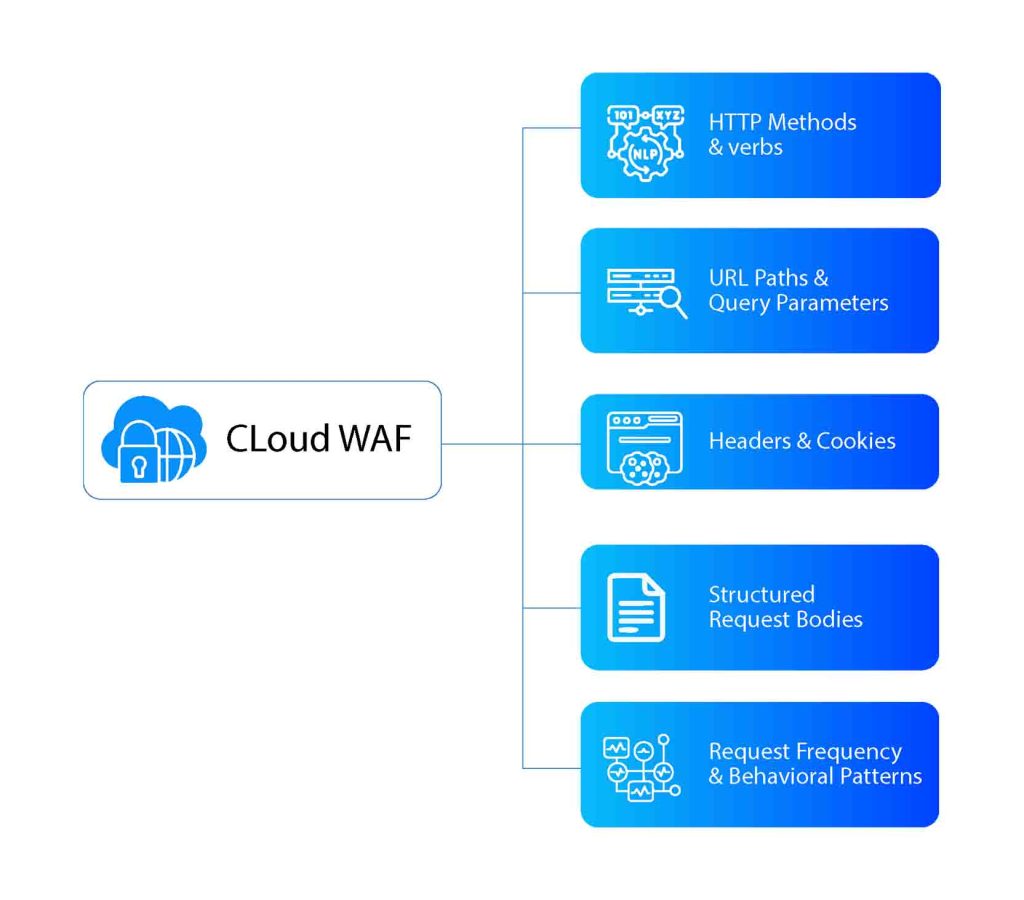
Because it operates at Layer 7 of the OSI model, Cloud WAF evaluates:
- HTTP methods and verbs
- URL path and query parameters
- Headers and Cookies
- Structured request bodies
- Request frequency and behavior patterns
Cloud WAF vs. Network Firewall vs. Traditional WAF
A cloud-native WAF, a traditional network firewall, and a legacy WAF appliance play complementary but distinct roles. Understanding where each operates explains why cloud WAF security cannot be replaced by network controls alone.
All three tools play different roles, and understanding what each can and can’t do explains why cloud WAF security needs its own dedicated layer.
A network firewall controls connectivity but is blind to application-layer attacks. A traditional WAF appliance inspects HTTP traffic and blocks known attack signatures, but relies on manual rule tuning, cannot scale elastically, and has no visibility across the distributed cloud environments. The cloud-based WAF security platform combines Layer 7 inspection with AI-powered behavioral detection, elastic scaling, and centralized policy management in every cloud and Kubernetes environment. All three play different roles, but for modern-scale web application security and protection, cloud WAF is the enforcement layer that the other two cannot replace.
Why Cloud WAF Is Critical for Kubernetes and Multi-Cloud Deployments
Most security incidents do not begin with a sophisticated exploit. They start with an exposed endpoint, a misconfigured access control, or an authentication flow that was never properly protected. This is the exact environment that Kubernetes and multi-cloud deployments create at scale.
Kubernetes ingress controllers distribute traffic across pods at scale within seconds. Multi-cloud strategies spread services across providers and regions. Static security controls fail in this environment. Cloud WAF for Kubernetes addresses this by sitting inline within the ingress routing layer, consistently enforcing Layer 7 policies across dynamically scaled workloads without requiring changes to application containers.
Centralized policy enforcement across cloud providers is a key selection criterion for organizations evaluating the best cloud WAF for api security & multi-cloud environments. A managed cloud WAF service handles policy delivery, updates, and scaling, reducing operational overhead on internal teams. Enterprises deploying across multiple cloud regions rely on enterprise cloud WAF solutions to maintain consistent web application security without per-environment reconfiguration.
What to Look for in an Enterprise Cloud WAF, and How Prophaze Delivers It
Static WAF rules capture known signatures, but credential stuffing campaigns evolve, payload variations multiply, and low and slow attacks are specifically designed to stay under threshold-based detection. What an enterprise cloud WAF solution really needs is behavioral analytics that adapts in real-time, not a rule set that requires manual updates every time a new version comes out.
Prophaze is a managed WAF security service built for cloud-native and hybrid deployments that require Layer 7 application security in distributed environments. It provides:
- Coverage for AWS, Azure, and GCP
- Global edge protection with auto-scaling for traffic spikes
- Centralized cloud policy management across all environments
- Built-in TLS and certificate management
- Best cloud WAF for API security, inspecting content and behavior for injection attacks, credential abuse, and payload anomalies.
- Compatibility with CDN, load balancer, and Kubernetes ingress integration.

Behavior detection models evolve with application traffic patterns, enabling AI-powered adaptive enforcement supported by real-time threat intelligence. This makes Prophaze the best cloud WAF for API security use cases, helping teams protect web applications from attacks, including credential stuffing, payload injection, and automated abuse that static rules consistently miss.
Network firewalls were never designed to look inside an HTTP request. Cloud WAF is the layer that controls what actually happens on the application.
Why Layer 7 Protection Matters
Most attacks against web applications do not come in the form of raw network traffic anomalies. They come in the form of carefully constructed HTTP requests, a login form submission with an injected SQL payload, an API call with a malformed parameter, a session cookie with manipulated values. None of these appear on layers 3 or 4
Layer 7 is where the application logic is executed. This is where authentication decisions are made, where database queries are triggered, and where user input reaches the backend system. Protecting connectivity at the network layer while leaving Layer 7 unsecured is like securing the front door of a building while also leaving every internal room open.
That’s why cloud WAF protection isn’t an optional add-on to the security stack, it’s an enforcement layer designed specifically for the surface where modern attacks operate.
How Cloud WAF Uses Layer 7 Inspection to Block Application Attacks
Think about what attackers are really doing. They are not sending malformed packets. They’re submitting login forms, making API calls, and injecting payloads into query parameters. SQL injection and cross-site scripting are not edge cases, they are the everyday reality of any exposed web application, and they are invisible to anything operating below Layer 7.
Cloud WAF parses the full HTTP transaction, request lines, headers, parameters, cookies, and body payload before forwarding the traffic to the backend system. This enables semantic interpretation rather than simple packet filtering. During inspection, the Cloud WAF Security Platform performs a protocol-aware assessment:
- HTTP methods are validated based on their expected usage.
- URI paths are assessed in relation to exposure policies. Headers are examined for structural consistency.
- JSON and XML bodies are parsed as structured data.
- Additionally, request patterns are analyzed across sessions for abnormal velocity, which helps prevent SQL injection in cloud environments and guard against XSS attacks that might bypass static rules.

Enforcement decisions are made before the application execution. Business logic is applied only after inspection and policy evaluation are complete. As a web application security layer, this model addresses the OWASP Top 10 highest-ranked risks, Broken Access Control, Injection, and XSS, at runtime. As a web application security mechanism, it stops threats before they can reach the code. As a web application solution for distributed teams, it enforces consistent policy without requiring code changes across each service.
- Your Application Layer Is The New Perimeter. Is It Protected?
Prophaze Cloud WAF provides AI-powered detection and a single policy layer across every cloud, deployed in minutes, without disrupting existing infrastructure.
Frequently Asked Questions (FAQ)
1. Is Cloud WAF a Layer 7 Firewall?
Yes. A web application firewall operates at Layer 7 of the OSI model, inspecting structured HTTP and HTTPS transactions rather than just network packets.
2. Do you need a network firewall if you have a cloud WAF?
Yes. Network firewalls protect connectivity at Layers 3 and 4, while cloud WAF protection focuses on application-layer security. Both are necessary for complete security; They operate at different levels and protect against different types of threats.
3. Does Cloud WAF protect against DDoS attacks?
Yes, against Layer 7 DDoS attacks targeting HTTP endpoints, login pages, and APIs. Cloud WAF mitigates these through rate limiting, behavior analysis, and detecting request patterns. For Layer 3 and 4 network-level DDoS, a dedicated DDoS mitigation service with a cloud WAF is recommended.
4. How does Cloud WAF work for Kubernetes?
Cloud WAF sits inline within the Kubernetes ingress routing layer, inspecting HTTP and HTTPS traffic before it reaches pod-level services. It applies Layer 7 policies consistently across dynamically scaled workloads without requiring changes to application containers.