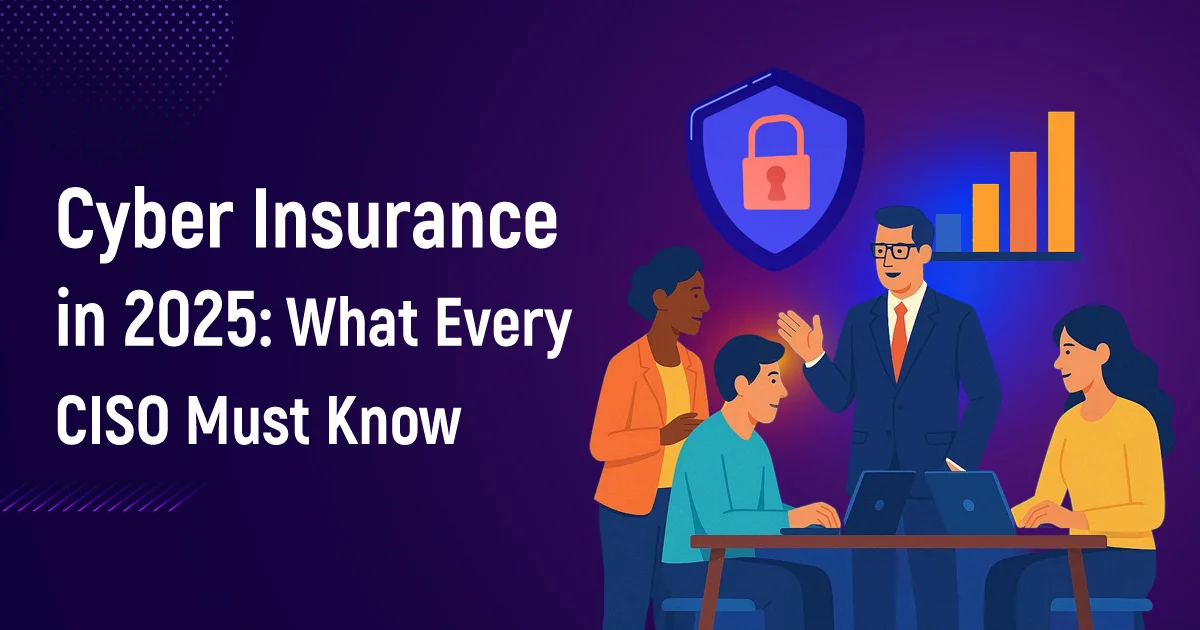
As digital risks multiply and enterprise environments become more complex, cyber insurance is fast becoming a critical pillar in every CISO’s cybersecurity strategy. No longer just a financial backup, it now plays a strategic role in risk assessment, compliance, and executive reporting.
Why Cyber Insurance Matters More Than Ever
Modern CISOs face rising threats—ransomware, supply chain attacks, insider risk, and regulatory fines. In this climate, cyber insurance does more than cover losses—it drives organizational maturity. Most insurers require strict preconditions like:
- Multi-Factor Authentication (MFA)
- Endpoint Detection and Response (EDR)
- Incident Response Plans
- Regular security audits

To extract value from cyber insurance (and get the best rates), CISOs must approach it strategically:
Assess Your Risk Landscape
Conduct a full-scale audit. Map out critical systems, third-party dependencies, data sensitivity, and exposure points. Knowing your risk is key to selecting the right coverage limits.
Align with Business Risk Appetite
Work with the CFO, legal, and board to understand which risks your company is willing to retain vs. transfer. This alignment guides smarter policy selection.
Understand Policy Scope and Exclusions
Not all incidents are covered equally. Some policies exclude:
- Nation-state attacks
- Third-party software breaches
- Data loss without clear attribution
Always review clauses around “acts of war,” ransomware thresholds, and breach notification timelines.
Evaluate Insurer Incident Response Capabilities
Fast payouts matter—but so does expert support. Choose insurers with a solid record in:
- Ransomware negotiations
- Digital forensics
- Breach communication
How Cyber Insurance Can Improve Security Posture
Insurance providers increasingly demand evidence of proactive defense. Use this to your advantage:
- Justify cybersecurity budgets by tying them to policy requirements.
- Prioritize foundational controls — like identity access policies, network segmentation, and log monitoring.
- Accelerate security projects that may have otherwise been deprioritized.
In effect, cyber insurance becomes a lever for internal security upgrades, not just a post-breach safety net.
Common Pitfalls CISOs Should Avoid
- Treating insurance as a substitute for security
- Applying without readiness (poor documentation, weak controls)
- Ignoring renewal processes — requirements change yearly
- Failing to loop in key stakeholders like legal, PR, or compliance
A CISO’s Role Beyond the Policy
Cyber insurance is not an IT checkbox. It’s a cross-functional risk tool that requires legal, financial, and technical alignment. Successful CISOs lead the charge in:
- Educating the board on insurance benefits and limitations.
- Running simulation drills to align response with policy terms.
- Keeping up with regulatory shifts that impact claims.
Final Thoughts
In 2026, cyber insurance is no longer optional—it’s strategic. It impacts compliance, reputation, and business continuity. As a CISO, embracing it early—and smartly—can be the difference between a controlled incident and a crisis.