The IT and SaaS sectors are the primary targets of the “identity-centric” and “API-first” attack era. In 2026, the traditional perimeter has completely vanished. SaaS platforms are now complex webs of interconnected APIs, third-party integrations, and automated AI agents. When an attack hits a SaaS provider, it isn’t just one company at risk, it’s the data and operations of thousands of downstream clients.
According to recent industry data, Broken Access Control and Security Misconfigurations remain the leading causes of breaches, while Software Supply Chain Failures have surged as attackers target the very code and libraries that build modern software.
Top IT & SaaS Cybersecurity Threats in 2026
The threat landscape has shifted from attacking servers to attacking the logic, identity, and integrations of the application.
API Abuse & BOLA (Broken Object Level Authorization)
APIs are the heartbeat of SaaS. Attackers manipulate object IDs in API requests to access unauthorized data, bypassing standard login screens entirely.
Shadow APIs and Improper Inventory
Forgotten “Zombie” or “Shadow” APIs, endpoints left behind during rapid development, are unpatched and offer easy entry for hackers.
Account Takeover (ATO) & Credential Stuffing
Automated bots use stolen credentials to flood login portals, targeting weak IAM (Identity & Access Management) protocols.
WAAP vs. Legacy WAF: Why the Difference Matters for SaaS Companies
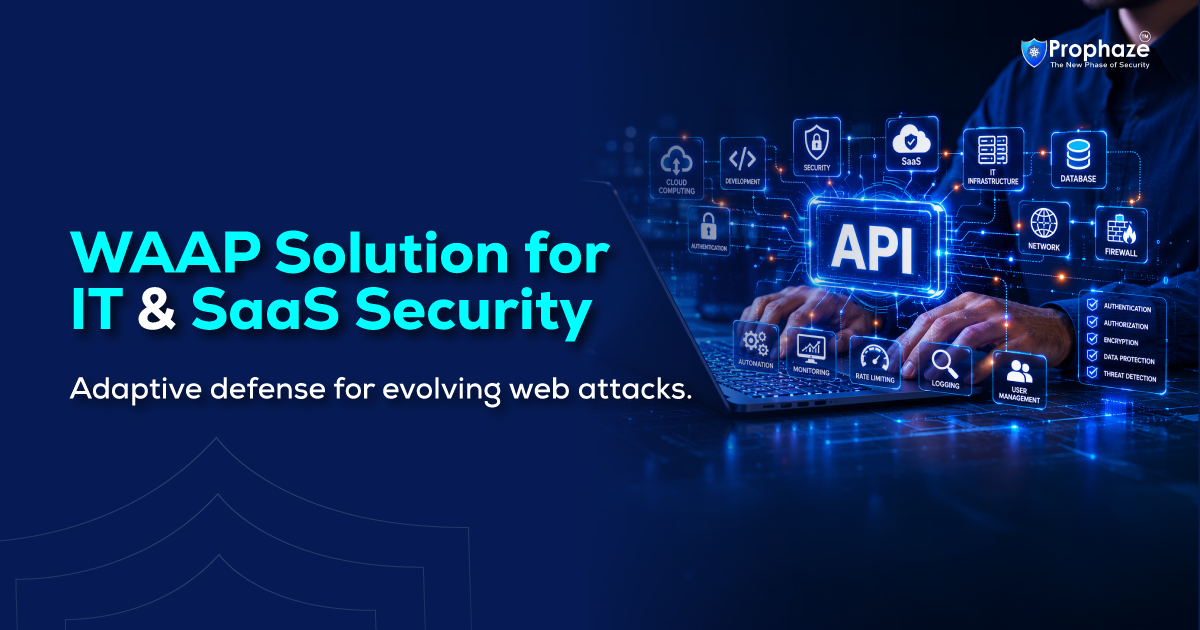
A traditional WAF matches known bad signatures. That worked when applications were static and attacks were predictable. Today’s SaaS environment is neither.
May 2026 Threat Update: The Week the SaaS Perimeter Collapsed
The first week of May 2026 made one thing clear, the modern attack surface is no longer your office network. It’s your software supply chain and your administrative APIs. Three incidents, three different vectors, one common thread: gaps that a WAAP would have closed.
Canvas LMS : When One Breach Becomes 8,800 Problems
The ShinyHunters attack on Canvas LMS didn’t just hit one company. It hit ~8,800 downstream institutions simultaneously. That’s the defining risk of SaaS interdependency, a single compromised platform instantly exposes every tenant built on top of it.
The root cause was API data exfiltration. Attackers pulled unauthorized data fields that a schema validation layer would have blocked at the edge. With Virtual Patching and API Cloaking in place, exploitation attempts can be stopped before they reach the application, buying security teams time to respond without a full shutdown.
cPanel Auth Bypass (CVE-2026-41940) : When Logic Is the Vulnerability
Ransomware groups didn’t need to brute-force their way into cPanel. They walked through a logic flaw. MSPs managing thousands of servers via administrative APIs were sitting ducks the moment that bypass was discovered.
This is where signature-based tools fail completely. There’s no “bad signature” to match when the attacker is technically authenticated. Behavioral analysis catches what signatures miss, an authenticated session suddenly executing administrative commands from an unknown location triggers an immediate block, regardless of how they got in.
Ubuntu Infrastructure DDoS : Volume as a Weapon
Layer 7 volumetric attacks don’t need a clever exploit. They just need scale. Adaptive rate limiting identifies and sheds malicious traffic in real time, keeping legitimate services online while the attack burns itself out.
Why These Incidents Prove a WAAP is Non-Negotiable in 2026
Q1 2026 Threat Deep Dive: Why SaaS Platforms Are Facing Unprecedented Threat Exposure
Prophaze’s Q1 data reveals exactly how attackers are getting in:
- 41.3% Injection Attacks (A03:2021): The #1 threat. Attackers are targeting customer-facing REST and GraphQL APIs, using SQL and LDAP probing across every accessible parameter.
- 28.1% Vulnerable Components (A06:2021): CI/CD pipelines are pulling dependencies without automated validation, allowing automated CVE scanning to find easy entry points.
- 20.5% Insecure Design (A04:2021): Authorization logic gaps are accumulating as microservices scale independently, creating parallel attack surfaces.
Check our recent threat analysis report to learn more
How Prophaze Protects IT and SaaS Application Security
Understanding the threat is one thing. Having the architecture to stop it is another. Is built for the high-velocity world of cloud-native development, not retrofitted for it.
Real-Time API Protection & Schema Validation
Every API request is validated against defined schemas to block malformed requests, BOLA attempts, injection probes, and unauthorized scraping before they reach the application.
Advanced Bot Mitigation
AI-driven behavioral analytics detect credential stuffing, scraping bots, and application-layer DDoS attacks in real time without impacting legitimate users.
Virtual Patching for Zero-Day Threats
Prophaze blocks exploitation attempts instantly at the WAAP layer while development teams work on permanent fixes in the background.
Security for Kubernetes & Cloud-Native Stacks
Native Kubernetes integration provides visibility into east-west traffic and internal service communication that traditional tools often miss.
Built for Modern DevSecOps Teams
Integrates with CI/CD pipelines, AWS, and Azure with sub-millisecond latency, flexible deployment models, and no code changes required.
For IT and SaaS organizations operating at cloud scale, Prophaze delivers the visibility, runtime protection, and operational flexibility needed to secure modern applications without slowing innovation.
Don't Let Your SaaS Be Next Week's Headline
In the high-stakes world of SaaS, instability is expensive. Whether it’s a surge in AI-driven phishing or a critical zero-day in your management console, Prophaze WAAP is built to neutralize the volatility of 2026. Our platform keeps your APIs locked down and your production services running, ensuring your reputation remains as resilient as your infrastructure.
- See how Prophaze handles SaaS Supply Chain Threats
Frequently Asked Questions (FAQ)
1. How does a WAAP differ from a traditional WAF in a SaaS environment?
A traditional WAF looks for known “bad” signatures. A WAAP (Web Application and API Protection) is purpose-built for APIs. It adds API discovery, schema validation, and behavioral analysis to stop advanced threats like BOLA and Layer 7 DDoS that traditional WAFs miss.
2. Can Prophaze protect us if one of our third-party libraries is compromised?
Yes. Prophaze identifies attacks targeting Vulnerable Components (which make up 28.1% of Q1 threats). By using virtual patching and runtime protection, Prophaze blocks the exploitation of that library even if the patch hasn’t been applied to your code yet.
3. Will implementing a WAAP slow down our application performance?
No. Prophaze is built on a high-performance, cloud-native architecture. It processes traffic with sub-millisecond latency, ensuring your SaaS platform remains fast while maintaining an Attack Density defense of over 84K hits per domain.