Artificial intelligence is no longer limited to generating responses or summarizing information. Modern AI systems are actively interacting with enterprise infrastructure, retrieving customer data, triggering workflows, updating records, orchestrating multi-step operations, and executing business-critical processes across APIs.
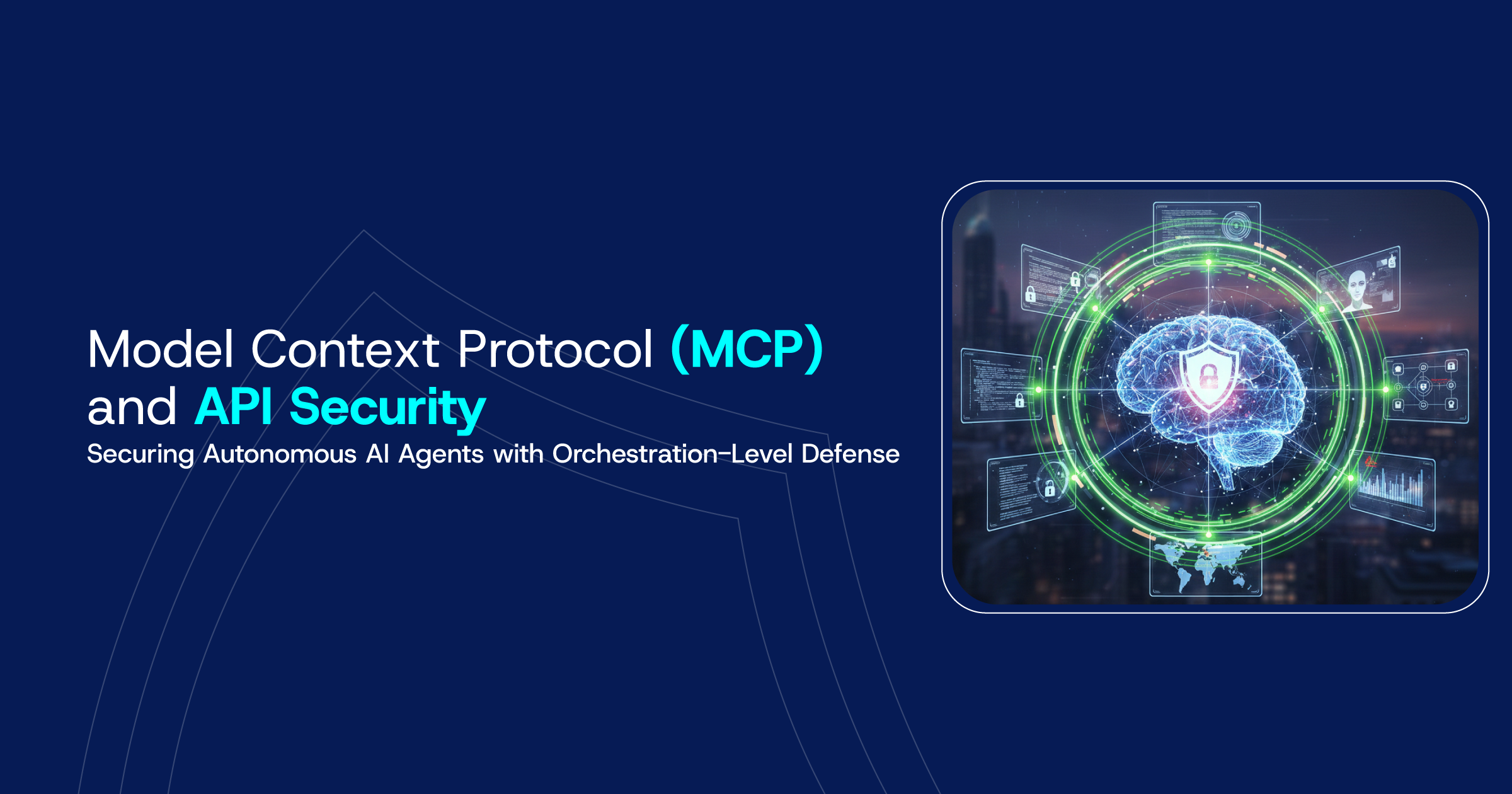
At the center of this evolution is the Model Context Protocol (MCP), a framework designed to standardize how large language models (LLMs) discover, interpret, and interact with external tools and APIs.
But while MCP accelerates enterprise AI integration, it also introduces a fundamental security shift:
MCP expands the API attack surface and moves risk from endpoints to orchestration.
MCP does not eliminate traditional API security. Instead, it builds on it by introducing new orchestration layers, persistent context, autonomous agents, and semantic execution flows that require a more advanced, agent-centric security model
Understanding the Model Context Protocol (MCP) Architecture
The Model Context Protocol acts as an abstraction and orchestration layer between AI models and enterprise systems. Instead of hardcoded integrations, MCP exposes APIs as structured tool definitions, enabling dynamic discovery and reasoning-based execution.
In a typical MCP architecture:
- Enterprise REST APIs continue to execute business logic.
- OAuth 2.1 manages authentication.
- Role-Based Access Control (RBAC) governs permissions.
- An MCP server wraps existing APIs into AI-readable tool manifests.
- The AI model selects and chains tools dynamically.
- Context is maintained across multiple interactions.
While APIs provide structured capabilities, MCP adds orchestration and contextual intelligence — shifting enterprises from deterministic API calls to dynamic, AI-driven execution paths that fundamentally alter the threat model.
Why MCP Fundamentally Alters the API Security Model
Traditional API security remains essential in MCP-driven systems. However, the operational model shifts significantly when AI agents and orchestration layers are introduced.
Traditional API security controls were designed for stateless, predictable, human- or application-driven interactions.
MCP environments introduce stateful, autonomous, and dynamically orchestrated workflows, which means security must evolve from simple endpoint inspection to orchestration-level, context-aware, and agent-centric protection.
How MCP Expands the API Attack Surface
1. Centralized Orchestration as a High-Value Target
In many deployments, the MCP server becomes a centralized orchestration hub. It may manage:
- Multiple delegated API access tokens
- Tool metadata definitions
- Persistent execution context
- Cross-system workflows
This creates credential aggregation. If compromised, they gain programmable access across integrated enterprise systems, not just a single API endpoint. The MCP layer effectively becomes a control plane for API-driven operations, increasing blast radius in the event of a breach.
2. Persistent Context as a Security Risk
Traditional APIs are stateless. Once a request completes, no memory of the transaction is retained. MCP environments maintain an evolving context that may include:
- Retrieved PII or regulated data
- Intermediate computation outputs
- Model reasoning traces
- Workflow states
- Authorization decisions
This persistence introduces new classes of vulnerabilities, including context poisoning, data leakage across sessions, historical data exposure, cross-step privilege escalation, and manipulation of future reasoning paths. In MCP security, protecting context integrity becomes as critical as protecting the underlying API endpoints.
3. Tool Manifest Exposure and Capability Enumeration
MCP implementations commonly use structured tool manifests that describe available capabilities, parameters, and execution methods. While this improves interoperability, it also creates a structured enumeration surface. Attackers may use exposed tool definitions to:
- Map backend capabilities
- Identify sensitive operations
- Infer privilege hierarchies
- Discover high-impact execution paths
Traditional API architectures often obscure internal endpoints. MCP formalizes them in machine-readable formats, increasing reconnaissance efficiency.
4. Multi-Tool Chaining and Workflow Compromise
AI agents frequently chain multiple tools in a single logical workflow. For example:
- Retrieve customer records
- Generate financial analysis
- Update billing systems
- Send notifications
- Log analytics events
If one step is compromised through prompt injection, manipulated output, or misconfigured permissions, downstream systems may be affected. Traditional API security evaluates individual requests. MCP security must validate entire execution sequences. Workflow integrity becomes a primary security requirement.
5. Blended Identities and Agent Privilege Risks
In MCP environments, AI agents often act on behalf of users while maintaining autonomous execution capability. This creates blended identities:
- Agents inherit user permissions.
- Agents operate asynchronously.
- Agents make independent decisions.
Traditional identity and access management models assume a clear distinction between human users and service accounts. MCP blurs this boundary. Security teams must evaluate not only authentication but behavioral alignment:
- Is the action consistent with user intent?
- Is privilege being amplified across tool chains?
- Is the agent operating within expected baselines?
AI-Specific Threat Models in MCP Environments
MCP introduces AI-native attack vectors that traditional API security cannot detect.
1. Prompt Injection
Attackers embed malicious instructions in user inputs or retrieved content, influencing agent reasoning. The resulting API calls may appear valid at the protocol level but originate from manipulated intent.
2. Tool Poisoning
Altering tool metadata can change how AI models interpret capabilities, potentially triggering unintended or sensitive operations.
3. Confused Deputy Attacks
An AI agent with legitimate permissions may be tricked into performing unauthorized actions due to manipulated context or misleading instructions.
4. Context Manipulation
Persistent state can be altered to influence downstream reasoning and execution decisions.
5. Agent Privilege Amplification
Chaining multiple permissions across systems can create unintended access patterns, even when individual permissions appear safe.
These vulnerabilities demonstrate why MCP security requires semantic awareness beyond traditional API inspection.
Why Traditional API Security Controls Are Not Enough
Traditional API security platforms were designed for deterministic, request-response architectures. Their primary focus is protecting endpoints from malformed requests, unauthorized access, and known exploit patterns.
Conventional API security mechanisms typically concentrate on:
- Request validation
- Token verification
- Rate limiting
- Signature detection
- Static authorization enforcement
While these controls remain necessary, they were built for predictable, stateless interactions initiated by humans or applications — not autonomous AI-driven orchestration layers.
MCP fundamentally changes this operating model.
1. Execution Sequences vs. Isolated Requests
Traditional API security evaluates individual requests in isolation. In MCP environments, however, security must assess full execution chains. AI agents frequently orchestrate multiple tools across systems in a single logical workflow.
Validating each request independently does not guarantee the integrity of the overall sequence. Security must evaluate whether the entire execution path aligns with policy and intent.
2. Context Integrity vs. Stateless Validation
APIs were originally designed to be stateless. MCP introduces persistent context that evolves across sessions and influences downstream reasoning.
Traditional controls cannot detect context poisoning, historical data manipulation, or subtle privilege shifts that occur across multi-step interactions. Protecting context integrity becomes as important as protecting transport layers.
3. Agent Reasoning Flows vs. Static Authorization
Static scopes and RBAC policies assume predictable access patterns. MCP agents, however, make reasoning-based decisions that dynamically select tools and combine permissions.
Authorization must adapt in real time to behavioral context. Static scopes cannot account for dynamic reasoning paths or cumulative privilege amplification across systems.
4. Cross-Tool Interactions vs. Endpoint Isolation
API gateways and WAFs inspect traffic at the perimeter or endpoint level. They do not analyze how multiple tools interact within an orchestrated workflow.
In MCP environments, a benign API call may become harmful when combined with downstream actions. Security must therefore monitor cross-tool interaction patterns rather than just individual endpoints.
5. Behavioral Anomalies vs. Signature Detection
Traditional security systems rely heavily on signature detection and known attack patterns. MCP-driven attacks often operate within legitimate API structures, making them invisible to signature-based tools.
Detecting anomalous agent behavior, reasoning drift, and intent manipulation requires behavioral analytics and semantic evaluation capabilities beyond conventional API inspection.
Building a Zero Trust Architecture for AI Agents
To secure Model Context Protocol environments effectively, organizations must expand their security architecture.
1. Strengthen Core API Foundations
Maintain strict OAuth 2.1 enforcement, fine-grained scopes, and robust token lifecycle management. APIs must remain hardened execution layers.
2. Enforce Tool-Level Least Privilege
Each tool should operate with minimal required permissions. Segmented credentials and isolated access boundaries reduce cascading risk.
3. Protect Persistent Context
Context storage should be encrypted, access-controlled, lifecycle-managed, and monitored for integrity violations. Sensitive data persistence should be minimized.
4. Implement Behavioral and Sequence Monitoring
Security systems must track tool invocation patterns, abnormal chaining behavior, cross-system privilege escalation attempts, and execution path deviations.
5. Enhance Observability and Auditing
Comprehensive telemetry across AI agents, tool usage, token consumption, and context mutation history enables detection and incident response.
From Endpoint Security to Orchestration Security
The most critical takeaway in understanding the connection between Model Context Protocol and API security is that the security boundary is moving upward.
In AI-driven enterprises:
- APIs remain foundational.
- But orchestration defines risk.
- Context defines exposure.
- Agent behavior defines impact.
Organizations that treat MCP as simply another integration layer risk underestimating its systemic implications. Those that adopt orchestration-centric, agent-aware security strategies will be better positioned to manage MCP vulnerabilities and secure AI-driven systems at scale.
Securing the Future of AI-Driven Enterprises
Model Context Protocol represents a powerful evolution in how AI systems interact with enterprise APIs. It enables dynamic tool discovery, multi-step orchestration, and persistent contextual reasoning — accelerating automation and integration.
However, it also expands the API attack surface by introducing credential concentration, context persistence risks, AI-specific vulnerabilities, and autonomous agent behavior.
MCP security does not replace API security. It extends it into new dimensions — semantic integrity, dynamic authorization, workflow validation, and orchestration protection.
As autonomous AI agents become embedded in enterprise operations, securing APIs alone will not be enough. Organizations must secure the agents and the orchestration layers that use them.