Kubernetes Web Application and API Protection (KWAAP) has become essential as traditional WAFs only secure the front door, while attackers increasingly exploit internal cluster communications that fall outside perimeter inspection. This API security blind spot in east-west traffic security quietly weakens the enterprise Kubernetes security posture, and is where modern breaches are increasingly emerging.
The Kubernetes Security Blind Spots Every CISO Must Understand
US enterprises are aggressively modernizing with Kubernetes. Applications are containerized. Monoliths are decomposed into microservices, and APIs are powering customer experiences. Multi-cloud and hybrid deployments are now the standard operating models. But as the infrastructure evolved, the security architecture often did not.
Most enterprise controls remain perimeter-based, optimized for north-south traffic entering and leaving the environment. Kubernetes clusters work differently. In modern deployments, most cluster communications flow east-west, including service-to-service, pod-to-pod, and namespace-to-namespace interactions that directly impact east-west traffic security.

That traffic rarely passes through your ingress WAF. In many environments, it receives little or no Layer 7 inspection at runtime. This structural imbalance leaves a significant portion of internal traffic without adequate runtime Kubernetes security coverage.
How Modern Kubernetes Breaches Actually Unfold In Real Time
Attackers no longer rely on noisy perimeter exploits. They take advantage of legitimate APIs and authenticated requests. Initial access can be through:
- Compromised Credentials
- Misconfigured Ingress rules
- Exposed internal endpoints
- Abuse of OAuth or Service Account Token
Once inside, the attacker pivots laterally to the microservices. The most active runtime risk vectors inside Kubernetes today include:
- Lateral movement between microservices
- Broken Object Level Authorization (BOLA)
- Token replay and service identity abuse
- Cross-namespace traversal
- Mass assignment exploitation
- Gradual API-driven data exfiltration
Because these attacks use valid tokens and syntactically correct requests, traditional WAFs and network-layer controls often fail to detect anything unusual.
They don’t break infrastructure. They exploit application logic.
In 2025, this risk is increasing due to two converging realities:
- APIs are now the primary enterprise attack surface.
- Kubernetes clusters expose more internal API endpoints than any previous architecture model.
Threat actors are no longer adopting legacy technologies. They are building Kubernetes-aware attack strategies designed to exploit East-West trust assumptions. Perimeter-only security models were never designed for this.
What is Kubernetes Web Application and API Protection (KWAAP)?
KWAAP stands for Kubernetes Web Application and API Protection.
This is not a traditional WAF product equipped with a helm chart. It is a purpose-built runtime security architecture designed to operate at the pod and node levels within a Kubernetes cluster, where modern vulnerabilities truly exist.
Instead of protecting only ingress traffic, Prophaze KWAAP embeds Layer 7 intelligence directly into cluster communications, providing continuous oversight across:
- North-south traffic
- East-West Service communication
- Cross-namespace calls
- Internal api activity
Security enforcement moves closer to the workload – not just the perimeter, strengthening the overall Kubernetes security posture through embedded runtime Kubernetes security controls..
How to deploy Prophaze KWAAP inside Kubernetes
Enterprise clusters vary in topology and maturity. Prophaze supports flexible deployment models individually or in combination.
1. Ingress Controller Integration
Layer 7 inspection at the ingress boundary. Malicious north-south payloads are blocked before they enter the cluster. And compatible with NGINX, Traefik, and HAProxy.
2. Sidecar-Based Protection
Deployed with specific pods to enable per-service east-west inspection. Identity-aware request analysis without requiring application code changes.
3. Daemonset Node-Level Coverage
A lightweight agent per node provides visibility into all pod traffic on that node. Complete east-west coverage with minimal overhead.
4. Hybrid and Multi-Cluster Management
Centralized policy enforcement across EKS, AKS, GKE, and on-premise clusters. Unified dashboard for enterprises running AWS, Azure, and GCP. Regardless of the deployment model, runtime security capabilities remain consistent. Determines model placement, not depth of inspection.
Core Runtime Capabilities Of Kubernetes Web Application And API Security
The strength of the Kubernetes WAAP platform lies in the depth of its runtime intelligence. Here’s a detailed look at the capabilities that make it effective.
This transforms Kubernetes security from static rule enforcement to adaptive runtime intelligence.
Why Does Data Exfiltration Look Different In Kubernetes
Traditional breach detection focuses on large outbound data transfers. Modern Kubernetes breaches rarely look like that.
Attackers often extract data slowly through internal APIs. Small, legitimate-looking requests are issued repeatedly over time. Every call respects authentication and schema rules. Traffic volume remains below abnormal limits. From an infrastructure perspective, nothing appears to be broken.
But at the application level, object access patterns deviate from established behavior. Prophaze KWAAP detects:
- Abnormal object enumeration
- Excessive data retrieval patterns
- Unusual cross-service access relationships
- Identity behavior inconsistencies

The result: Intrusion attempts are detected early during forensic review – not weeks later.
Understanding The Kubernetes Attack Chain Inside The Cluster
A realistic Kubernetes breach typically unfolds in stages:
1. Ingress Bypass
Initial access through misconfiguration, stolen credentials, or zero-day exploits.
2. Internal Api Enumeration
Discovery of undocumented endpoints and investigation of logic vulnerabilities.
3. Token Pivot
Service account tokens are intercepted and replayed to impersonate trusted services.
4. Privilege Escalation
Mass assignments or RBAC misconfigurations extend internal access rights.
5. Gradual Data Exfiltration
Sensitive data is extracted via legitimate internal APIs within days or weeks.

Stages two to five occur entirely inside the cluster boundary. A traditional WAF can assist in the first stage. But without east-west runtime inspection, the rest of the attack remains invisible.
From Fragmented Tools To Unified Kubernetes Web Application And API Protection
Many enterprises gradually try to overcome these shortcomings:
- Standalone or perimeter-focused Cloud-Native WAF deployments
- API gateway add-ons
- Individual bot mitigation tools
- Service mesh for mTLS
- Disconnected monitoring dashboards
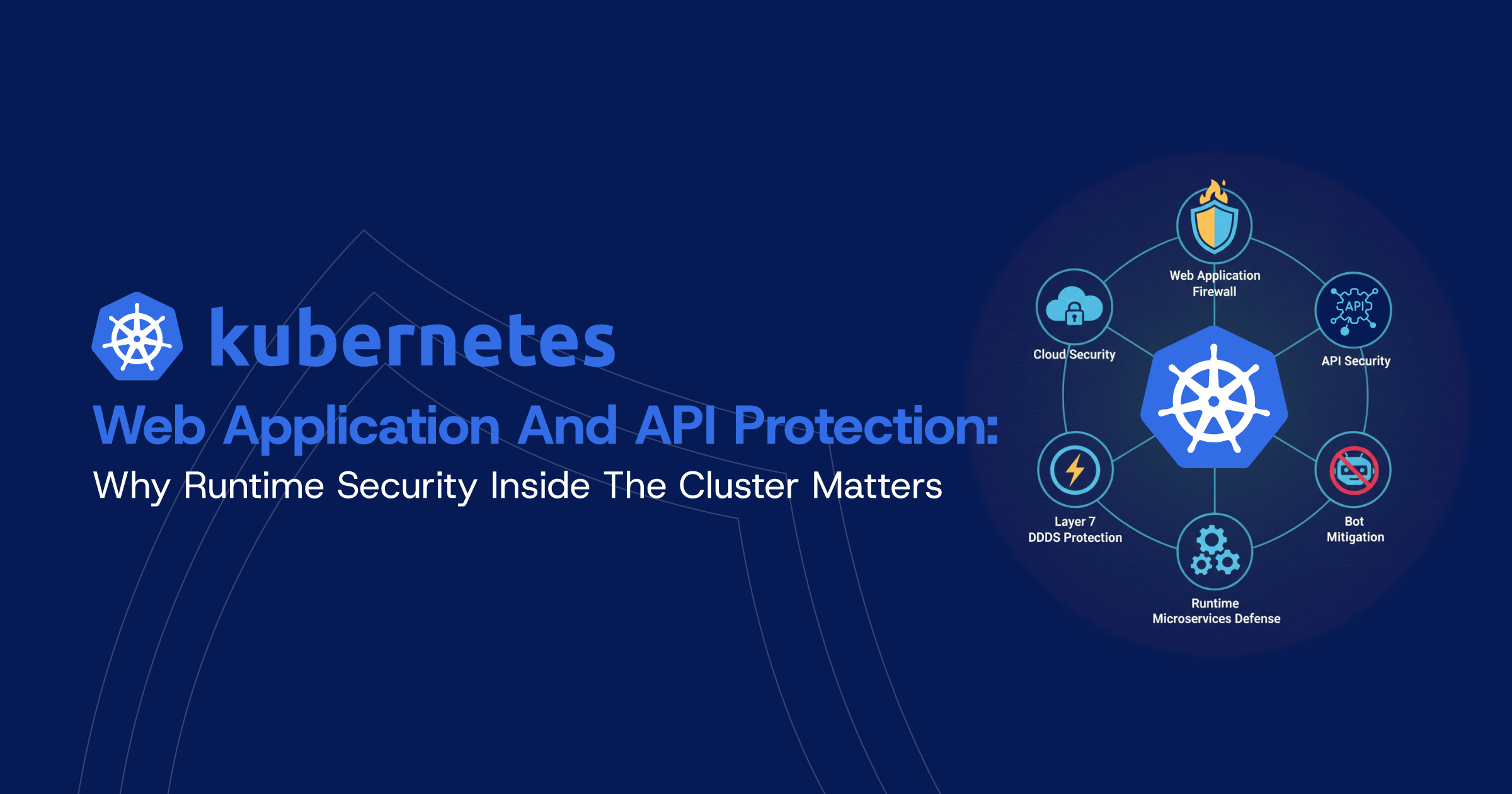
The result is fragmentation and complexity without comprehensive coverage. ProphaZe KWAAP integrates:
- Web Application Firewall
- API Security
- Bot Mitigation
- Layer 7 DDoS Protection
- Runtime Microservices Defense
All Kubernetes-native. One platform. One behavioral ML engine. One unified dashboard.
For CISOs, this translates directly into board-level results:
- Lateral movement prevention
- API-driven data exfiltration control
- Token abuse detection
- Security stack consolidation
- Reduced the total cost of security operations
Modern Kubernetes Security Requires Runtime Intelligence
Kubernetes has fundamentally changed how applications are built, deployed, and scaled, breaching the traditional perimeters that legacy security models were designed to protect. In enterprise environments across the US and Gulf region, particularly in financial services, healthcare, government, and critical infrastructure clusters, hundreds of internal APIs now run continuously across namespaces and nodes, with most east-west traffic never touching perimeter control.
Threat actors are actively exploiting this architectural change through lateral microservice movement, API privilege escalation, cross-namespace traversal, business logic misuse, and gradual data infiltration. These attacks target the structural gap between the locations where traditional WAFs perform inspection and where modern threats actually operate, making runtime Layer 7 visibility, behavioral intelligence, and internal API validation essential to securing cloud-native environments.
Strengthening east-west traffic security is now central to maintaining a resilient cloud-native environment.
The CISO Decision Framework
Security leaders evaluating Kubernetes security should ask whether their stack provides east-west Layer 7 inspection, continuous API discovery, behavioral baseline determination per microservice, real-time lateral movement prevention, and identity-aware token abuse monitoring. Without these capabilities, the overall Kubernetes security posture remains incomplete, and a large portion of the effective attack surface remains unmonitored.
A purpose-built Kubernetes Web Application and API Protection (KWAAP) platform deployed natively inside the cluster closes this gap by embedding runtime intelligence where modern threats reside, and Prophaze KWAAP consolidates WAF, API protection, bot mitigation, Layer 7 DDoS protection and microservices defense into a unified Kubernetes-native platform designed specifically for cloud-native architectures.

Take Control Of Your Kubernetes Security: Close The Gap With Prophaze KWAAP
Kubernetes modernization without runtime protection leaves significant risks inside the cluster. Prophaze KWAAP provides adaptive, AI-powered Kubernetes Web Application and API Protection, securing APIs, microservices, bots, and Layer 7 threats in distributed environments.
Protect the internal cluster traffic that perimeter tools never inspect.
Secure your runtime. Close the east-west blind spot. Strengthen your Kubernetes security posture today.
Frequently Asked Questions (FAQ)
1. What is Kubernetes Web Application and API Protection, and how is it different from a WAF?
A WAF inspects north south perimeter traffic. Kubernetes Web Application and API Protection extends protection inside the cluster by way of analyzing east-west service communication, discovering internal APIs, validating schemas, and detecting behavioral anomalies.
WAF protects the perimeter. KWAAP protects the interior.
2. Does Service Mesh replace Kubernetes WAAP with MTLS?
No, mTLS encrypts and authenticates traffic. KWAAP inspects the payload inside that encrypted channel.
mTLS verifies who is communicating. KWAAP verifies what is being sent.
3. Does Prophaze KWAAP require a sidecar in each pod?
No, Prophaze supports daemonset-based deployment or ingress controller integration without mandatory sidecar injection. This reduces overhead, proxy sprawl, and upgrade complexity.
4. Why can’t perimeter firewalls discover BOLA?
BOLA happens whilst an authenticated person accesses unauthorized items. Requests are legitimate and schema-compliant. Only behavioral baselining can discover unusual object access patterns.
5. When does protection become active?
Runtime inspection and schema validation are set off straight away after Helm deployment. Behavioral models refine over time. And no code modifications required.
6. Is Prophaze KWAAP available within the US and the Middle East?
Yes. Prophaze supports deployments throughout the USA and the Middle East with AWS, Azure, and GCP compatibility and centralized policy management.