Introduction
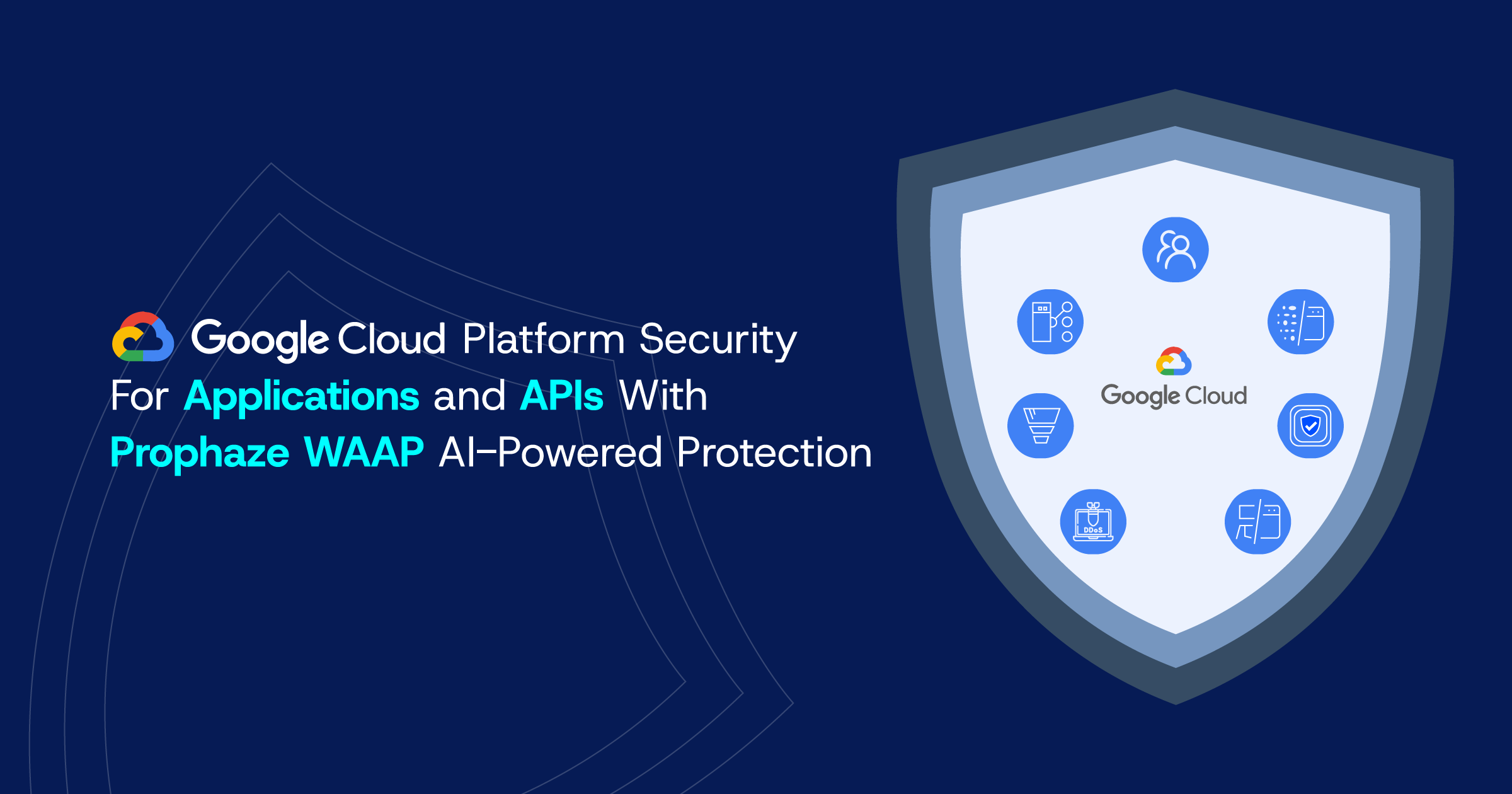
Google Cloud Armor secures your infrastructure perimeter. But modern APIs, GKE workloads, and microservices require much more than rule-based filtering. They require behavioral intelligence. Prophaze WAAP on GCP provides a seamless, AI-powered runtime security layer built for cloud-native environments. It integrates behavioral detection, advanced bot mitigation, continuous API discovery, and full OWASP API Top 10 security, closing runtime security gaps that perimeter control alone cannot address. This approach strengthens Google Cloud Platform security by providing a unified, cloud native WAAP for GCP that protects APIs, microservices, and Kubernetes workloads in real-time. As organizations expand modern applications, AI-powered WAAP becomes essential to maintaining runtime API security in GCP environments and strengthening overall Google Cloud Platform security.
Learn more about our dedicated Prophaze GCP cloud security platform, designed specifically to protect Google Cloud applications and APIs.
As organizations move into GKE, Cloud Run, and APG, the risk shifts from infrastructure to application behavior. And this is where traditional WAF controls start to lose visibility. In this article, we explain why native controls are not enough without add-ons and how Prophaze WAAP strengthens runtime security and runtime API security in GCP for cloud-native environments.
Understanding the GCP Application-Layer Security Gap
WAAP solutions are becoming essential as organizations face Google Cloud security limitations at the application level. While Google Cloud offers strong infrastructure security and native WAF capabilities through Cloud Armor, many enterprises require a broader cloud-native WAAP for GCP to fully protect modern APIs, microservices, and Kubernetes workloads.
Google itself recognizes this: its own architecture document recommends WAAP, combining Cloud Armor, ReCAPTCHA Enterprise, and Apigee for enterprise use cases, where API calls originate from websites and mobile applications. The first point of contact in a WAAP solution is Cloud Armor; If none of its configured rules are triggered, the request is evaluated by reCAPTCHA Enterprise before proceeding to the API. But this native stack also has shortcomings that platforms like Prophaze WAAP are designed to close.
In real-world cloud-native environments, organizations running workloads on GKE, cloud runs, and load-balanced applications face persistent threats that must be addressed with adaptive, AI-powered defense, not just static rule enforcement:
- Rapidly scaling API surfaces – Dynamic endpoints created by microservice deployments change faster than policy updates
- Deprecated or shadow API - remaining publicly accessible without visibility
- Advanced bot attacks – which rotate IPs, use residential proxies, and mimic human interaction
- Business logic abuse – using valid authenticated requests invisible to signature-based rules
- Rule fatigue – manual WAF tuning, false-positive analysis, and policy revalidation during each deployment
- The Core Gap
Static rule sets and signature-based detection struggle in environments where APIs are constantly changing. As more organizations accelerate their digital transformation journey and business processes become more dependent on digital interactions, the need for heightened levels of security and protection has increased significantly. Security must adapt to application behavior, not just block known signatures. This is important for GCP application security.
This security gap directly impacts Google Cloud API security and exposes vulnerabilities in GCP application security strategies that rely solely on perimeter enforcement.
Why Cloud Armor Alone Isn’t Enough For GKE And Cloud Run APIs
Expanding API Attack Surface
As GCP services grow, the exposed API endpoints multiply. Google Cloud’s Advanced API Protection detects undocumented and unmanaged APIs connected to Google Cloud L7 load balancers, regularly assesses managed APIs, and exposes proxies that don’t meet security standards. But even with these tools, APIs face risks that require behavioral analysis beyond rule matching, notably the OWASP Top 10 API Security, which includes broken object-level authorization (BOLA), excessive data exposure, injection attacks, and business logic misuse. Without continuous discovery and runtime validation, visibility gaps persist.

Bot-induced abuse beyond reCAPTCHA
Today’s bots targeting Google Cloud workloads are highly sophisticated, rotating IPs, using residential proxies, replaying sessions, and mimicking human behavior to attack login APIs, checkout flows, and account recovery endpoints while staying below volumetric DDoS thresholds.
Google reCAPTCHA Enterprise uses AI/ML-powered, score-based behavioral analytics to detect account takeover and credential stuffing attempts with minimal user friction. However, it is licensed separately from Cloud Armor and requires independent integration.
As bots increasingly target API workflows and authenticated sessions, organizations need not just challenge-based verification, but continuous runtime-level behavior enforcement across APIs and microservices.
Rule Fatigue And Operational Overhead
Managing Cloud Armor policies at scale involves ongoing rule tuning, false-positive analysis, and policy revalidation with every deployment, keeping security teams in reactive mode.
Google Cloud Armor offers Enterprise Adaptive Protection, which uses machine learning to baseline traffic and can suggest or auto-deploy mitigation rules. However, this capability is limited to the enterprise level. When combined with reCAPTCHA Enterprise, Apigee, and Service Mesh, organizations must manage multiple products and configurations, adding operational complexity in fast-moving GKE and Cloud Run environments.
To better understand how Prophaze WAAP on GCP enhances Google Cloud Platform security, the comparison below explains how integrated AI-powered WAAP differs from modular controls.
Google Cloud offers advanced security capabilities across several products, including Cloud Armor, reCAPTCHA Enterprise, APG Advanced API Security, Adaptive Protection (Enterprise tier), and Cloud Service Mesh. However, these components require separate configuration, integration, and licensing.
Prophaze consolidates these capabilities within a single WAAP platform. We provide these capabilities while simplifying both security architecture and cost control without the need for separate enterprise-level upgrades, multiple SKU management, or cross-product billing coordination.
The Architectural Differences: Modular Vs Unified WAAP
Google Cloud offers powerful security building blocks, Cloud Armor, reCAPTCHA Enterprise, Apigee Advanced API Security, Adaptive Protection, and Cloud Service Mesh, each addressing specific threat vectors.
However, these capabilities are distributed across multiple products, enterprise tiers, and billing models. Integration, cross-product visibility, policy alignment, and operational management are the responsibility of the customer.
Prophaze WAAP provides a seamless, AI-powered runtime enforcement layer that integrates:
- Web Application Firewall (WAF)
- Full OWASP API Top 10 Security
- Continuous API Discovery
- Behavioral bot mitigation
- Per-endpoint anomaly detection
- Layer 7 DDoS Protection
One platform. One console. One operational model.
A single console. A single policy framework. A single adaptive learning engine. A single deployment path across GKE, Cloud Run, and API workloads. Instead of coordinating multiple dashboards, rules engines, and service layers, security teams operate under a unified runtime enforcement layer.
Prophaze WAAP: Eliminating Fragmentation in GCP Application Security
Prophaze WAAP Security Platform for Web and API Defense is a fully managed, integrated, cloud-native application security platform designed for enterprises running mission-critical workloads on Google Cloud Platform. Instead of tying together multiple security services, Prophaze integrates WAF, API security, behavioral bot mitigation, Layer 7 DDoS protection, and runtime anomaly detection through a single enforcement layer.
Designed for an API-first and microservices architecture on Google Cloud, Prophaze provides continuous exposed API discovery, behavioral threat detection, and unified security visibility.
Unlike traditional WAF solutions, Prophaze continuously validates security decisions to reduce false positives, shifting security from reactive rule tuning to adaptive prevention while protecting against DDoS attacks, malicious bots, OWASP Top 10, OWASP API Top 10, and zero-day attack techniques.
How Prophaze Strengthens Native GCP With The WAAP Stack
Prophaze WAAP on GCP does not replace Google Cloud Armor. It acts as an intelligent runtime layer that integrates APIs, bots, and behavioral threat detection in a Cloud Armor-protected environment without the need for product-level upgrades or multi-service orchestration.
Eliminating Runtime Security Gaps On GCP With Prophaze WAAP
Modern Google Cloud workloads face dynamic threats that traditional WAF and rules-based controls cannot fully address. Credential stuffing, API abuse, and automation-driven attacks often fail, leaving runtime traffic invisible. Prophaze WAAP proactively monitors and protects applications and APIs in real-time, preventing breaches before they impact your environment.
In high-growth GCP environments, these differences translate directly into revenue loss, compliance risk, and operational downtime.
By shifting security from reactive rules to AI-powered runtime enforcement, Prophaze WAAP ensures that your APIs and applications are continuously monitored, preventing real-time breaches while reducing false positives and operational overhead.
Rising Security Threats In Retail, Finance, And Healthcare On GCP
These risks make AI-powered WAAP increasingly central to modern GCP application security strategies. In retail, finance, and healthcare, strengthening Google Cloud API security and GCP Kubernetes security is becoming increasingly important as attacks increasingly target runtime behavior rather than infrastructure.
Runtime API visibility and behavioral enforcement are becoming essential to reduce risk and ensure regulatory alignment.
Prophaze WAAP Seamless Integration with Google Cloud Architecture
Prophaze WAAP integrates directly into the Google Cloud services your team uses without disrupting existing architecture. All HTTP(S) requests are sent to an external application load balancer, with the first point of contact being Cloud Armor; Prophaze’s behavioral layer slots in after Cloud Armor’s rule evaluation and before requests reach Apigee or backend services.
- Google Cloud External Application Load Balancers
- Cloud Armor-protected deployments that improve rule enforcement using adaptive machine learning
- GKE ingress controllers, including configurations based on NGINX and Envoy
- Cloud Run services that secure serverless API endpoints
- Backends on Apigee that enhance API management with behavioral security
- Zero-Disruption Deployment
No code changes. No architectural redesign. No DNS re-routing. No downtime. Security enforcement occurs at the application level, which aligns with existing Google Cloud traffic flows. Most enterprises can deploy Prophaze WAAP in minutes without code changes or architectural redesign, accelerating security across GKE, Cloud Runs, and API workloads. This deployment model ensures that Google Cloud Platform security remains consistent when extending Cloud Native WAAP for GCP across APIs and microservices.
- Why High-Growth GCP Teams Adopt WAAP
Most organizations consider having an advanced WAAP only after a breach, a bot-driven revenue loss, compliance audit findings, or account compromises. By then, the damage has already been done. Prophaze enables proactive, adaptive security built for modern Google Cloud workloads, shifting security from a reactive cost center to a competitive advantage.
How Prophaze Integrates With Google Cloud Architecture
Prophaze WAAP integrates directly into the Google Cloud services your team uses without disrupting existing architecture. All HTTP(S) requests are sent to an external application load balancer, with the first point of contact being Cloud Armor; Prophaze’s behavioral layer slots in after Cloud Armor’s rule evaluation and before requests reach Apigee or backend services.
Integration Flow
- Traffic is directed to the Google Cloud External Application Load Balancer.
- Cloud Armor assesses the configured Layer 7 rules.
- Prophaze WAAP conducts behavioral and API-level inspections.
- Clean traffic is then forwarded to GKE, Cloud Run, or Apigee backends.
Deployment Model
- No code changes are required.
- No DNS rerouting is necessary.
- No architectural redesign is needed.
- No developer-side modifications are required.
- This solution is compatible with GKE ingress controllers, Cloud Run services, and Apigee-managed APIs.

Most enterprises will be able to complete deployment in approximately 15 minutes, allowing for quick security without service disruption. Prophaze provides 24×7 managed support to assist with onboarding, tuning, and ongoing policy customization.
This model strengthens runtime API security in GCP while preserving existing Google Cloud configurations.
How To Increase Security On Google Cloud Using WAAP Solutions
Enhancing Google Cloud API security requires more than enabling Cloud Armor rules. From our experience securing GCP environments at large scale, modern WAAP for Google Cloud Platform must combine rules-based filtering with behavioral threat detection, continuous API discovery, and runtime validation in GKE, Cloud Run, and Apigee.
Organizations that successfully secure APIs in Google Cloud adopt a layered model: Cloud Armor provides perimeter enforcement, while Prophaze WAAP monitors API behavior in real-time, detecting abuse that static rules cannot.

Essential WAAP Features for Cloud-Native Applications
An effective WAAP for Google Cloud Platform must extend beyond perimeter rules and provide runtime API security in GCP through behavioral intelligence and continuous validation. Cloud-native environments demand more than signature-based filtering. Effective GCP application security should include:
- Comprehensive OWASP API Top 10 protection
- Ongoing API discovery and defense
- Session-level prevention of API abuse
- Inspection of east-west traffic in GKE
- Machine learning-based anomaly detection for each endpoint
- Centralized logging for compliance
Enterprises that treat these capabilities as optional extensions rather than integrated requirements often discover deficiencies only after an incident or audit finding. These are not optional in the modern threat environment. Without these capabilities, organizations lack true cloud-native runtime security and are exposed to behavioral threats.
The Bottom Line: From Modular Control To Unified Runtime Security On GCP
Google Cloud Platform Security is infrastructure-robust, but requires modern AI-powered WAAP to secure dynamic APIs, Kubernetes workloads, and evolving cloud-native applications. But application-layer security, where modern breaches occur, requires:
- Behavioral Intelligence
- Continuous Visibility
- Adaptive Identity
- Managed Expertise
Prophaze provides a seamless, AI-powered WAAP platform that unifies WAF, API security, behavioral bot mitigation, DDoS protection, runtime anomaly detection, and compliance visibility into a single enforcement layer, eliminating the need to tie together multiple security products across different tiers and SKUs.
Modern Google Cloud environments don’t fail because the infrastructure is weak; They fail when runtime behavior is not monitored, and security controls are fragmented across multiple tools, tiers, and dashboards. Differing licensing models, enterprise add-ons, and cross-product configurations introduce operational fatigue and policy drift. Integrated, AI-powered WAAP is no longer an enhancement; It is becoming the security baseline for cloud-native applications.
If your current GCP security strategy relies on coordinating multiple products, enterprise tiers, and multiple independent dashboards, you may already be operating under a fragmented architecture.
Evaluate whether your Google Cloud security architecture is integrated or fragmented across multiple products and tiers.
Frequently Asked Questions (FAQ)
1. What Is WAAP For Google Cloud Platform, And How Is It Different From Cloud Armor?
Cloud Armor provides rules-based Layer 7 perimeter enforcement on the load balancer. WAAP for Google Cloud Platform enhances Google Cloud Platform security by adding AI-powered WAAP capabilities like runtime API security in GCP, behavioral bot mitigation, and continuous API discovery to GCP. Prophaze delivers these capabilities as a unified AI-powered enforcement layer, rather than distributed across separate products and enterprise tiers.
2. Does Prophaze replace Google Cloud Armor?
No, Cloud Armor remains the first enforcement point in the architecture. Prophaze builds on top of this, including behavioral intelligence, API visibility, and adaptive runtime threat detection across GKE, Cloud Run, and Apigee environments.
3. How Is Prophaze Different From Using Cloud Armor, Recaptcha Enterprise, And Apigee Together?
Google Cloud offers robust, modular security components. However, bot mitigation, advanced API security, adaptive security, and service mesh inspection are delivered across different products, configurations, and licensing models.
Prophaze integrates these capabilities into a unified WAAP platform, minimizing SKU stacking, simplifying cross-product policy management, and reducing operational fragmentation.
4. What API threats does Prophaze protect against?
Prophaze provides protection against all OWASP API Top 10 vulnerabilities, including broken object-level authorization (BOLA), broken authentication, excessive data exposure, business logic abuse, and security misconfiguration. This is achieved through continuous API discovery, schema validation, and behavioral machine learning at the endpoint level.
5. Why is advanced bot protection needed beyond reCAPTCHA?
Google reCAPTCHA Enterprise offers robust, AI-driven, score-based detection for account takeovers and credential stuffing, all while keeping user friction to a minimum. However, it functions as a separate product from Cloud Armor, requiring independent integration. As bots increasingly target API workflows, authenticated sessions, and business logic, organizations need continuous runtime behavioral enforcement combined with API inspection. A unified Web Application and API Protection (WAAP) platform provides this capability within a single enforcement layer.
6. Can Prophaze be deployed without architectural changes?
Prophaze integrates seamlessly after Cloud Armor enforcement and before backend services. It supports GKE ingress controllers, Cloud Run workloads, and Apigee-managed APIs. Deployment requires no code changes, DNS rerouting, or architectural redesign, allowing most enterprises to achieve protection within minutes.