What Is the DPDP Act of India
India’s Digital Personal Data Protection Act (DPDP Act) marks a fundamental shift in the way organizations collect, process, secure, and control personal data. With the notification of DPDP Rules 2025, compliance is no longer theoretical, it is operational, enforceable, and time-bound.
The Digital Personal Data Protection Act of India is the country’s first comprehensive data protection law governing the processing of digital personal data. It requires organizations to treat personal data as a regulated asset collected for defined purposes, processed lawfully, kept secure consistently, and deleted when no longer needed.
Inspired by global frameworks like GDPR and CCPA, the DPDP Act is tailored for India’s digital-first ecosystem, where apps, APIs, cloud platforms, and large-scale data processing are the backbone of business operations.
DPDP Rules 2025 and Core Compliance Requirements
The DPDP Rules 2025 operationalize the Act by defining how compliance should be enforced. They introduce enforceable obligations around:
- Lawful and verifiable consent
- Purpose limitation
- Data Minimization and Retention
- Proper security measures
- Breach detection and reporting
- User (Data Principal) Rights Management
Under the DPDP framework, compliance is not achieved through policies alone it must be embedded in the system architecture.
Why Was the DPDP Act Introduced?
India’s digital economy processes personal data on a large scale in banking, healthcare, telecom, e-commerce, SaaS, logistics, gaming, and public services. Before the DPDP, data protection obligations were fragmented.
The DPDP Act was introduced:
- Build confidence in India’s digital economy
- Prevent misuse and unauthorized display of personal data
- Standardize consent, governance, and retention practices
- Implement modern cybersecurity safeguards
- Provide individuals with clear rights (data principals)
How Is the DPDP Act Applicability Enforced in India
One of the unique features of the DPDP Act applicability is its phased enforcement model. Rather than burden organizations with immediate compliance requirements, the Ministry of Electronics and Information Technology (MeitY) has carefully designed a timeline that allows companies to prepare their systems, policies, teams, and technologies for DPDP compliance requirements.
These include:
- Startups and SMEs
- Enterprises and Multinational Companies
- SaaS Platform and B2B Provider
- Public Sector and Government-Related Institutions
The most affected industries include BFSI, healthcare, telecom, e-commerce, edtech, OTT platforms, mobility, logistics, manufacturing and hospitality.
How Does Phased Enforcement Work Under DPDP Rules 2025
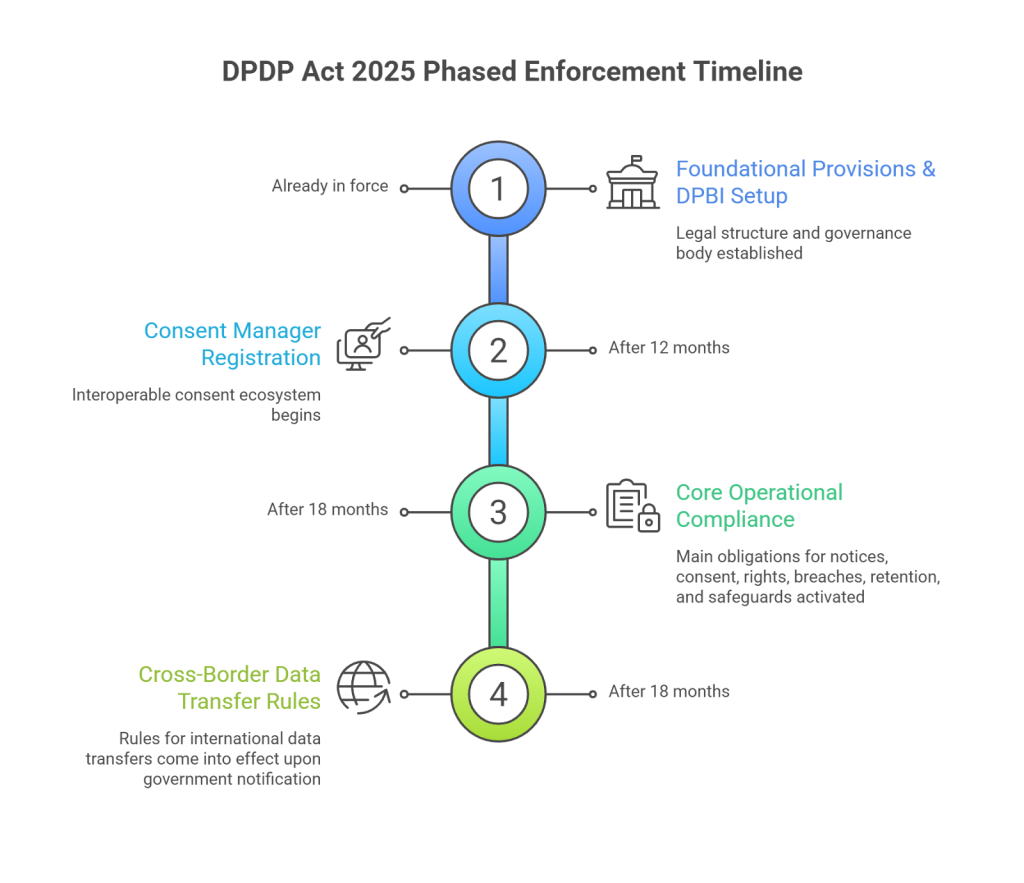
The phased rollout reflects a realistic, implementation-friendly approach, allowing companies to progressively build their compliance capabilities.
What Counts as Personal Data Under the DPDP Act?
Personal data includes any information that directly or indirectly identifies or can identify an individual, such as:
- Name, phone number, email address
- IP address and device identifier
- Cookies and Analytics Identifiers
- Financial and transaction data
- Health and medical information
- Behavior and usage data
As a result, even basic website analytics and application logs may fall within DPDP applicability.
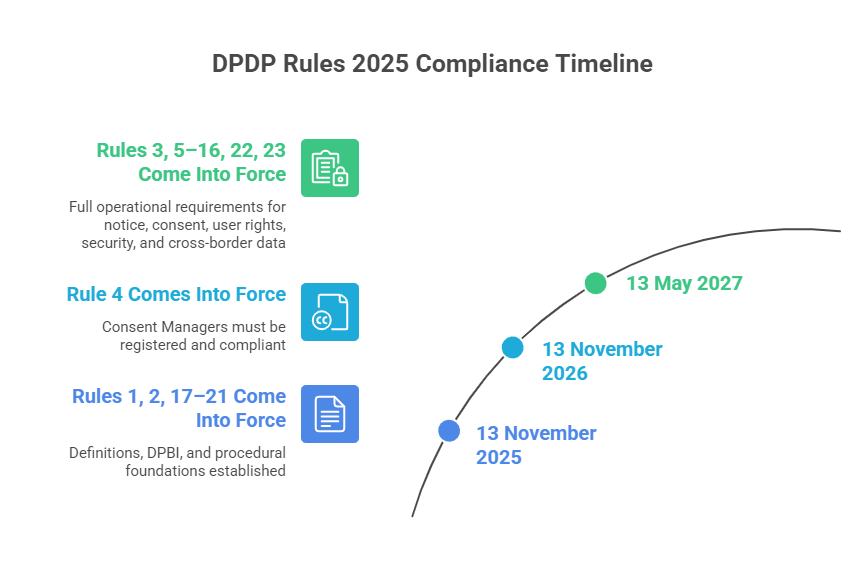
DPDP Compliance Timeline Under DPDP Rules 2025
DPDP Penalties in India
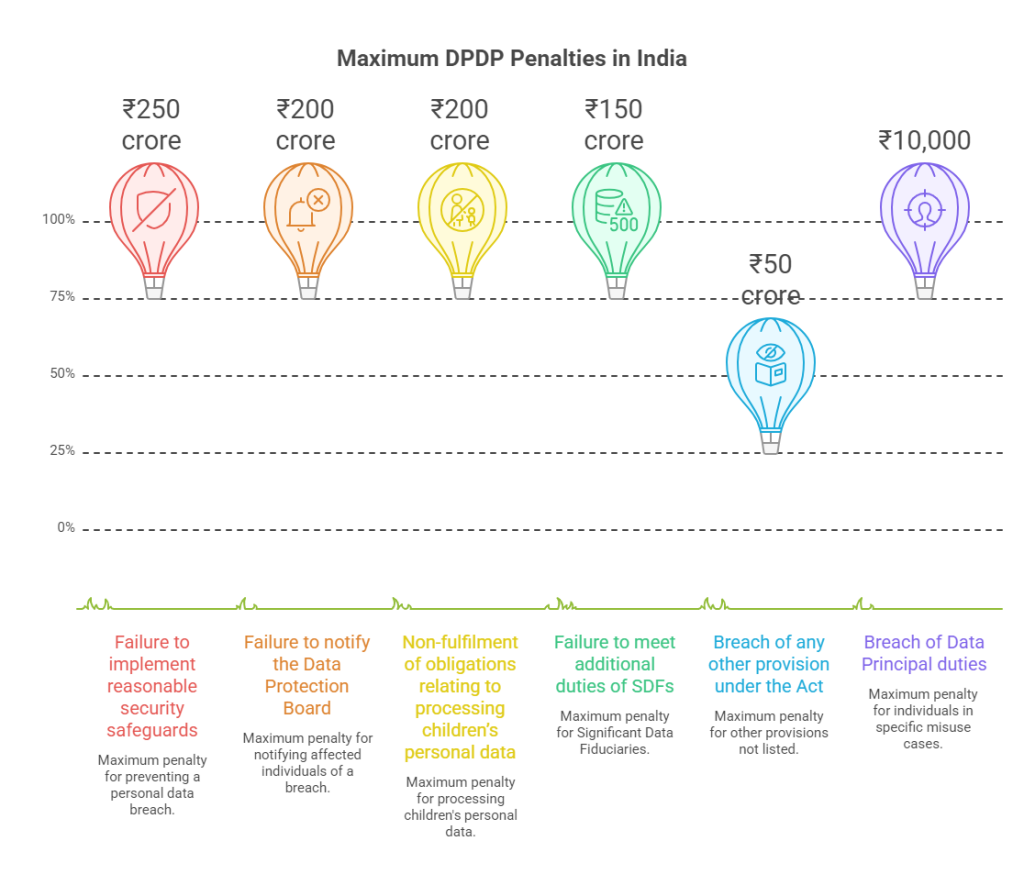
How Are DPDP Penalties in India Applied in Practice?
It is important to note that this is a maximum fine limit, not a fixed fine. The Digital Personal Data Protection Act clearly states that the Data Protection Board of India (DPBI) will determine the actual penalty amount only after conducting an official investigation. It is also important to note that DPDP penalties are not automatic , the Board must consider several factors before deciding on a penalty, including:
- Nature and seriousness of the violation
- Type and sensitivity of personal data involved
- Period of violation or non-compliance
- Whether the violation was repeated or intentional
- The extent of harm caused to individuals
- Has the organization taken appropriate preventive or mitigation steps
- Actions taken by the data fiduciary to mitigate the impact and prevent recurrence
The Act also specifies that all penalties imposed by the Board are deposited in the Consolidated Fund of India, emphasizing the seriousness and statutory nature of the enforcement framework
Are the DPDP Rules Already in Effect?
The Urgent Reality: The Rules Are Active, and the Compliance Clock Is Running
Yes, the DPDP Rules 2025 came into force after their notification in November 2025, and the DPDP Act applicability is already in force with a transition period. Organizations have an eighteen-month transition period until May 13, 2027, to complete DPDP compliance requirements, the implementation is expected to begin immediately.
This window is to create technical, organizational, and governance controls, not to delay action. Non-compliance under the DPDP framework poses significant financial and reputational risks. The Data Protection Board of India can impose substantial penalties for failures such as inadequate security safeguards, delayed breach reporting, or misuse of protected data. In addition to fines, violations can trigger mandatory disclosures, operational disruption, and long-term loss of customer confidence.
As organizations move from policy awareness to implementation, several important questions emerge:
- Do we have clear visibility into where personal data resides across applications, APIs, logs, backups, and cloud environments?
- Can we reliably enforce purpose-specific and granular consensus across systems?
- Are encryption, access controls, monitoring, and governance applied consistently throughout the data lifecycle?
- If a system is compromised, can we demonstrate that personal data remains secure and auditable?
- Are we operationally ready to respect data principal rights, such as access and deletion, while being audit ready?
Under the DPDP Act, failure to implement appropriate security safeguards is considered a serious violation and can attract some of the highest penalties prescribed under the law. These provisions are designed to push organizations toward continuous, system-level data security rather than reactive fixes or last-minute compliance efforts.
How Can Organisations Build DPDP Compliance Requirements by Design
Consistently meeting DPDP requirements requires more than policies and documentation. This demands security controls that operate continuously across applications, APIs, cloud workloads, and data flows.
We support organizations in creating DPDP-aligned security architectures by securing the surfaces where personal data is collected, processed and transmitted. Through integrated application security, API security, bot mitigation, and cloud workload defense, organizations can reduce the risk of breaches while maintaining real-time visibility into data access and activity.
By combining continuous traffic monitoring, behavioral threat detection, and centralized logging, we help organizations demonstrate proper security safeguards in practice, not just in audits. This approach enables faster breach detection, stronger data security and audit-ready evidence trails, turning DPDP compliance into an operational outcome rather than a recurring compliance fire drill.
Who Must Comply Under the DPDP Act Applicability
DPDP Act applicability applies to every organization regardless of size, sector or geography as long as it processes personal data of individuals in India. This includes startups handling a few thousand users, multinational companies processing millions of customer records, and public sector institutions managing citizen data.
Industries like BFSI, healthcare, telecom, e-commerce, edtech, OTT, mobility, logistics, government service providers, hospitality, and manufacturing are particularly affected as they handle large amounts of personal data. But smaller software companies or B2B platforms also have to comply if they store or process data like names, phone numbers, emails or IP addresses.
What Counts as Personal Data Under the DPDP Act of India
Under the DPDP Act, personal data is defined broadly. This includes any information that directly or indirectly identifies an individual. This includes obvious identifiers like name and phone number, but also behavioral data, device identifiers, financial data, medical information, cookies, and analytics tokens. As a result of this, the DPDP Act applicability is extremely broad.
Since almost every modern business collects some form of identifiable data, even simple website analytics, the DPDP Act applies far more broadly to most organizations than before.
What Are the Privacy Notice DPDP Compliance Requirements
Organizations must provide clear, easy-to-understand privacy notices that clearly explain what data is being collected, why it is collected, how it will be used, how long it will be stored, whether it will be shared, and how users can withdraw consent or exercise their rights. Unlike traditional privacy policies, DPDP notices should be simple, accessible, and ideally available in multiple Indian languages. They should be shown up front, not hidden in footers or lengthy documents, and updated regularly as data practices evolve.
How Does Consent Work Under DPDP Rules 2025
Consent must be a clear affirmative action under the DPDP Act. Previously ticked boxes, unclear permissions, or tacit consent are no longer valid. Users should be clearly told what purposes their data will serve, and they should have the ability to withdraw consent at any time, easily and without penalty. Importantly, businesses must maintain verifiable logs of each consent and withdrawal, which creates a strong reliance on proper logging and monitoring systems.
Children’s Data Protection Under DPDP Act
The DPDP Act imposes strict restrictions on the processing of children’s data. Organizations must verify the age of users and obtain parental consent before processing children’s personal data. They also cannot engage in behavioral tracking, profiling, or targeted advertising of children. Edtech platforms, gaming companies, content apps, and online communities will need to create age-verification workflows, redesign onboarding processes, and ensure that children are not subject to covert tracking.
Reasonable Security Safeguards Under DPDP
This is one of the most important sections of the DPDP Act, and where cybersecurity platforms become essential. Organizations should adopt appropriate technical and organizational safeguards to prevent personal data breaches. This includes encryption, access control, authentication, application security, event detection, API governance, logging, backups, and more. They are essential to meet DPDP compliance requirements.
Importantly, the law does not prescribe specific equipment; This simply requires organizations to meet the baseline of modern cyber hygiene. This is where application security, WAF, API security, bot management, and cloud workload security systems naturally fit into the compliance ecosystem.
What Are the DPDP Breach Reporting Obligations
The DPDP Act requires companies to detect breaches and immediately report them to both the Data Protection Board of India (DPBI) and affected users (when there is a possibility that it is being used to harm them).
It indicates that organizations must have:
- Continuous monitoring
- Real-time alert of any violation of forensic logging
- Clear incident response workflows
- Evidence trails that support official reporting
The speed with which organizations detect incidents will have a direct impact on their compliance status.
What Are the Data Retention And Deletion Rules Under DPDP Rules 2025
All data processing logs, records of consent, and activity logs must be retained for at least one year as per DPDP regulations. Data should be securely deleted once the business purpose is fulfilled, unless it is legally justified to retain it for a longer period of time. This requirement reshapes how companies think about storing logs, managing cloud storage, designing lifecycle policies, and planning audits.
Who Are Significant Data Fiduciaries (SDFs) Under the DPDP Act Applicability
Significant Data Fiduciaries (SDFs) are organizations handling large-scale or high-risk personal data that face duties in India, such as appointing a data protection officer, conducting annual audits, conducting data protection impact assessments (DPIAs), implementing AI governance mechanisms, and maintaining strict logs. Sectors like BFSI, telecom, e-commerce, health-tech, and leading digital platforms are likely to be placed as SDFs.
How Organizations Should Begin Their DPDP Compliance Journey
Organizations should start by conducting a DPDP gap assessment, mapping data flows, updating notices, modifying consent mechanisms, implementing encryption, and deploying access controls. Over the next 12 months, they should establish logging, monitoring, cloud security measures, API governance, and develop workflows for user rights and breach response. The next six months should focus on automating deletion workflows, conducting DPIAs, preparing for audits, and enhancing cybersecurity posture. After 18 months, ongoing compliance should include ongoing monitoring, governance reviews, audits aligned with DPDP Rules 2025, and vendor assessments.
How Do Cybersecurity Platforms Support DPDP Compliance Requirements
Cybersecurity is the fundamental foundation on which DPDP compliance requirements stand. Application security, cloud security, API security, traffic monitoring, bot mitigation, logging, and threat detection all immediately meet the Act’s requirement for reasonable security safeguards. Modern cybersecurity platforms help organizations:
- Protect apps and portals that collect personal data
- Secure API-driven data flow
- Reduce bot attacks and fraud attempts
- Encrypt and monitor cloud workloads
- Anticipate violations
- Maintain logs for retention compliance
- Support forensic evidence for DPBI reporting
Therefore, this is why cyber security tools and services to protect data are not optional under the DPDP Act, it is a core compliance requirement.
How Do We Support Organisations With DPDP Compliance?
We assist organizations in building a strong technical framework for DPDP preparation and compliance through:
- An AI-powered web application firewall (WAF) that protects user data from OWASP threats.
- API security that protects all microservices and application traffic.
- Bot mitigation, preventing automated exploits, scraping, and credential attacks.
- Cloud workload security, securing Kubernetes, microservices, VMs, and cloud applications. Autonomous threat defense, identifying unknown threats in real time.
- Centralized logging and monitoring, one-year retention, and support of audit trails.
- Incident response acceleration, enabling faster reporting to DPBI when needed.
They will help strengthen your DPDP compliance while enhancing the security posture of your organization.
Platforms like Prophaze demonstrate how DPDP-aligned security is implemented in practice by addressing the multiple surfaces where personal data is collected, processed, and transmitted. By combining web application security, API security, bot mitigation, cloud workload protection, centralized logging, and real-time threat detection, Prophaze supports the DPDP requirement for appropriate security safeguards, continuous monitoring, and timely breach detection in modern digital environments.
What Does the DPDP Act of India Mean for the Future
The DPDP Act and DPDP Rules 2025 represent a major step forward for India’s digital governance and data protection ecosystem. Compliance is not just about meeting legal obligations; It is about strengthening digital trust, improving the security posture, and enabling safer and more transparent data-driven innovation. With the right security stack, governance processes, and continuous monitoring, organizations can comply with the DPDP Act while building a flexible, future-ready digital foundation.
Frequently Asked Questions (FAQ)
Below are the most common questions businesses, startups, enterprises, and digital platforms ask about the DPDP Act.
1. Does the DPDP Act apply to small startups?
Yes. Startups are not exempt. If you collect personal data such as emails or phone numbers, compliance is absolutely mandatory.
2. Do foreign companies need to comply?
Yes. If your service processes data from individuals located in India, you must comply.
3. Does DPDP affect cookies and analytics?
Yes. Tracking technologies fall under personal data and may require consent.
4. How soon must breaches be reported?
Breach notifications should be submitted immediately to DPBI and affected users when there is harm to the users.
5. Does DPDP apply to employee data?
Yes. Employee data is also personal data.
6. What happens if my organisation fails to comply?
Depending on the seriousness of the violation, the DPDP fine can reach hundreds of crores.
7. Does using cloud services guarantee compliance?
No, DPDP compliance is shared between the organization and the cloud vendor.
8. How does the one-year retention rule work?
Logs and processing records should be stored for at least one year, then securely deleted when no longer needed.
9. Do gaming, EdTech, and children-focused apps face stricter rules?
Yes. They must enforce age verification, parental consent, and avoid profiling or targeted advertising.
10. How do cybersecurity tools help?
They provide encryption, logging, monitoring, application security, API security, and incident response, and these are all essential for helping to be DPDP compliant.