Is Your Azure Cloud Security Enough?
Enterprises running mission-critical workloads on Microsoft Azure are increasingly adopting Prophaze WAAP (Web Application and API Security) to secure applications beyond native cloud controls. Azure provides robust infrastructure, identity, and network security. However, application and API security remain the organization’s responsibility.
Azure WAF and Defender for APIs provide strong default controls, but they rely heavily on static rule sets, predefined schemas, and north-south traffic inspection. Modern attacks target APIs, microservices, and business logic areas that require continuous behavioral intelligence rather than just signature-based enforcement.
Prophaze WAAP fortifies Azure environments with AI-powered application-layer security, closing visibility gaps across API, bot, and application-layer traffic.
How Does Azure Cloud Security and Azure API Protection Fall Short?
Even well-designed Azure deployments face application-layer security gaps that infrastructure controls alone cannot address in Azure application-layer security.
1. API & Application-Layer Risk
AKS Security, API Management, and Azure Functions enable rapid scaling of microservices and APIs. Over time, undocumented or deprecated endpoints remain exposed, creating silent risks in distributed environments.
Modern Azure APIs are increasingly exposed to the OWASP API top 10 Azure risks, including broken object-level authorization, excessive data exposure, injection attacks, and business logic misuse. Native controls often rely on clearly defined APIs and static rule sets, making dynamic environments insecure when APIs are developed in the context of Azure API Protection.
Without continuous discovery and schema-aware validation, security teams lack visibility into shadow APIs and abuse of object-level access across distributed services, impacting
API security
on Microsoft Azure.
2. WAF Rule Fatigue & False Positives
Signature-based controls require constant tuning. Security teams must constantly balance strict enforcement with legitimate traffic flow, which will increase operational stress.
Static rule sets lack contextual awareness of user behavior, often resulting in missed application-layer attacks or excessive false positives that disrupt legitimate client sessions and the constant DevSecOps overhead required for static Azure WAF rules, which WAAP helps reduce.
3. Automation & Layer-7 Application Abuse
Modern application-layer attacks are not simple network floods. They combine intelligent automation with logic-layer resource exhaustion to bypass traditional controls.
Common targets are:
- Authentication and Login API
- Payment and checkout workflow
- Search and recommendation engine
Attackers use rotating IPs, residential proxies, and session replay to mimic legitimate users while repeatedly implementing compute-intensive operations.
The result can be credential stuffing, scraping, transaction abuse, or backend resource exhaustion, often without triggering network-level DDoS thresholds. Even with bot mitigation for Azure, these low and slow attacks often bypass existing controls.
Such threats require behavioral and intent-aware detection beyond static rules enforcement, highlighting the gaps in Azure Layer 7 security that WAAP addresses.
4. Compliance & Monitoring Complexity
Meeting regulatory obligations under the DPD Act, GDPR, HIPAA, or PCI DSS requires persistent application-layer visibility, integrated logging, and rapid breach detection capabilities.
In Azure environments where WAF, API management, and monitoring tools work separately, correlating security events and producing audit-ready reports often requires additional integration and manual workflows, especially in tools like Azure Front Door Security.
Before WAAP: Reactive Azure Application Security
Despite strong Azure cloud security controls, many enterprises experience fragmented visibility at the application layer. The result is reactive security and operational stress.
Without continuous application-layer intelligence, security teams spend more time tuning controls than preventing and mitigating modern threats in Azure application-layer security.
After Prophaze WAAP: Unified Application-Layer Protection
Prophaze strengthens Azure cloud security by adding AI-powered security to WAAP APIs, bots, and layer-7 traffic, enhancing
Azure API protection
without increasing operational complexity.
How Prophaze WAAP Secures Azure Cloud Security Workload
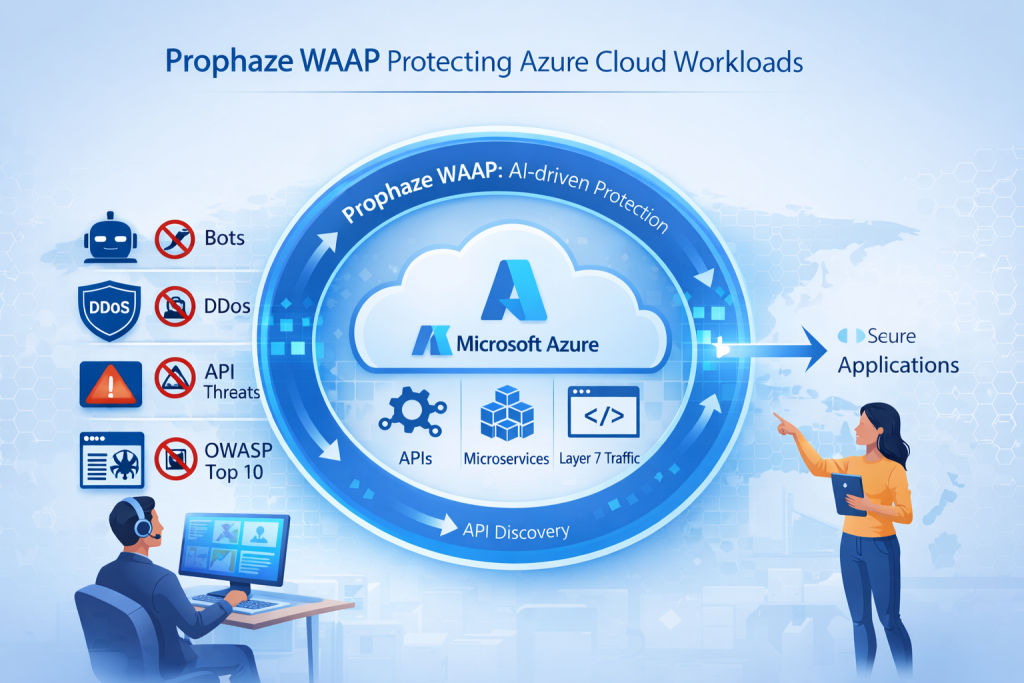
Prophaze WAAP is a fully managed, AI-powered
WAAP Security Platform for Web & API Defense
that strengthens Azure cloud security beyond its native controls. Built on a zero-trust foundation, it provides 360° web application and API security powered by machine learning and supported by 24×7 human security experts.
Designed for an API-first and microservices architecture, Prophaze provides advanced application layer security, behavioral threat detection, and unified visibility into distributed Azure environments. Unlike traditional WAF, it continuously validates security decisions to reduce false positives while protecting against DDoS, malicious bots, OWASP Top 10 threats, API attacks, and zero-day threats.
Prophaze integrates rapidly with Azure Front Door Security, Application Gateway, API management, App Services, and AKS Security without code changes, downtime, or architectural disruption. With active 24×7 monitoring and continuous API discovery, organizations can elevate API security on Microsoft Azure in minutes.
The following sections outline how Prophaze WAAP addresses sector-specific threats in Azure workloads.
How Prophaze WAAP Protects Azure Workloads and APIs in Highly Targeted Industries
Across all industries, Prophaze WAAP provides adaptive, AI-powered application-layer security to protect revenue, compliance, and customer trust in Azure environments.
Integrating Prophaze WAAP into Azure Architecture
Without Disruption
Prophaze WAAP security Platform integrates directly with Azure Front Door Security, application gateways, API management, App Service, and AKS environments without forcefully rewriting or introducing complex gateway chains.
- No code changes required
- No downtime during deployment
- No latency-heavy inspection proxies
Security scaling happens at the same pace as Azure workloads.
How Prophaze WAAP Fits into Azure Front Door,
WAF, and AKS Environments
Prophaze WAAP fits naturally into:
- Azure Front Door Edge deployment
- Application Gateway WAF environment
- API management backend
- AKS ingress Controller
- Multi-area hub-and-spoke VNET designs
This enhances the Azure security posture without disrupting routing, CI/CD workflows, or autoscaling configurations.
Why Enterprises Trust Prophaze WAAP to Secure
Azure Apps & APIs
Azure Apps & APIs
- Unified WAAP across Front Door, App Gateway, AKS and APIM
- Continuous API discovery across subscriptions and regions
- Detecting behavioral bots beyond static WAF rules
- Layer-7 DDoS protection that complements Azure DDoS Protection
- Schema-aware validation aligned with OWASP API Top 10L
- Low-latency inspection designed for cloud-scale workloads
Azure provides the foundation. Prophaze provides application-layer intelligence.
Don’t Wait for Bots, Breaches, or Audits to Force
Your Security Upgrade
Most organizations evaluate additional security only after:
- Bot-driven revenue loss
- An API breach
- A compliance audit finding
- Or customer accounts being compromised
Proactive security is significantly more cost-effective than incident response.
Prophaze WAAP security platform prevents real-time breaches through continuous API discovery, AI-powered behavioral analysis, and adaptive bot mitigation. Instead of relying solely on static rules, it monitors application-layer behavior, detects unusual traffic patterns, and stops malicious activity before it escalates into account compromise, data exposure, or service disruption. Supported by 24×7 security expert monitoring, threats are identified and addressed as they develop.
If you’re running high-volume APIs, microservices, or customer-facing applications on Azure, now is the time to evaluate your application-layer security posture.
Advanced AI-powered WAAP for Securing Azure workloads End to End
As Azure environments become more distributed and API-driven, application-layer threats are no longer predictable or stable. Modern threats demand intelligent, adaptive security that evolves with application traffic and attack patterns.
Prophaze WAAP provides advanced, AI-powered security designed specifically for Azure workloads, combining continuous API visibility, behavioral threat detection, bot mitigation, and Layer-7 resiliency into one fully managed platform.
Rather than increasing operational burden, it simplifies security while strengthening security posture. For organizations running mission-critical applications on Azure, the question is no longer whether infrastructure security is in place but whether application-layer intelligence is strong enough to prevent the next breach.
Now is the moment to move from reactive controls to adaptive, AI-powered WAAP protection that actually keeps up with your attackers.
Start your free trial and see Prophaze WAAP in action to stop real-world, web, API, bot and DDoS threads in minutes