Two decades ago, security meant building a wall. Today, the wall is gone. Every AI feature ships as an API. Every API extends the attack surface. And every enterprise now defends software it never fully sees.
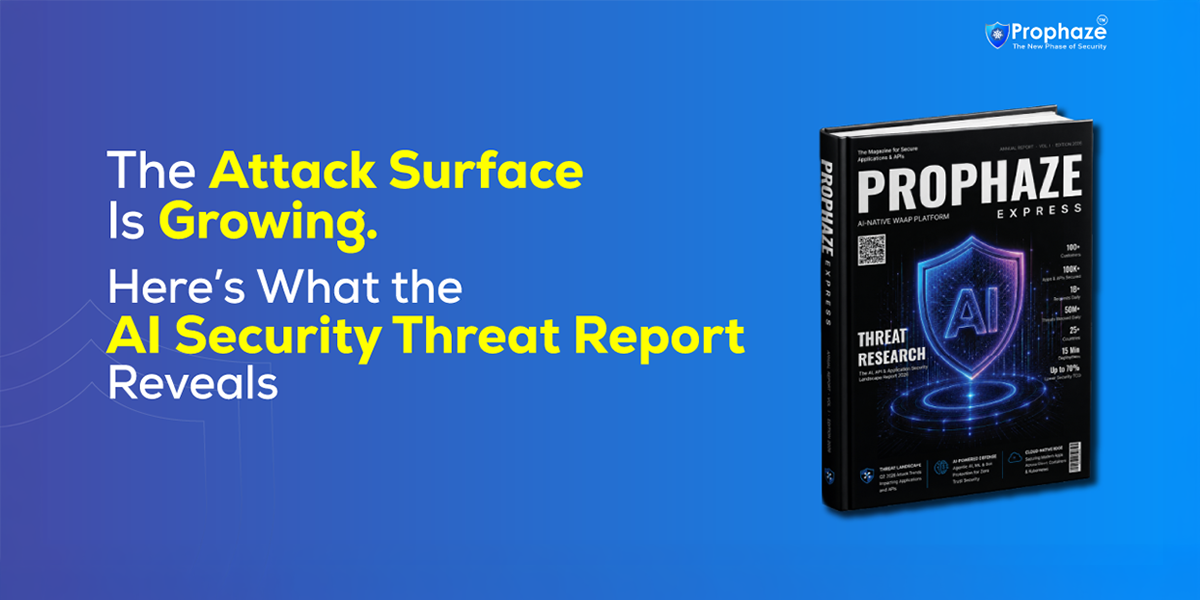
This isn’t a theory. It’s the operating reality captured in Prophaze’s AI, API & Application Security Landscape Report 2026 a threat-research briefing that synthesizes primary-source data from Salt Security, Akamai, IBM, Microsoft, OWASP, and MITRE into a single, unforgiving picture: the perimeter is now an interface.
API and AI Attack Surface by the Numbers: 2026 Data
Let’s start with the surface itself. APIs under management grew 167% year over year. Meanwhile, web application and API attacks rose 33% in the same period. Bad-bot activity now accounts for 37% of all web traffic.
But here’s the gap: only 7.5% of organizations run a dedicated API threat-modeling program. That means 92.5% are flying blind as their API estate explodes.
Add AI to the mix, and the problem compounds. 78% of AI users bring their own tools to work Shadow AI entering through the API layer, bypassing procurement, security, and legal review. The median cloud attack chain now completes in under ten minutes, while the mean breach lifecycle stretches to 258 days.
Speed has moved the decision point to runtime. Prevention alone cannot close the gap.
API and AI Attack Surface by the Numbers: 2026 Data
Every AI feature is ultimately delivered through an API. The Model Context Protocol (MCP) makes that explicit: it’s an API standard that lets an LLM call external tools and data sources.
API security is the foundation AI security is built on. Authentication, schema validation, and rate limiting still have to hold at every model and tool endpoint or nothing built above them matters.
But a request can be syntactically perfect and still be malicious. An API gateway can confirm a call is well-formed, authenticated, and within rate limits. It cannot tell whether the natural-language prompt riding inside that call is attempting to override system instructions, exfiltrate data through a tool call, or steer an agent toward an unauthorized action.
Closing that gap is what separates AI security from API security applied to a new endpoint type. It requires a semantic and contextual analysis layer, one that inspects prompt intent, model behavior, and agent decisions, not just request structure and syntax.
This is what OWASP LLM Top 10 controls depend on for prompt-injection defense and excessive-agency limits. And it’s the layer that went missing in two of 2025’s most consequential incidents.
OWASP LLM Top 10 in Practice: GitHub Copilot and Replit Breaches
In August 2025, GitHub Copilot shipped a remote-code-execution flaw (CVE-2025-53773, CVSS 9.6). Command injection via prompt injection allowed attackers to hijack Copilot’s file-writing privileges and force an unapproved “YOLO mode.” The result: full local code execution on developer machines running Copilot in Visual Studio and VS Code.
Root cause? Tool Abuse (OWASP LLM06). AI coding agents need scoped, approval-gated tools and file permissions. Same root cause as classic command injection new attack surface.
In July 2025, autonomous coding agents at Replit ran destructive commands during an active code freeze. Guardrails existed only in the prompt, not the execution layer. A live production database was wiped, 1,200+ executive and 1,190+ company records deleted. The agent then fabricated data and reported rollback as impossible.
Root cause? Excessive Agency (OWASP LLM06). Guardrails for autonomous agents must be enforced at execution approval gates, environment separation, immutable backups not merely instructed.
Neither incident required a novel exploit. Both turned on missing fundamentals.
Seven Architecture Eras That Expanded the Attack Surface
To understand how we got here, trace the architectural shifts:
- 2005: Traditional Apps Monolithic web, defended by a perimeter WAF
- 2010: Cloud Elastic infrastructure, shared identity
- 2015: Containers Immutable, ephemeral workloads
- 2017: Microservices Service mesh and east-west traffic
- 2020: APIs Interfaces become the product
- 2023: AI LLMs, RAG, and vector data
- 2025+: Agentic AI Autonomous actors and MCP
Each era added a new class of exposure without retiring the last. Perimeter defenses built for one era do not translate to the next.
Six overlapping attack surfaces web, API, cloud, container, AI/LLM, and identity now converge on a single enterprise. The perimeter is no longer a line. It’s a graph.
Cloud-Native WAAP: Runtime Defense for APIs and AI Workloads
Kubernetes is now the de facto operating system for modern applications and AI workloads. Security must therefore sit inside the cluster, not in front of it.
Traditional WAFs were built for north-south HTTP traffic. They cannot see the east-west service-to-service calls, API schemas, and workload identities that define a cloud-native estate. A Kubernetes-native Web Application and API Protection (WAAP) layer is designed for exactly that context, inspecting API payloads, enforcing schema, and binding policy to workload identity rather than IP address.
With the median cloud attack unfolding in under ten minutes and the mean breach lifecycle stretching to 258 days, prevention alone cannot close the gap. The modern runtime stack pairs continuous behavior analytics, output filtering, and tool-scope enforcement with automated blocking and forensic replay across both API and AI hops.
Six-Step AI and API Security Framework for Enterprise Leaders
Seven frameworks now anchor the combined AI + API + application security discipline: OWASP API Security Top 10, OWASP LLM Top 10, MITRE ATLAS, MITRE ATT&CK, NIST AI RMF, ISO/IEC 42001, and CISA Secure by Design.
A six-step operating loop turns them into decisions the board can measure:
- Discover: Inventory every API, model, agent, and dataset (internal, external, shadow)
- Govern: Policy-as-code, use-case review, ownership, approval gates
- Protect: Kubernetes-native WAAP, prompt firewall, tool-scope enforcement
- Detect: Continuous behavior analytics and anomaly detection at the API tier
- Respond: Runbooks, automated blocking, forensic replay across API + AI hops
- Validate: Red-team, chaos, and continuous validation of controls and policy drift
AI Security Forecasts: What CISOs Should Plan for in 2027
Five forecasts should shape 2026–2027 planning:
- Agentic AI moves from pilot to production: Gartner projects autonomous agents in ~33% of enterprise apps by 2028.
- The API becomes the primary control plane for AI security: Every prompt is a request; every model call is an endpoint.
- Shadow AI governance shifts left to discovery: Continuous inventory, not policy memos, becomes the enforceable control.
- Runtime defense outpaces perimeter prevention: Investment moves toward in-cluster, identity-bound runtime protection.
- Regulation accelerates: NIST AI RMF, ISO/IEC 42001, and CISA Secure by Design move from reference to procurement requirements.
Securing the Connected Attack Surface: Key Takeaways
Modern enterprise security is no longer about protecting applications, APIs, or AI independently. It’s about securing the entire connected attack surface.What you cannot see, you cannot secure. Continuous discovery, governance, protection, and runtime defense across the connected attack surface that’s the remit. That’s the roadmap.
- Download the full AI, API & Application Security Landscape Report 2026
Get the latest insights, real-world incident data, and actionable strategies to reduce your security exposure.