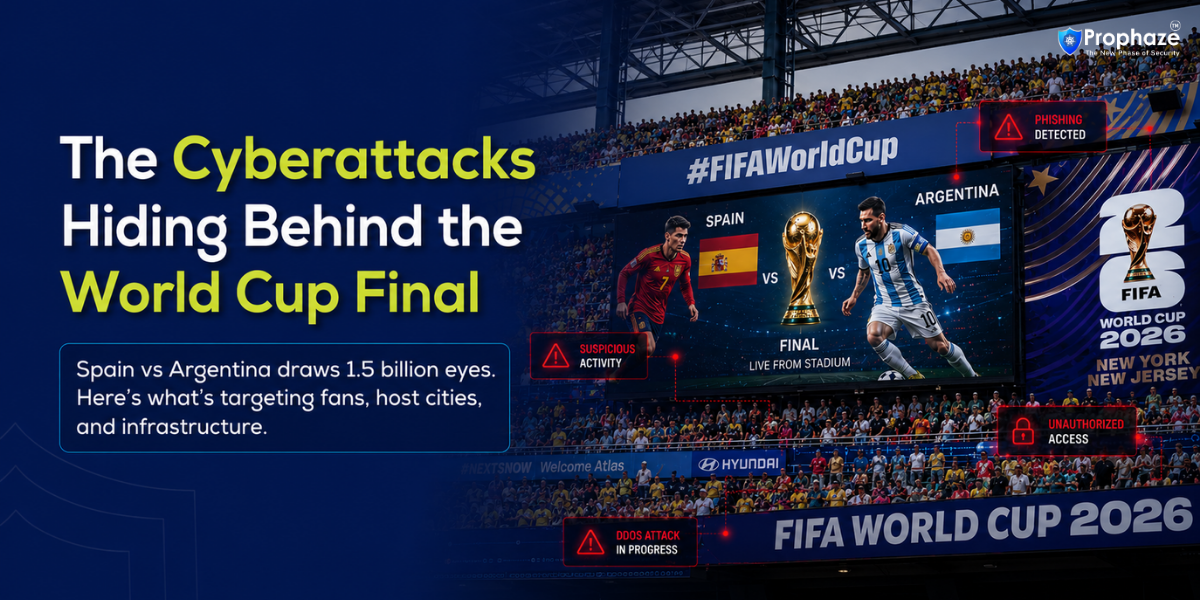
In two days, the planet’s attention turns to MetLife Stadium for Spain vs Argentina, the reigning European champions against the reigning world champions, and the first time these two nations have ever met in a World Cup final. Kickoff is 3 p.m. ET on Sunday, July 19, in front of one of the largest live audiences any single event draws (the 2022 final reached a reported ~1.5 billion viewers).
A second contest runs in parallel with no referee, no final whistle. For months, criminal, hacktivist, and state-linked actors have been building operations around this tournament: fan-facing scams, infrastructure attacks, and supply-chain risk. This is a plain-language read of what the threat data shows, who’s behind it, and the part that matters for anyone running event infrastructure where the risk actually concentrates.
Why a World Cup final is a high value Target
Major global events combine three things attackers love: urgency, volume, and distraction. Millions of people search for tickets and travel under time pressure and lower their guard. That surge of legitimate traffic gives cover to fraudulent messages riding the same themes. And the security teams meant to catch them are stretched across a far larger footprint than usual.
Three factors make 2026 different from a typical tournament:
- Geopolitics is live Amid heightened U.S.–Iran tensions, CISA and partner agencies issued advisory AA26-097A (April 7, 2026) describing an active campaign by Iranian-affiliated actors against internet-exposed programmable logic controllers in U.S. critical infrastructure water, energy, and government systems. The advisory doesn't name the World Cup, but it points to exactly the class of municipal and utility systems that host cities depend on. Separately, pro-Russian group NoName057(16) has a multi-year record of DDoS surges timed to symbolic events most recently the Milan-Cortina 2026 Winter Olympics, where NETSCOUT measured a 181% rise in DDoS activity against Italian infrastructure during the Games.
- The cybercriminal ecosystem has industrialized. Generative AI now spins up phishing pages and fake storefronts faster than takedowns can keep pace, and hospitality-sector ransomware crews active since the 2023 casino attacks have a repeatable playbook ready for the highest-occupancy week of the year.
- Scale multiplies the attack surface. Sixteen host cities across three countries means sixteen separate vendor ecosystems that no single team owns end to end.
What fans will actually run Into
Most fans will never encounter a nation-state operator. They’ll encounter a convincing fake. Here are the six patterns researchers are tracking right now with the sources, because in security an unsourced number reads as an invented one.
- Fake domains and phishing. Since April 1, 2026, Recorded Future's Insikt Group has tracked more than 1,100 suspicious "World Cup" domains, 600+ typosquats of fifa.com, and roughly 260 domains pairing FIFA branding with host-city names. Recorded Future's Payment Fraud Intelligence team separately mapped a network of 33 fake merchandise stores tied to ~2,500 ads on platforms like Meta buyers got drained cards and no product. Group-IB documented a Chinese-speaking operation ("GHOST STADIUM") running a single phishing kit across 300+ lookalike domains to harvest logins now circulating on dark web markets. Watch for: "free tickets" offers, refund/cancellation notices, FanID problems, illegal stream links, counterfeit merch ads.
- Ticket and resale fraud. Expect lookalike resale sites, fake reseller accounts, and lottery scams. Buy only through FIFA's official platform or an authorized partner, pay by credit card, and never complete a purchase over DM or a peer-to-peer app.
- DDoS from hacktivists. NoName057(16) and Iran-aligned groups are both active. For scale, one DDoS attack on the Paris 2024 Olympics website peaked at 190,000 requests per second (Cloudflare) defenders are told to plan for at least that.
- Ransomware targeting hospitality. Hotel reservation systems, digital keys, and POS terminals have been favored targets since the 2023 casino-industry attacks, a live concern with millions of fans moving between 16 host cities.
- QR code and transit scams. Fake shuttle passes, parking permits, and transit QR codes scale easily across a geographically spread tournament. Verify any QR code against the host city's official app before scanning.
- Rental and accommodation fraud. Scammers list properties they don't control to collect deposits. Cross-check photos, avoid off-platform payments, stick to reputable booking platforms.
None of these require advanced skills to avoid, just a beat of hesitation before you click.
The bigger picture: prepared events hold
Here’s the balanced read. None of this puts the final itself at risk. Tokyo, Paris, and Milan-Cortina all absorbed serious cyber activity without operational disruption, because organizers prepared for years and the same coordinated response is running across U.S., Canadian, and Mexican cyber agencies now.
The real exposure sits with fans, not the pitch. The infrastructure protecting the match is far better resourced than the infrastructure protecting one person clicking a “free tickets” link at 11 p.m. That asymmetry, not the spectre of a hacked final is the story worth telling.
Where the risk concentrates: the web app and API layer
Look again at the threat list and a pattern emerges. Nearly every threat funnels through the same choke point: a web application or an API.
- Fake resale sites are web apps.
- FanID logins hit authentication APIs.
- DDoS floods hit ticketing portals.
- Scraping and inventory bots hammer pricing and availability endpoints.
That’s the layer a Web Application and API Protection (WAAP) platform sits in front of and it’s where past tournaments’ “nothing was disrupted” outcomes were actually earned.
Where Prophaze fits
For teams running ticketing, fan-portal, or hospitality infrastructure, the practical question is whether the trusted platforms hold up under bot, API, and DDoS pressure. That’s the outcome Prophaze’s WAAP platform sits in front of:
- Layer 7 bot + DDoS defense - an AI-driven WAF, bot mitigation and Layer 7 DDoS defense in one layer, built for traffic that looks legitimate but isn't.
- Shadow API discovery - auto-discovers APIs in live traffic rather than relying on a manual inventory, critical when a stack is stitched together from a dozen vendors under time pressure.
- Behavioral baselining over static rules - models normal traffic for a specific application, so it can flag technically-valid-but-abnormal patterns like a login flow suddenly hit by residential proxies at ticket-drop volume.
- Edge deployment, no code changes - deploys at the edge without engineering rework, a far lighter lift than standing up a new security stack mid-tournament.
A WAAP platform won’t stop someone from clicking a phishing link in their personal inbox — but it’s the piece that determines whether the official platforms fans are told to trust actually hold up under bot, API, and DDoS pressure. That’s the layer where past tournaments’ “nothing was disrupted” outcomes were actually earned.
Running ticketing, fan-portal, or hospitality infrastructure for a major event?
Frequently Asked Questions (FAQ)
1. Is it safe to buy World Cup final tickets online right now?
Only through FIFA’s official platform or authorized resale partners — researchers have tracked 1,100+ suspicious World Cup-themed domains built to intercept buyers.
2. Are free livestream links for the final safe?
No — they’re one of the most common vectors for credential theft and malware, and volume is expected to peak during the final.
3. What's the biggest cyber risk during the final?
For fans, phishing and fake e-commerce. For host-city infrastructure, DDoS from hacktivist groups and potential disruption to municipal utilities and hospitality systems.
4. How can I tell if a FIFA app is legitimate?
Cross-check it against FIFA’s official published app list before downloading, and avoid sideloading.