The Security Gap No Single-Environment WAF Can Close
Enterprise hybrid WAF solutions have become essential as organizations expand across on-premises, cloud, and Kubernetes environments. Most web application attacks come in an HTTP request: a login form carrying a payload, where organizations must prevent SQL injection in hybrid environments, an API call with a manipulated parameter, or a compromised session token. Network firewalls at layers 3 and 4 cannot read these. Traditional WAF tools can.
Yet, that’s only for the traffic that passes through them, and this is where hybrid WAF security becomes important for enterprises running applications across on-premises, cloud, and Kubernetes environments. The problem is not the lack of WAF tools. That is, each is linked to a single environment while applications span several. Cloud WAF covers public-facing APIs, but cannot reach the data center. An on-premises appliance protects the data center but has no access to AWS or Azure. This gap is particularly visible in enterprises that are still running legacy applications, where hybrid WAF for legacy applications is often the only way to extend modern Layer 7 security without rewriting the application stack. This results in divergence in rule sets, silent coverage gaps, and two systems that one has to manually reconcile. A hybrid web application firewall closes that gap, with one enforcement model that applies consistently across every environment your application runs.
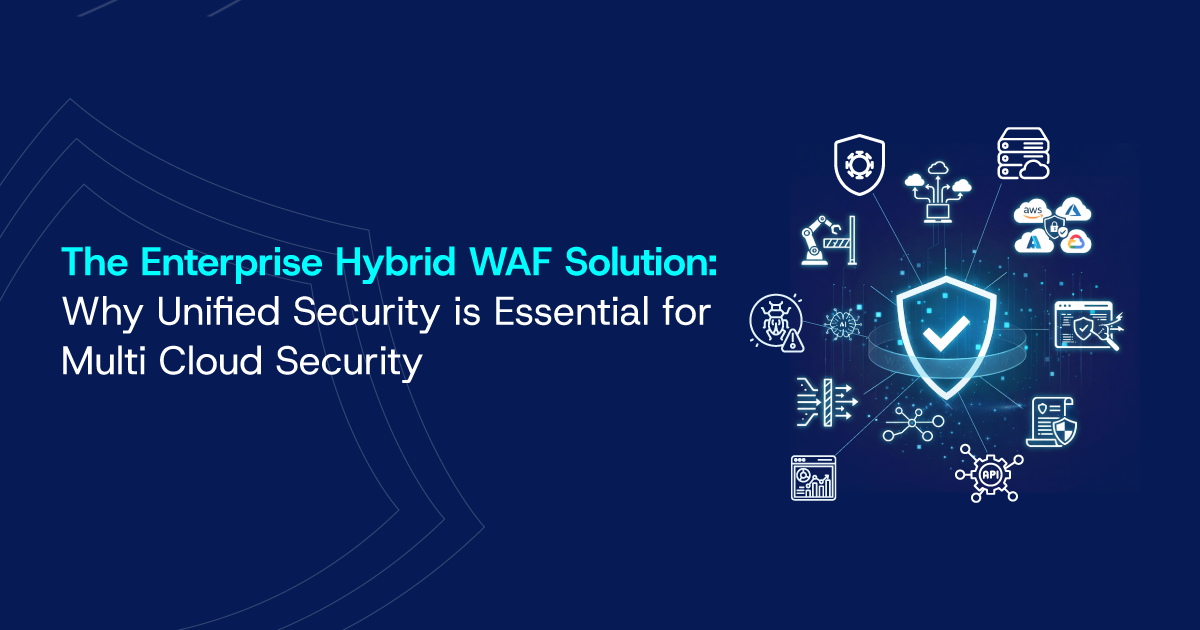
Enterprises need web application security for a hybrid infrastructure that follows workloads, rather than being tied to a single environment and unaware of everything outside it. Whether a request comes to an internal admin portal, a public-facing API, or a microservice inside a Kubernetes cluster, it should be inspected according to the same policy, enforced by the same engine, and visible on the same dashboard. That’s what enterprise hybrid WAF solutions provide, and this blog covers the standard of hybrid WAF protection.
How Hybrid WAF Works: Split-Plane Architecture And Local Traffic Inspection
A hybrid web application firewall runs on a split-plane model. The enforcement engine, the component that intercepts and inspects HTTP and HTTPS traffic, is deployed on customer-controlled infrastructure: a VM, a data center, or a cloud VPC. The management plane handles policy, rule updates, AI model delivery, and compliance reporting from the cloud, communicating with each enforcement node over an encrypted, authenticated channel completely separate from the application data path.
Result: Application traffic never leaves your perimeter. The engine locally inspects each request, URL path, headers, cookies, JSON and XML payloads, API schema conformance, and behavior patterns throughout the session. Policy updates are pushed down from the cloud control plane to each node; Unknown telemetry flows back. In a fully managed deployment, rules management, false positive tuning, and virtual patching sit with the vendor, not the internal team.

Hybrid WAF vs Cloud WAF vs On-Premises WAF: Which Model Fits a Multi-Environment Architecture?
A network firewall, an on-premises WAF appliance, and a hybrid WAF each occupy a different layer and serve a different purpose. Understanding what each can and cannot do makes the shortcomings visible and explains why hybrid WAF security cannot be replaced by the other two.
The network firewall cannot read HTTP requests. A traditional on-premises WAF inspects Layer 7 traffic but requires manual updates and has no cloud access. This enforcement model combines local Level 7 oversight with centralized policy management and behavioral detection that adapts in real-time to every environment.
Why Hybrid WAF Is Important For Kubernetes And Multi-Cloud Deployments
Most WAF coverage failures in hybrid environments are structural, not detection failures. A rule exists in Cloud WAF but has never been implemented on-premises. The Kubernetes cluster went live without any WAF policy. An API in a different region was omitted because a different configuration was deprecated. These gaps are the operational reality of running separate devices across environments that were never designed to share state.
A Cloud WAF covers the public access boundary of a Kubernetes cluster, but does not cover the traffic between that cluster and the data center or the internal APIs connecting the cloud to on-premises systems. Enforcement nodes inside both the cluster and the data center, governed by the same policy, ensure that each threshold is inspected under the same rules.
For organizations evaluating the best hybrid WAF for multi-cloud environments, the question is whether a single policy applies equally across AWS, Azure, GCP, and on-premises. When a CVE patch reaches every enforcement node in seconds, rather than someone logging into three different consoles, the window the attacker relies on disappears. This consistency extends to the hybrid WAF API security solution, REST and GraphQL endpoints, which are inspected against the same schema rules and rate-limiting thresholds in each cloud.

How Hybrid WAF Keeps Application Traffic Inside Your Perimeter, And Why It's Important For PCI DSS, HIPAA, And GDPR
In the cloud WAF model, application traffic that crosses a network boundary that it should never have crossed is sent through the vendor’s infrastructure for inspection. In a hybrid web application firewall, the enforcement engine sits inside the customer-controlled infrastructure, with the management plane communicating over an encrypted channel completely separate from the data path. It looks at anonymous telemetry, not application payload.
This is why the architecture, not the policy claim, meets requirements that cloud WAFs cannot meet by design:
Hybrid WAF for HIPAA compliance: ePHI cannot traverse uncontrolled networks. Enforcement is local. Data never leaves the perimeter.
Hybrid WAF for PCI DSS compliance (Req. 6.4.2): Cardholder data is secured at the point of processing, not after crossing the external boundary.
Hybrid WAF for GDPR compliance: The inspection engine operates within the jurisdiction where the data resides. A cloud WAF cannot satisfy this structurally. A hybrid web application firewall satisfies this architecturally.
Unified WAF Policy Management Across On-Premises, Cloud, And Kubernetes From One Dashboard
A new CVE landed. Cloud WAFs are patched within an hour; After the manual change window, on-premises environments are patched three days later. A well built hybrid WAF closes that gap; A rule once written is broadcast simultaneously to every enforcement node within seconds, with no manual sync and no window of inconsistency.
- Unified policy management on-premises and cloud: One change, applied instantly everywhere, the same rule version in every environment, including internal and public-facing applications that previously required separate configuration.
- Centralized dashboard hosted on Prophaze Cloud: Traffic volume, blocked requests, anomaly detection, and compliance status across internal, on-premises, and cloud-hosted applications, all in one view, without switching consoles.
- Cross-environment attack visibility: Threats spanning environments emerge as correlated patterns, not as isolated alerts, allowing coordinated operations to become visible even before they are completed.
Running two separate WAFs does not double your security. This doubles your operational overhead and halves your visibility. This is why organizations adopt an integrated model to reduce WAF operational overhead in hybrid cloud environments.
Hybrid WAF is the layer that gives you one policy, one alert stream, and one compliance posture across multiple environments.
What Enterprises Need From A Fully Managed Hybrid WAF Security Service
Static WAF rules capture what’s already listed, not variations or credential stuffing campaigns that evolve from week to week. Prophaze is a fully managed hybrid WAF security for cloud and on-premises apps service and is an enterprise hybrid WAF solution built for environments spanning on-premises infrastructure, public cloud, and Kubernetes with an enforcement engine on customer-controlled infrastructure and strict data plane separation on every node.
- Coverage across every environment: AWS, Azure, GCP, and on-premises with a single policy. Hybrid WAF for Kubernetes deploys through Helm Chart and Ingress controller integration, internal apps, public-facing APIs, and microservices in a unified model.
- Threat coverage without per-environment configuration: On-premise hybrid WAF bot security, API schema enforcement, and rate limiting from a central policy. A behavior model tuned to an environment is broadcast to each node; Reducing false positives in a hybrid WAF is an organization-wide benefit.
- Fully Managed Operations: Prophaze handles rules management, tuning, and virtual patching under a fully managed model, including CI/CD-compliant policy-code for DevSecOps and purpose-built support for regulated sectors, including financial services security, healthcare, and hybrid WAF for government.
- Your Hybrid Environment Has More Than One Entry Point. Is every one of them protected under the same policy?
Prophaze Hybrid WAF enforces consistent Layer 7 protection across on-premises, cloud, and Kubernetes, deployed on your own infrastructure, managed from one dashboard, without disrupting existing networks.
Frequently Asked Questions (FAQ)
1. Is Hybrid WAF the same as Cloud WAF?
No, this difference matters significantly for any organization evaluating a fully managed hybrid WAF. A cloud WAF routes application traffic through the vendor’s external infrastructure for inspection. A hybrid WAF places the enforcement engine inside your own infrastructure, on a VM, in your data center, or within a VPC, so your application traffic never leaves your perimeter. For operational convenience, the management plane runs in the cloud, but monitoring is local. This distinction is important for data residency requirements, hybrid WAF HIPAA compliance, and PCI DSS 4.0.
2. Do you need separate WAFs for on-premises and cloud environments?
No, and running two separate tools is exactly the problem that a hybrid WAF eliminates. Different WAFs create different rule sets that diverge, generate different alert streams that cannot be correlated, and double the operational overhead. A hybrid WAF enforces unified WAF policy management across on-premises and cloud through a single enforcement model, with a policy that is propagated simultaneously to every environment.
3. Does hybrid WAF meet PCI DSS 4.0 requirements?
Yes. PCI DSS 4.0, effective March 2025, mandates continuous automated WAF security under requirement 6.4.2. Hybrid WAF satisfies this with inline enforcement, real-time inspection, and audit-ready logging generated on the local enforcement node. Because the inspection occurs inside your perimeter, data residency requirements for QSA review are met without routing cardholder data through external infrastructure.
4. How does Hybrid WAF work with Kubernetes?
A hybrid WAF for Kubernetes integrates directly into the ingress routing layer as a daemonset, ingress webhook, or sidecar within NGINX, Traffic, or Istio, so every inbound HTTP request is inspected in-line before reaching any pod-level service. The WAF policy is applied consistently across all namespaces and dynamically scaled workloads without changes to the application containers. Rule updates from the central control plane are automatically broadcast to the cluster.