Why API Disovery Matters in Modern Infrastructure
Modern digital infrastructure is mainly driven by APIs (Application Programming Interfaces). Every mobile app request, SaaS integration, fintech payment workflow, IoT telemetry stream, and microservice transaction relies on these APIs. As environments scale, manual tracking becomes impractical, making AI-powered API discovery essential for uncovering hidden endpoints and mapping data flows in real time.
As organizations adopt cloud-native architectures, Kubernetes deployments, and microservices, the number of APIs deployed in production environments is growing rapidly. In many enterprises today, APIs outnumber traditional web interfaces by 10–20x.
This explosive growth introduces a critical challenge: maintaining complete visibility across every active API endpoint.
Many organizations struggle to:
- Detect undocumented APIs and shadow endpoints
- Identify deprecated or orphaned API versions
- Detect automated API abuse and bot attacks
- Monitor API traffic behavior in real time
- Prevent malicious API requests before applications are impacted
Without continuous runtime API visibility, organizations cannot effectively detect attacks or control their application attack surface. This is where AI-powered API discovery platforms become essential.
Solutions like Prophaze provide fully managed web application and API protection, combining automated discovery, runtime monitoring, and AI-driven threat detection to secure modern application environments.
The Growing Challenge of API Sprawl in Cloud-Native Environments
Modern development practices prioritize speed and continuous delivery. While this accelerates innovation, it also leads to uncontrolled API expansion.
DevOps pipelines, CI/CD deployments, feature branching, and microservices architectures constantly introduce new endpoints into production systems.
Over time, organizations accumulate large numbers of unmanaged APIs, including:
- legacy API versions retained for compatibility
- undocumented endpoints deployed during development
- partially decommissioned services
- internal APIs unintentionally exposed through ingress configurations
Traditional API management tools rely heavily on static documentation such as OpenAPI specifications. However, these only represent design intent, not runtime reality. If an API endpoint responds to live traffic, it becomes part of the active attack surface, whether it is documented or not.
This growing gap between API documentation and runtime behavior makes continuous API discovery and monitoring essential.

Why Continuous API Discovery Is Critical
API discovery is not just about inventory management. It is the foundation of modern API security and visibility.
Static API documentation approaches create several operational gaps:
- Documentation updates lag behind deployments
- Shadow APIs remain invisible to security teams
- Deprecated versions continue to receive traffic
- The runtime API behavior remains unmonitored
AI-powered API discovery platforms solve these problems by analyzing real application traffic instead of relying on configuration files.
By observing live interactions between clients and services, discovery platforms can:
- Map the full API surface of an application
- Detect hidden or undocumented endpoints
- Identify deprecated API versions
- Monitor endpoint usage patterns
- Detect abnormal API behavior
This ensures every API interacting with the application environment is visible, monitored, and protected.
How AI-Powered API Discovery Works
Modern API discovery systems analyze runtime traffic flowing through infrastructure layers such as reverse proxies, API gateways, and Kubernetes ingress controllers.
Runtime Traffic Inspection
The discovery engine passively monitors ingress controllers, reverse proxies, service meshes, or gateway traffic. It extracts structured metadata such as URI patterns, HTTP methods, query parameters, header attributes, response codes, payload schemas, authentication context, and identity claims.
This allows organizations to monitor API traffic in production environments without disrupting application performance.
Intelligent Endpoint Normalization
Dynamic path parameters such as user IDs, order IDs, or transaction references can generate thousands of unique URIs. AI-driven normalization algorithms detect structural similarity patterns and cluster endpoints into logical templates.
For example:
/api/v1/user/48291/profile
/api/v1/user/93721/profile
Are automatically normalized to:
/api/v1/user/{id}/profile
This prevents fragmented inventories and enables accurate API endpoint discovery and monitoring.
Shadow and Orphaned Endpoint Detection
Any endpoint observed in runtime traffic but absent from declared API specifications is flagged. Similarly, endpoints that remain accessible after architectural changes are identified as orphaned artifacts.
Continuous discovery ensures no runtime API remains unmanaged.
Discover Hidden and Shadow APIs Automatically
Before organizations can secure APIs, they must first know exactly what exists across their infrastructure.
Prophaze automatically discovers and maps every API across internal, external, and partner environments, creating a living inventory that updates continuously.
Key capabilities include:
- Auto-discover APIs across cloud, Kubernetes, containers, and legacy infrastructure
- Monitor schema changes, versions, and access controls
- Detect misconfigurations and drift
- Identify non-compliant or exposed endpoints
Security teams gain a real-time view of their entire API ecosystem, enabling faster risk prioritization and remediation.
Prophaze: Unified API Discovery and Runtime Security
In modern API ecosystems, visibility without enforcement creates operational gaps. Discovery must integrate directly with runtime protection mechanisms.
Prophaze combines AI-powered API discovery with runtime API protection in a unified platform architecture. Rather than functioning as disconnected tools, inventory mapping and runtime protection operate as a continuous feedback loop.
Through this architecture, Prophaze delivers:
- Automated runtime API inventory generation
- Detection of shadow and undocumented APIs
- Monitoring of deprecated API exposure
- Real-time API anomaly detection
- Schema validation enforcement
- Adaptive API rate limiting
- Policy-based API access control
Every discovered API endpoint is immediately placed under behavioral monitoring and policy enforcement.
Runtime API Protection Beyond Traditional Web Application Firewalls
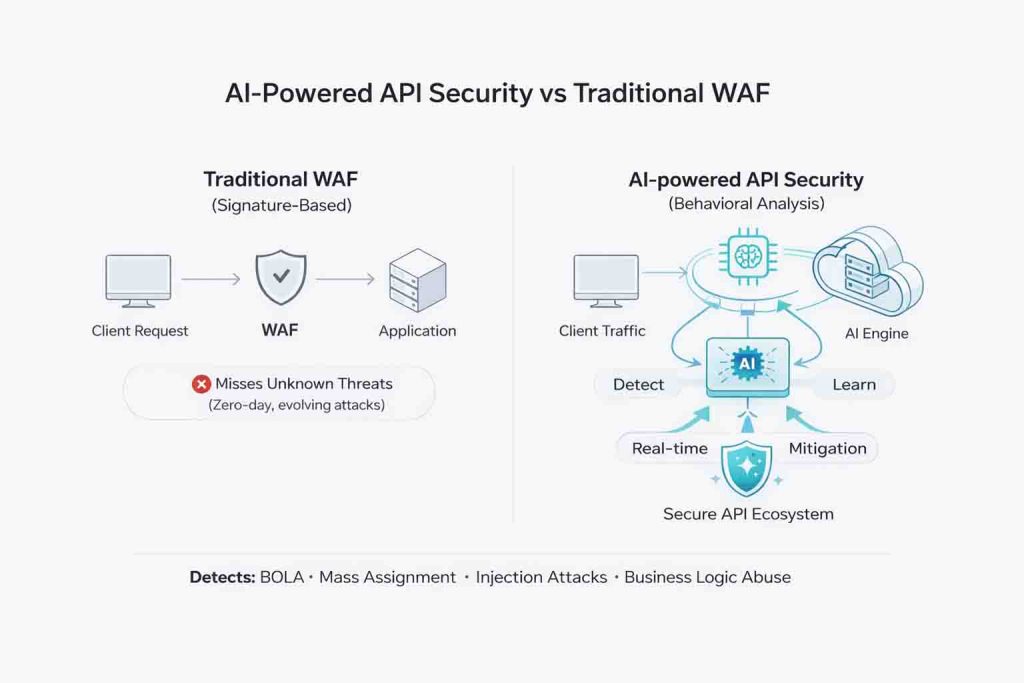
Traditional Web Application Firewalls (WAFs) rely heavily on signature-based detection. However, modern API attacks increasingly involve abuse of legitimate API functionality.
AI-powered API protection analyzes requests across multiple behavioral dimensions:
- Deep payload structure validation
- Behavioral deviation modeling
- Identity and token context verification
- Rate anomaly detection
- RBAC enforcement
- Sequence integrity validation
- Zero-day anomaly detection
Instead of relying on static rules, AI-driven systems establish behavioral baselines for normal API usage. When deviations occur, automated mitigation policies can be applied immediately.
How Prophaze Protects Every API Call
Prophaze uses a multi-layer protection model designed for modern application architectures.
Traffic Ingestion
API traffic is captured directly at the edge or gateway layer, eliminating the need for SDKs or application code changes.
Behavioral Analysis
User behavior and API usage patterns are analyzed continuously to establish baseline activity.
Real-Time Mitigation
Suspicious requests are automatically blocked or challenged without disrupting legitimate users.
Securing Business Logic at the API Layer
Many modern attacks target application business logic rather than traditional vulnerabilities.
Business logic misuse occurs when APIs are consumed in ways that remain syntactically valid but violate intended application behavior. This includes transactional abuse, automated workflow manipulation, excessive data enumeration, or reward exploitation patterns.
Because such calls often conform to schema and authentication rules, traditional filtering systems fail to recognize them as anomalous.
Prophaze applies machine learning-based behavioral correlation models to analyze request sequencing, identity context, token reuse patterns, and transaction frequency across sessions. By modeling legitimate consumption behavior, deviations can be identified at early stages.
This transforms API security from pattern blocking to intent analysis.
Kubernetes-Native API Security for Modern Infrastructure
API security must align with cloud-native infrastructure models. Modern enterprises deploy APIs across Kubernetes clusters, containerized workloads, hybrid environments, and multi-cloud architectures.
Prophaze integrates directly with:
- Kubernetes ingress controllers
- Service mesh layers
- Cloud-native API gateways
- Edge proxy environments
- Hybrid cloud routing architectures
Both north-south client traffic and east-west service communication are continuously monitored. This architecture allows API security to operate as a native infrastructure layer without requiring SDK insertion or application code changes.
API Governance, Compliance, and Regulatory Alignment
Continuous API visibility directly strengthens regulatory alignment. Frameworks such as PCI-DSS, HIPAA, GDPR, and OWASP API Top 10 increasingly emphasize API governance, data exposure control, and auditability.
AI-powered API discovery and runtime enforcement enable:
- Accurate API inventory documentation
- Automated schema validation
- Access policy traceability
- Detailed audit logging
- Version lifecycle oversight
- Data exposure monitoring
This unified visibility accelerates incident response and threat mitigation.
Continuous API Security Is Now Essential
As microservices scale and multi-cloud complexity increases, manual API tracking becomes unsustainable. Static security assessments cannot match deployment velocity.
Without continuous runtime API discovery and protection:
- API surface area remains partially invisible
- Deprecated endpoints remain reachable
- Version drift accumulates silently
- Behavioral misuse goes undetected
- Incident response complexity increases
Combined with runtime API protection, organizations can enforce policies, detect anomalies, and secure application infrastructure continuously.
Prophaze unify API discovery and protection, delivering fully managed web application and API security for cloud-native environments.
Protect Your APIs from Modern Threats
Secure your entire API ecosystem with AI-powered discovery, real-time threat detection, and automated policy enforcement.
Protect against bots, abuse, and zero-day attacks without slowing your development teams.
- Start securing every API call today.